

The Context Line: How Your Context Layer Decides What AI Agents Own (and What Rises to Your Sellers)



TL;DR
- Every revenue outcome has two drivers, a person and an agent. The Context Line is the boundary between them: what agents own, and what rises to your sellers.
- Your context layer sets the height of that line: it's what your system knows about which specific plays convert deals at every stage in the mid-funnel, and it's now the limiter in GTM: not the LLM model's level of reasoning.
- This line rises throughout a "learning loop." Sellers feed it their judgment, agents raise up the "moments that matter," to the seller, and the revenue outcome closes the loop. Which is how context starts to compound over time.
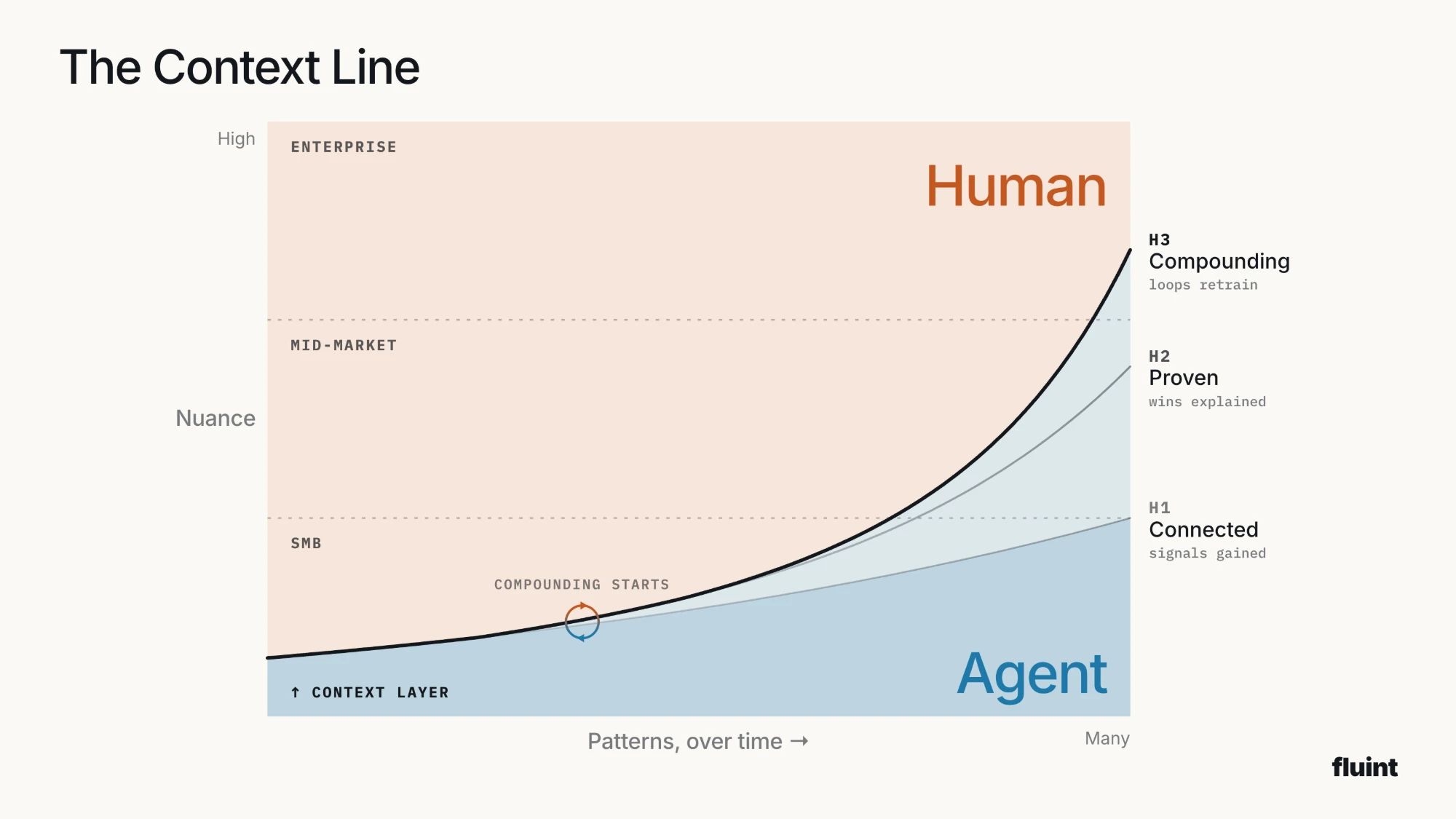
- As that learning stacks up over time, the context line climbs through three horizons: Connected (signals gained), Proven (wins explained), and Compounding (loops retrain).
- SMB is typically impacted first, and enterprise is impacted last. But every role shifts over time: GTM engineers scale patterns, enablement trains the human for the moments above the line, AEs spend more of their weeks with customers, and SDRs become apprentices learning a skilled trade.
Let's start with a simple thought experiment: say two companies start building on the same agents platform (there are many to choose from), they all run the latest model, all hooked up to their CRM.
Now, let's say one year later:
- The first company's agents are running most of the SMB motion on their own, and every morning, they hand each Enterprise AE a shortlist of deals that need their attention.
- The second company's agents are still writing first drafts, that reps delete and rewrite before they hit send.
Same model, same tools, WILDLY different results.
So, what's different?
How that revenue organization learned throughout the year: their ability to prove which specific plays convert deals at each stage of the pipeline, when to run them, and how it changes by segment and buyer.
That's the context layer, and it decides how much of your go-to-market an agent can own.
We've been drawing this out as a single chart, and it's become the simplest way I've developed to explain where AI fits inside a revenue team, what changes as it gets better, and what happens to the people inside.
We call it, The Context Line.
Most of the AI-in-sales conversation asks which jobs will start to evaporate, but, I think the better question is: where does The Context Line sit in your business today, and how will you raise it?
So, let's build the chart one piece at a time.
What's The Context Line?
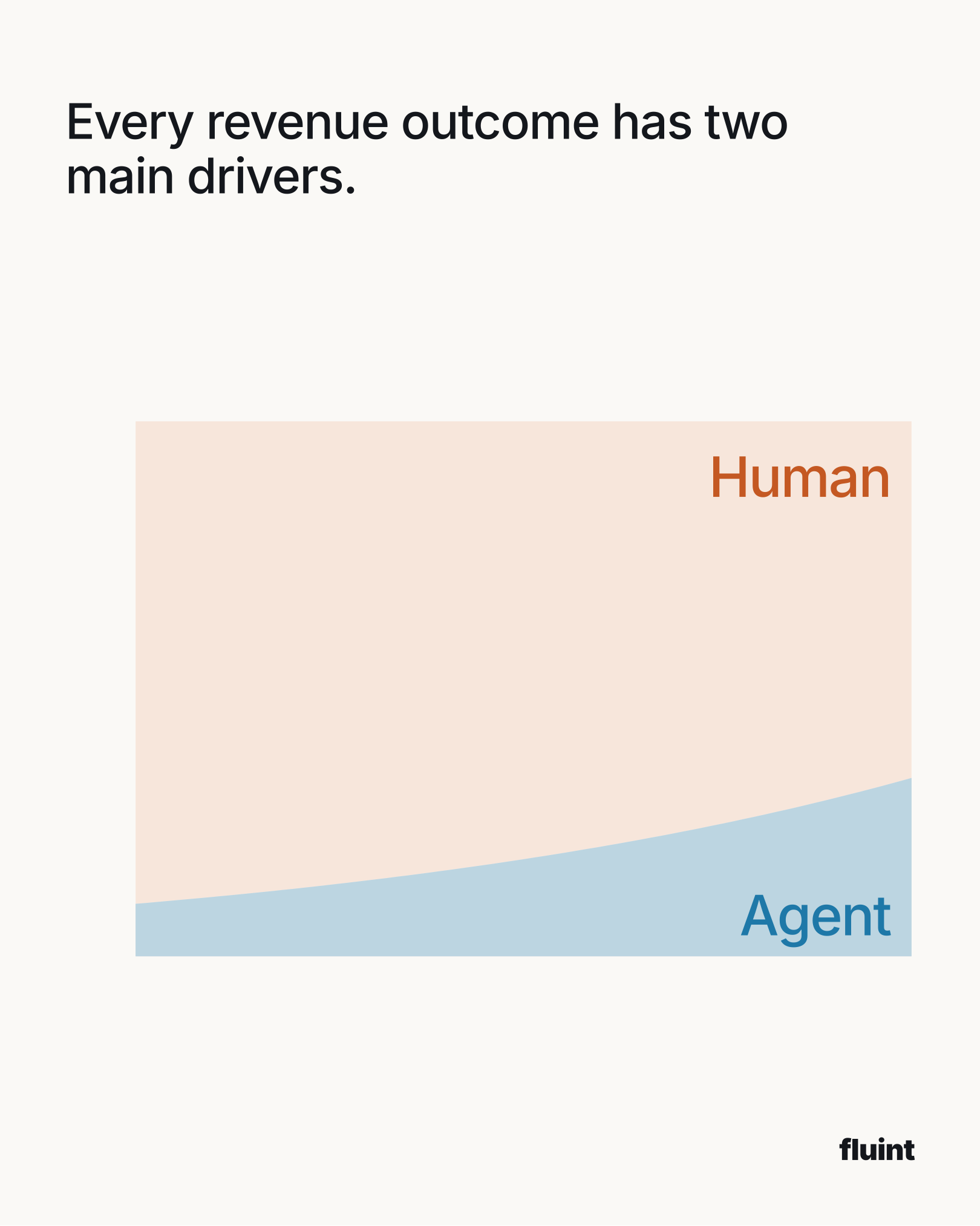
Every revenue outcome has two main drivers: a person and an agent. We'll break them out on two axes, like the above.
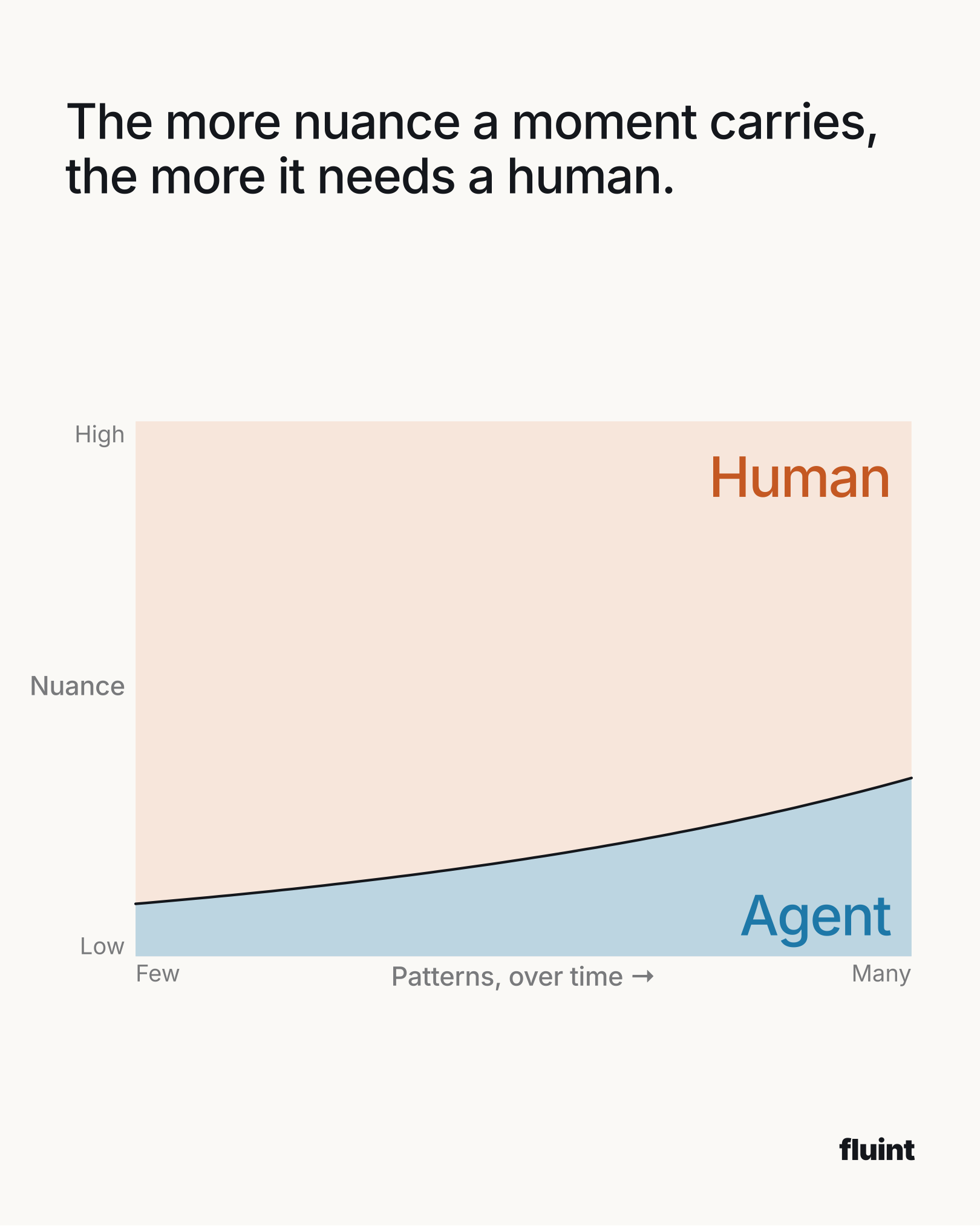
The vertical axis is nuance.
Meaning, how much judgment a specific moment in a deal requires;
- Low-nuance moments have a right answer most people would agree on: log the call, route the inbound lead, enrich the account, book the follow-up.
- High-nuance moments often help explain a deal's outcome. A COO disputes a metric in your business case, or a VP of Ops declines the meeting invite. Your champion spent weeks saying "when we roll this out," and then shifts to, "if we do this." These are the moments that compress an outsized amount of influence on a buying decision.
The horizontal axis shows patterns, captured over time.
Time is part of it, but what moves you to the right is evidence: how many times your system has watched a situation play out and recorded how it ended. Few patterns on the left, many on the right.
Everything under the line, an agent can own. Everything above it needs to rise up to a person. So the more nuance a moment carries, the more it needs a human.
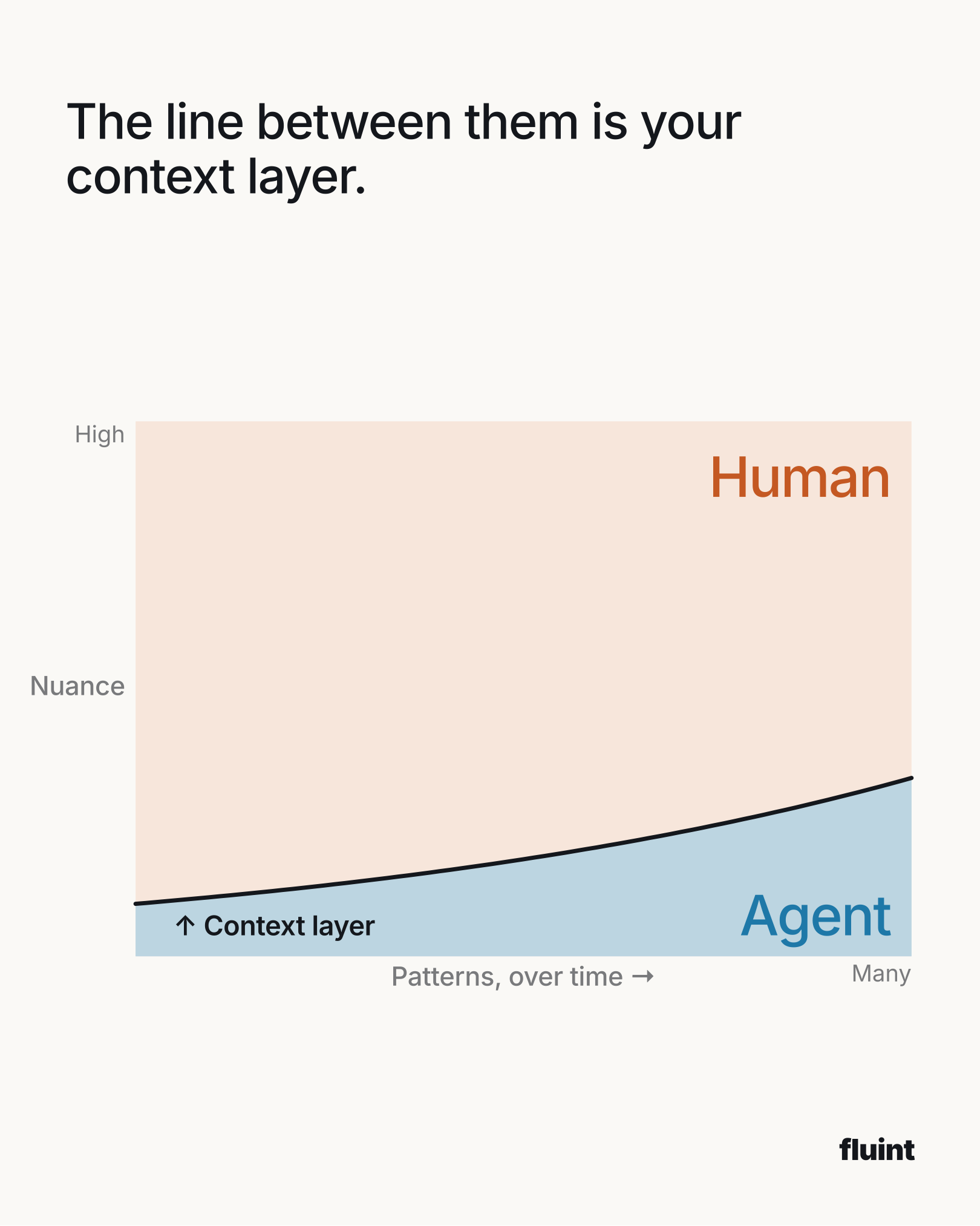
The line between the two zones is your context layer. It starts a little above zero, because even on day one, an agent with no context can handle the generic stuff (summarize the call, draft the recap). Then it slopes up as patterns stack up, since every pattern your system proves out is one more type of moment that agents can handle without asking.
Which is the point most AI planning misses: How high the line sits has a lot less to do with how smart the model is, as compared to what the model knows about the patterns behind your wins (and losses).
So two teams on the same model can have totally different lines, and that's the point in the tale of two companies we started with.
What raises The Context Line?
Adding "knowledge base" style context, like your buying personas, playbook and so on, will create a small uptick in The Context Line to start. But the primary way to elevate The Line over time is a learning loop that runs in two directions.
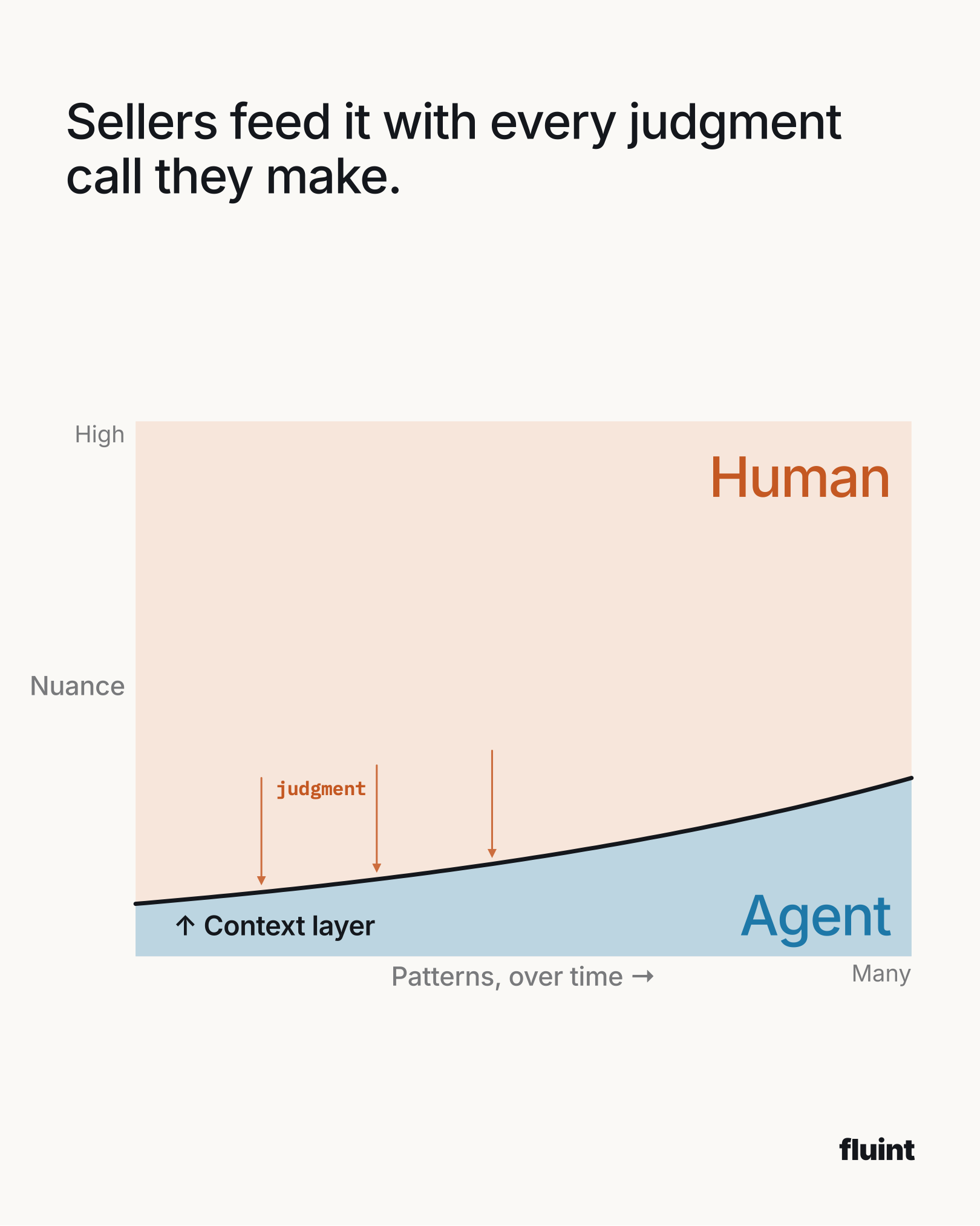
Learning starts by capturing a seller's judgment.
Every judgment call that a seller makes is a data point: who they looped in, when they pushed for a next step, when they held back, etc... The catch is that most of those judgement calls are invisible to the GTM stack today.
They live in a rep's head, a Slack DM, or an edit nobody tracked, and none of them get tied back into how the deal ended. Which is the "tacit knowledge" we wrote about in What Is GTM Judgment?, and it's the raw material The Context Line is engineered from.
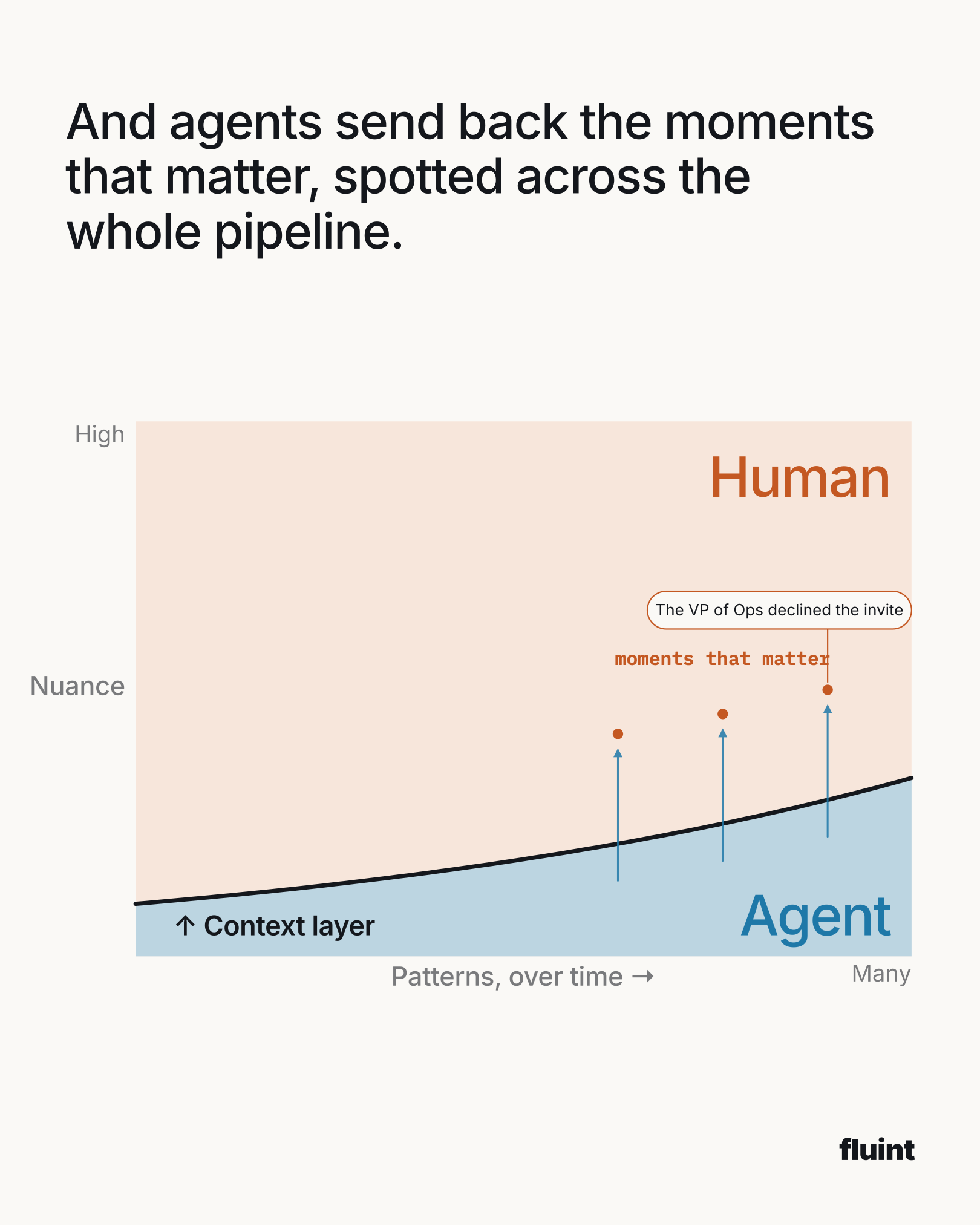
Then, agents surface the moments that matter.
Agents can watch every deal in the pipeline at once, which, obviously, no rep or manager can do. So, when something above the line happens, like the VP of Ops declining the invite, the agent's job is to spot it and route it to the person who should handle it, along with the context they'll need to handle it well. It doesn't try to fix the issue in the moment, it observes the action, then traces it back to the outcome over time.
By the way, did you catch where the arrows sit?
The "judgment" arrows land on the left side of the chart, early on, when there are few patterns and your sellers do most of the teaching.
Then, the moments-that-matter arrows appear further down on the right, once there are enough patterns for an agent to recognize a moment worth flagging.
In other words, early on, the line learns from your people, and later, it partners with them.
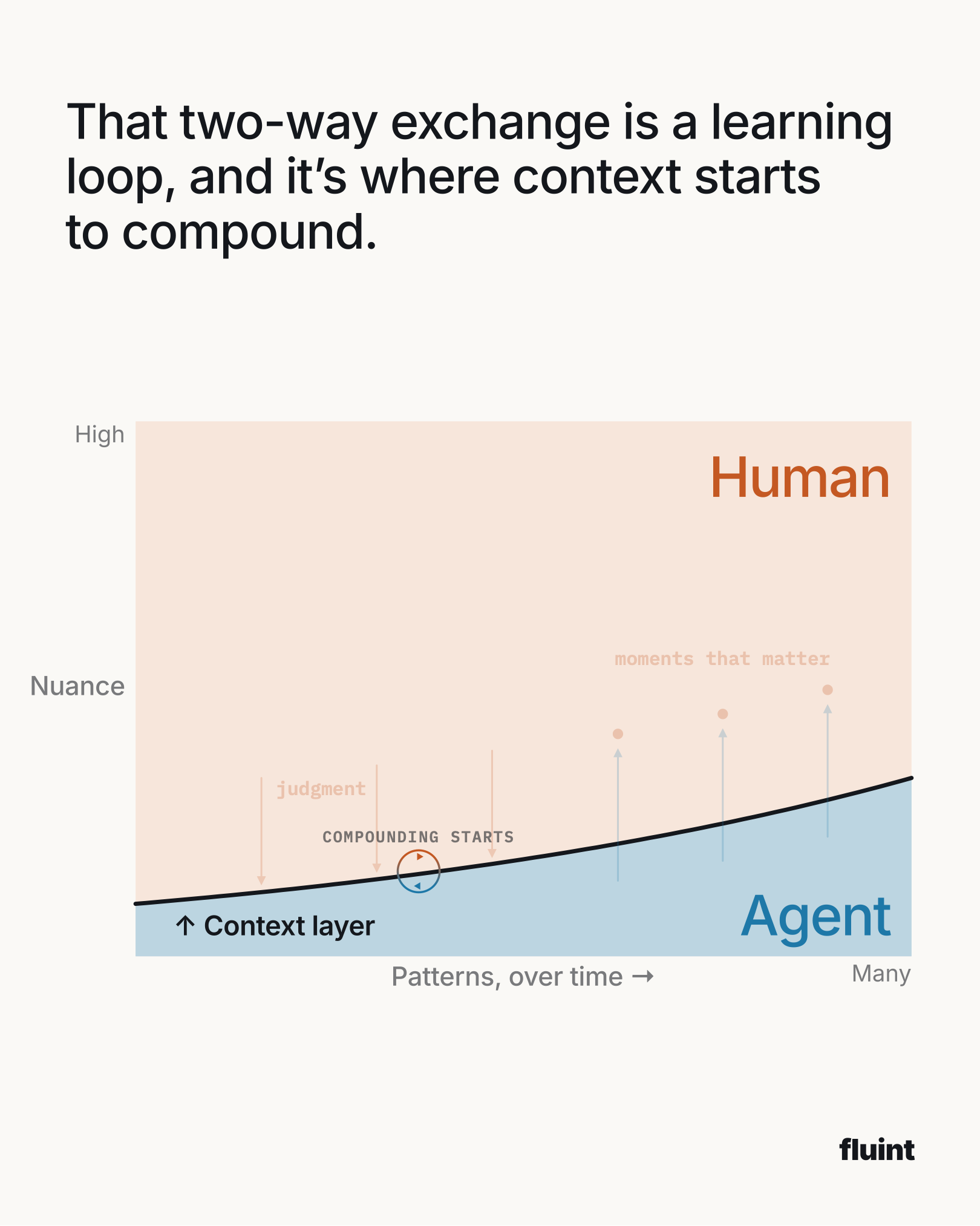
That two-way exchange is a learning loop, and it's where context starts to compound, one turn at a time:
- An agent spots a moment and routes it to a seller.
- The seller makes a judgment call.
- The deal resolves: stage conversion %, age-in-stage, and won or lost with a deal value.
- Those outcomes get traced back to an action arising from the human.
- Your context stores if that specific action or "play" drives deals, and by how much.
- Next time the situation comes up, an agent can handle it (or at least prep it), and The Line sits a little higher.
Step 4 is the one most teams skip, and I learned to respect it early in my career, by the way, well before Fluint:
I built technology valuation models: point-in-time projections of what a piece of IP would be worth, given a certain dataset. Those projections were later compared against real outcomes, to test how well the model described reality. A projection that never gets checked against the outcome is an opinion with a spreadsheet attached, and most GTM context today is exactly that: plenty of signals, but nothing's ever fact-checked against the outcome.
What are the three context horizons?
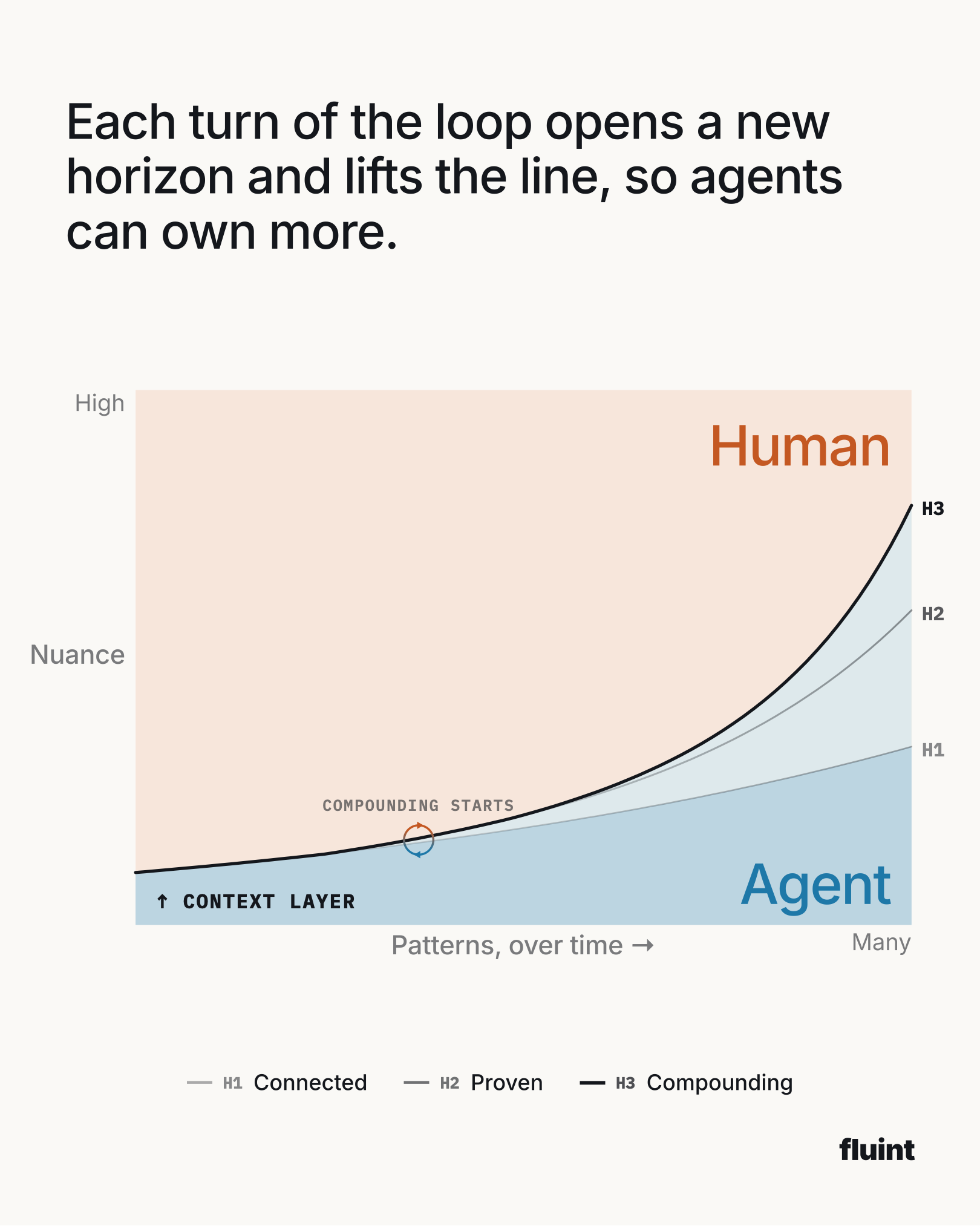
Each turn of the loop opens a new horizon and lifts the line, so agents can own more. There are three:
- H1, Connected: signals gained.
You connect your tech stack: CRM, calls, email, and calendar. Agents can finally see what's happening inside a deal, and the line rises, slowly, in a fairly straight path. This is where most context graph projects stop. A graph can map who's in the deal and tell you a COO is involved. But it can't tell you whether the COO matters, by how much, or which moments drive that engagement. - H2, Proven: wins explained.
Signals get tied back to outcomes. Now you can say which plays separate your won deals from your lost ones, by segment, with a level of confidence attached to each. The line curves up, because agents are acting on patterns your own data has proven. - H3, Compounding: loops retrain.
Every deal that closes retrains the model. The line keeps angling up, without anyone rewriting the playbook, and the curve goes from a slight bend to a vertical climb.
Now, all three horizons share the same path until the loop closes. Left of "compounding starts," a team that's only connecting data and a team that's building the loop look identical. The difference between them shows up later, and then, it keeps widening.
Which is what compounding feels like from the inside: one turn of the loop doesn't feel like much. Looking back, the gap between H1 and H3 is huge.
That shaded gap between H1 and H3 on the right side of the chart is the cost of never closing the loop. It's the work your team still does by hand, and the moments nobody caught, even though the data was connected the whole time.
(If you want the build itself, the five steps are in How to Build a Context Layer for GTM: time-series capture, a feature store, models trained on your outcomes, validation, and serving it back where selling happens.)
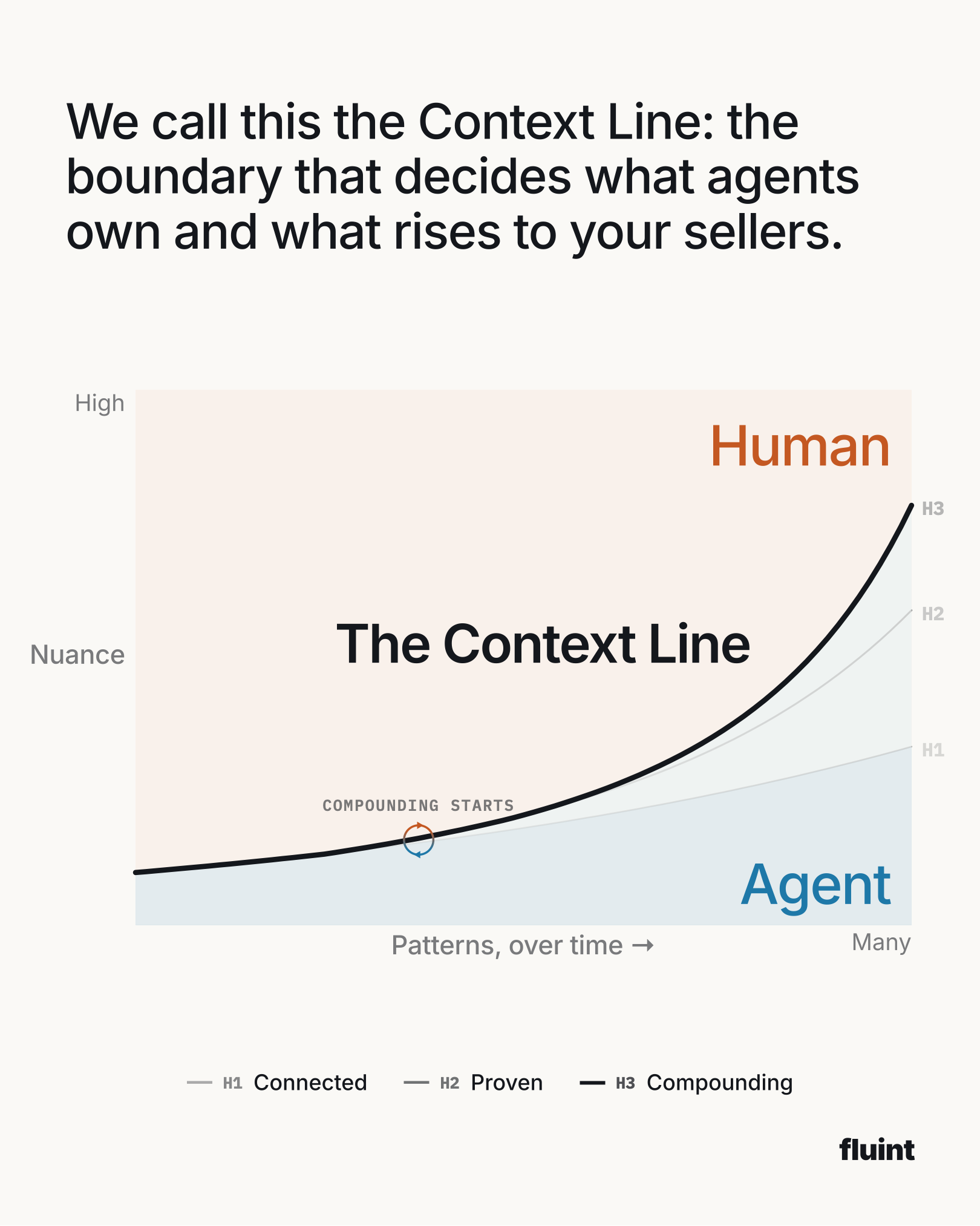
Put it together, and you get the Context Line: the boundary that decides what agents own and what rises up to your sellers.
Why do SMB and enterprise move at different speeds?
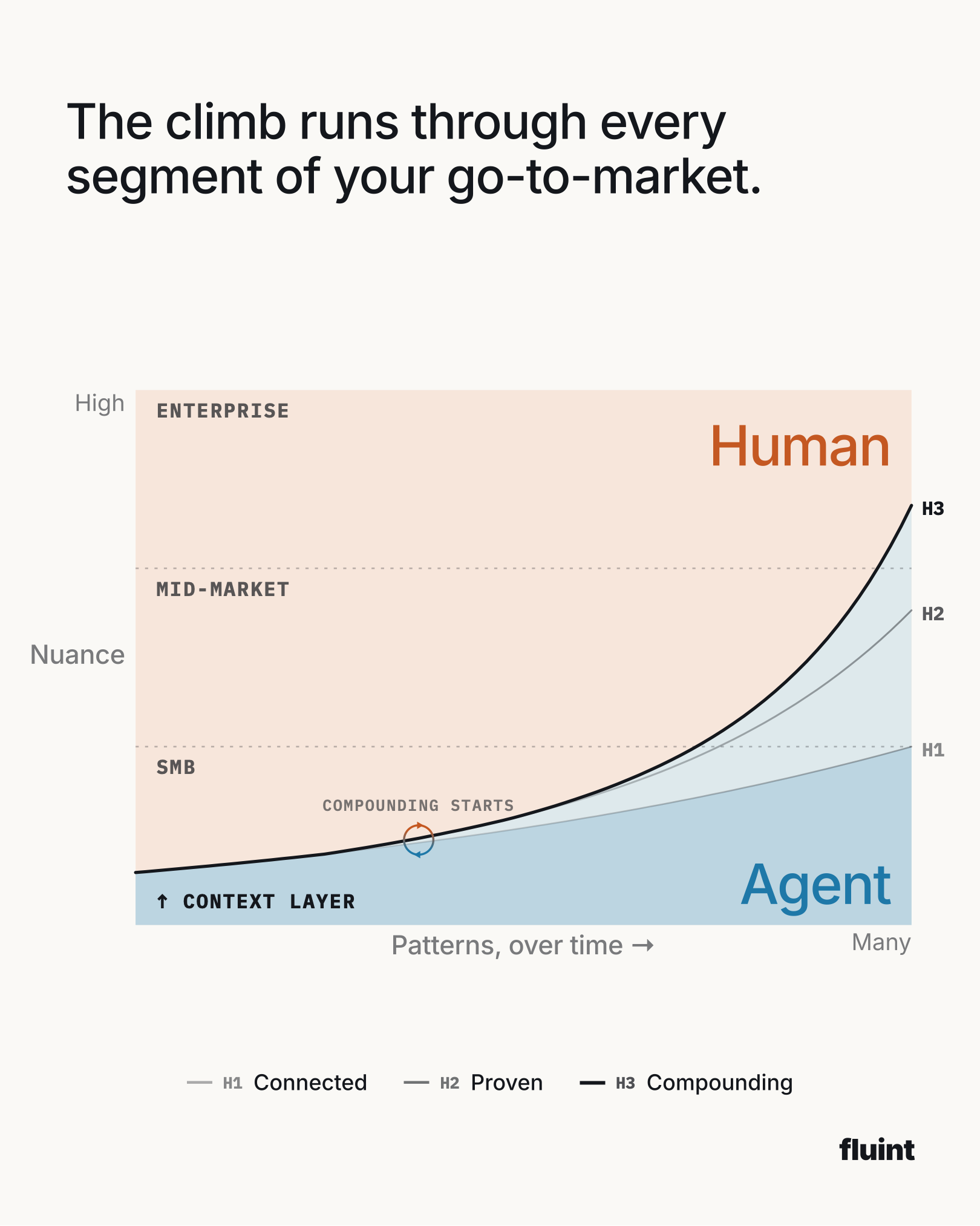
Add your segments, and the chart gets a lot more interesting.
SMB, mid-market, and enterprise stack up the nuance axis, because the average moment in an enterprise deal carries far more nuance than the average moment in an SMB deal. More people, more politics, more egos and fear and reputations, with more ways for one signal to change the energy of a deal.
The Context Line climbs through each segment, at varying speeds.
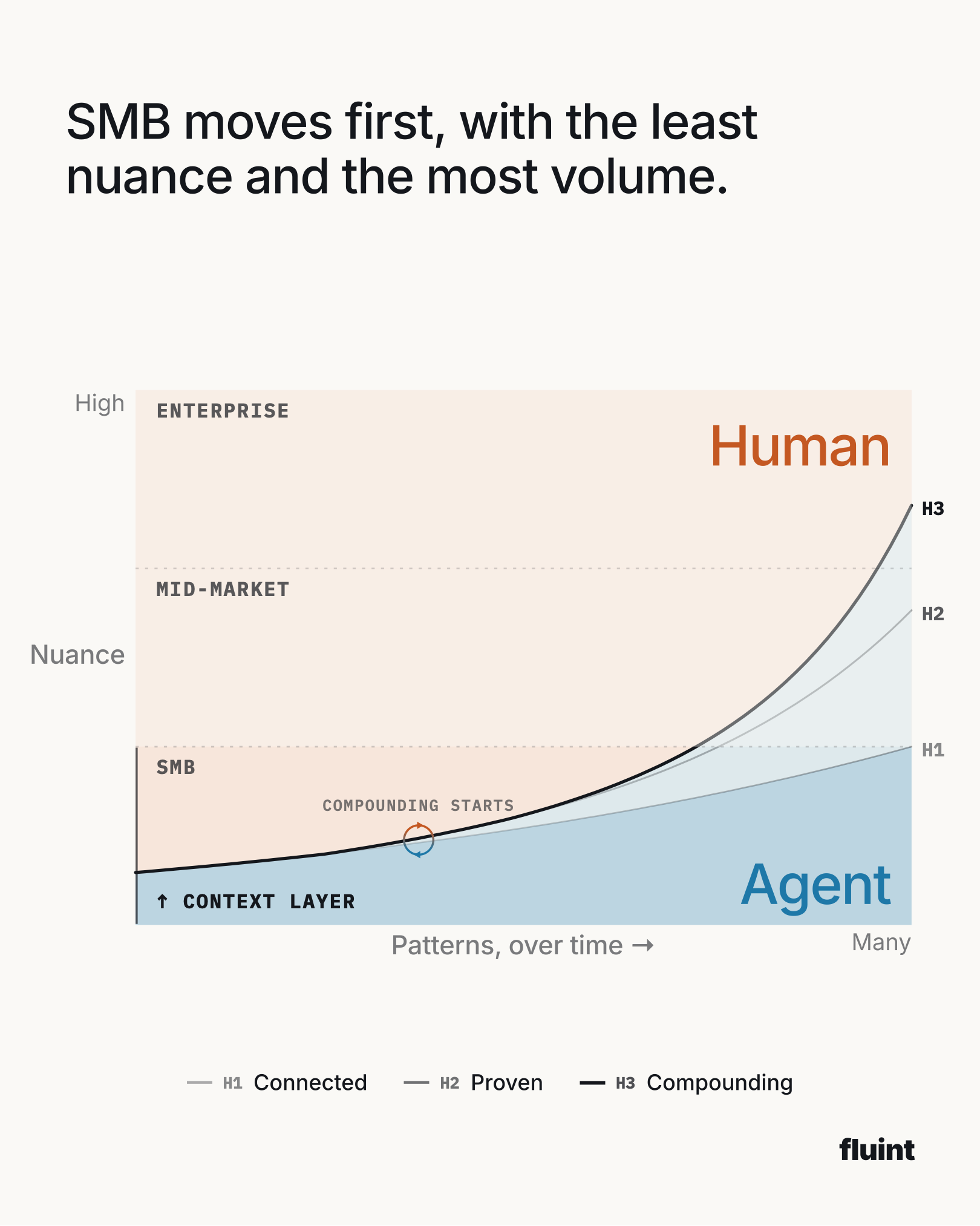
SMB moves first, with the least nuance and the most volume.
- Volume matters as much as nuance here: more deals means more patterns, faster, so SMB moves right along the chart quicker than any other segment.
- Look where the curves land. Even H1, connected data on its own, eventually reaches pretty far up in the SMB band, and with the loop running, the line gets there much sooner.
- Downmarket, deals are fairly linear. The process works like GPS, qualify, demo, propose, close, as long as nobody goes off-route. That's the kind of work an agent can own once it has the patterns.
Mid-market is where the loop decides it.
- H1 never crosses into the mid-market band at all.
- H2 gets partway up, and H3 covers most of it.
- So if you sell mid-market, connecting your data won't move the line much on its own. Proof and retraining are what get you there.
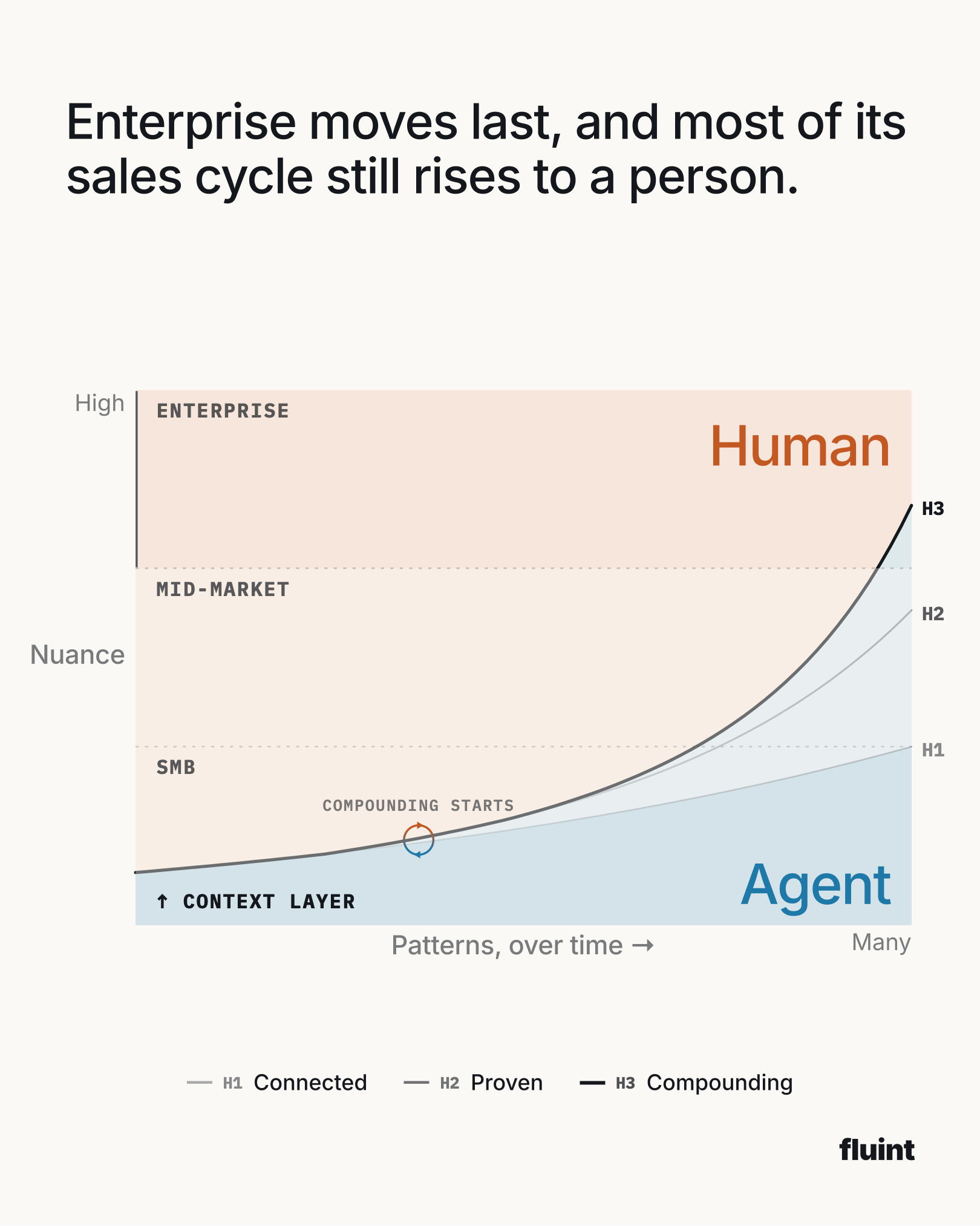
Enterprise moves last, and most of its sales cycle still rises to a person.
- Even H3 pokes into the enterprise band at the far right edge.
- Both axes work against it: more nuance in every moment, and fewer deals, so patterns stack up slower.
- Upmarket, the GPS loses signal, and there's no turn-by-turn direction for a CFO who stays quiet for the whole call and then asks one question at minute 58.
Which means a single AI approach won't fit your whole go-to-market:
- In SMB, plan for agents to own a significant majority of the motion over time, with people handling the exceptions agents flag.
- In mid-market, the loop is key. Without stepping up into Horizon 2, the line stalls below the segment band.
- In enterprise, plan for agents to work for your AEs: research, prep, drafts, a daily feed of moments that matter. Above the line still has agents in it, but a person makes the final call.
What changes for each GTM role?
As The Line rises, every role in the GTM org shifts with it, and the chart shows where each one ends up.
GTM engineering: scales patterns
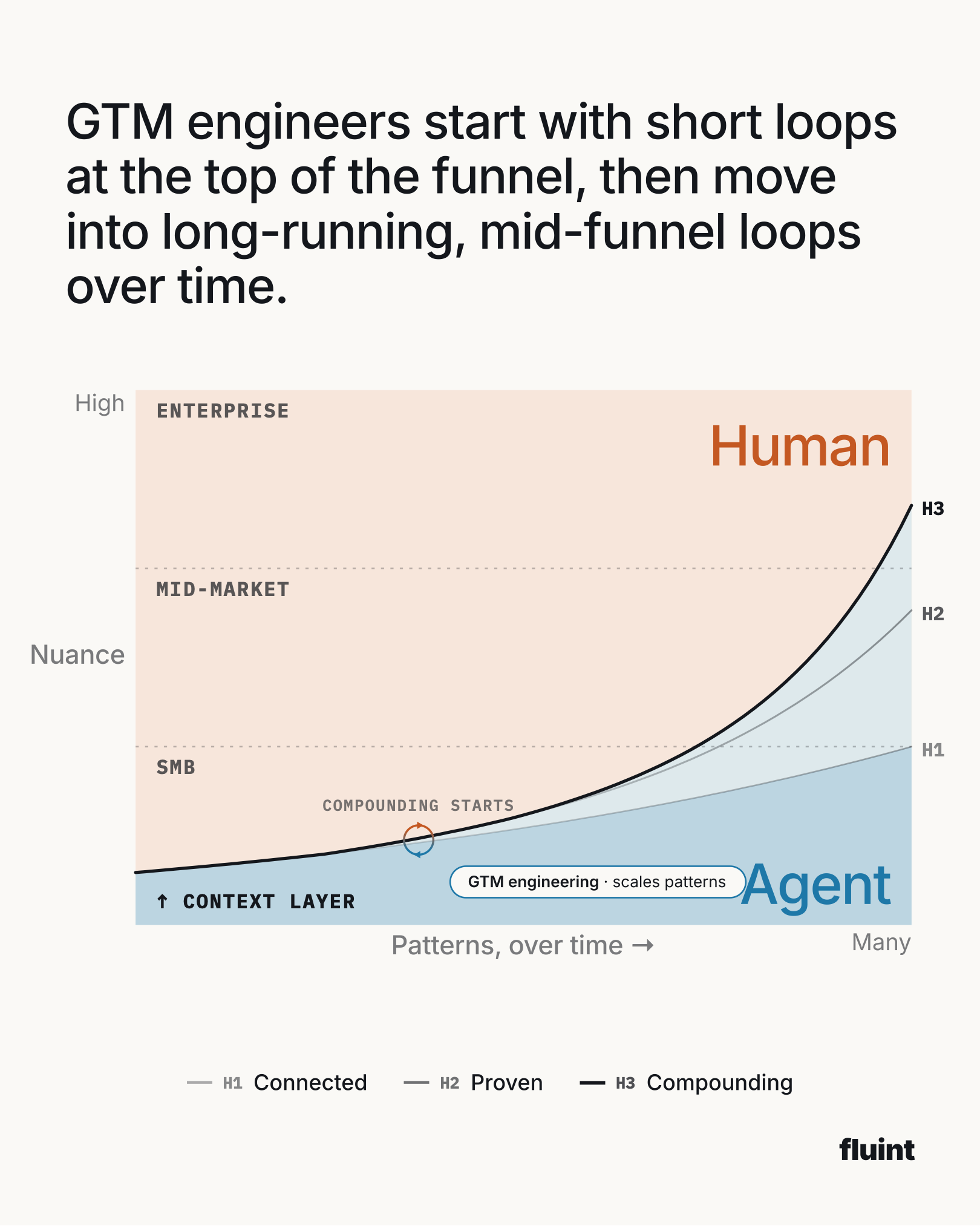
GTM engineers work below the line. Their job is turning proven patterns into agents, and the smart sequencing of work is to start with short loops at the top of the funnel, then, move into long-running, mid-funnel loops over time.
- The reason is loop length. A top-of-funnel loop comes back fast: the email gets a reply or it doesn't, the meeting gets booked or it doesn't, the account turns out to be a fit or it doesn't. So that loop turns many times a quarter, and compounding starts early.
- Mid-funnel loops are slower, because the outcome (did the business case land, did multithreading into the buying group pay off) takes a full sales cycle to resolve. But that's where deals get won or lost, so that's where the loops have to go next.
Which changes what "done" looks like for a GTM engineer:
An agent that runs a task is an automation. An agent that runs a task and writes back what happened, so the outcome can be tied to it, is a loop. (Build the second kind!)
Enablement: skills for moments that matter
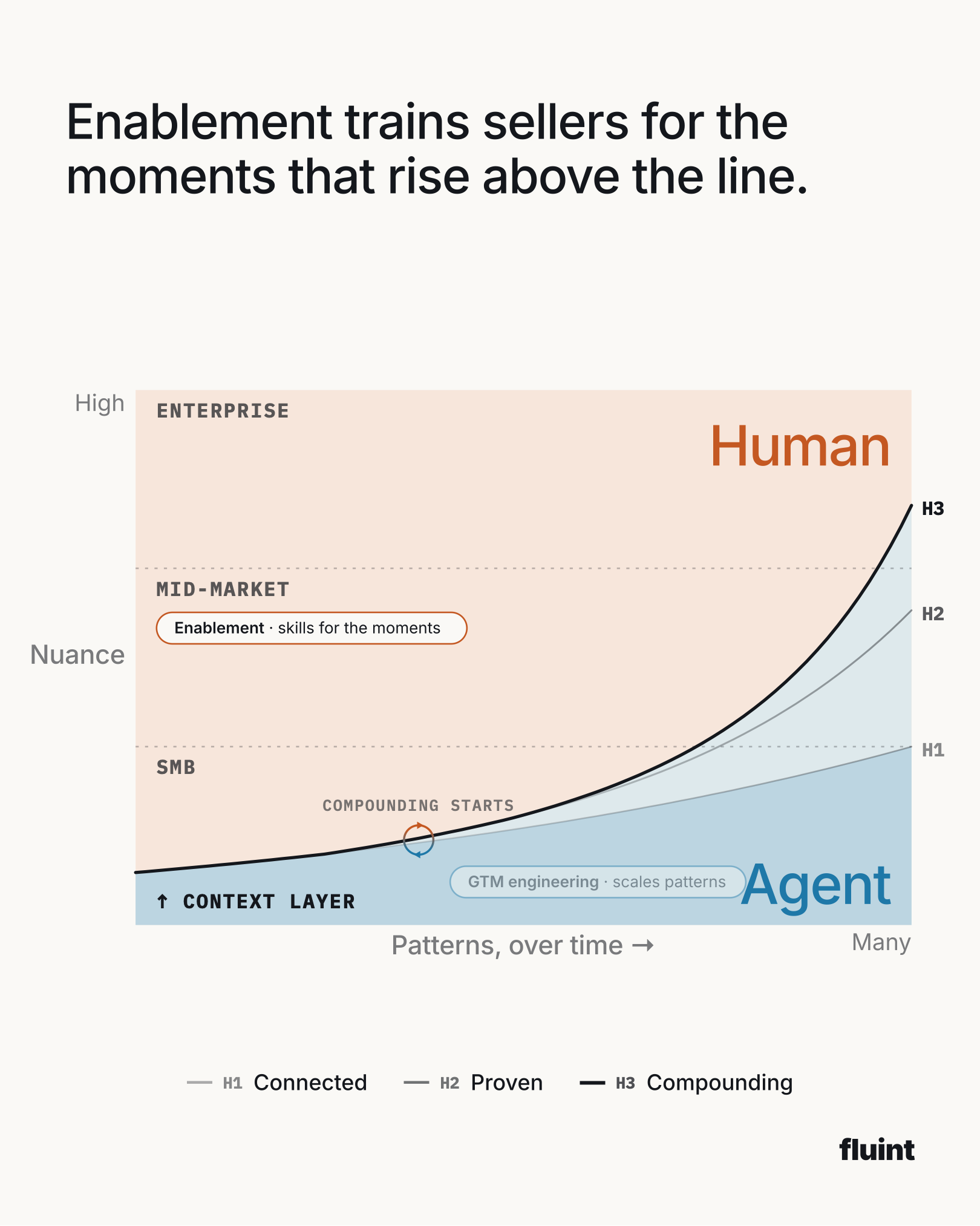
Enablement trains sellers for the moments that rise above the line.
- As the line climbs, the moments left for people get harder, by definition, since everything easier has sunk below it. That's tough stuff for a training program built mostly on process and product knowledge, because agents now carry a lot of that.
- The good news is the curriculum writes itself. The moments-that-matter feed is a running list of the situations your sellers face, how often they come up, and (once the loop is closed) which ones your team handles well.
- That's the core of outcome-based sales enablement: find the gap between a high-value behavior and how often your team runs it, practice it on live deals, and measure it against won deals.
AEs: big accounts
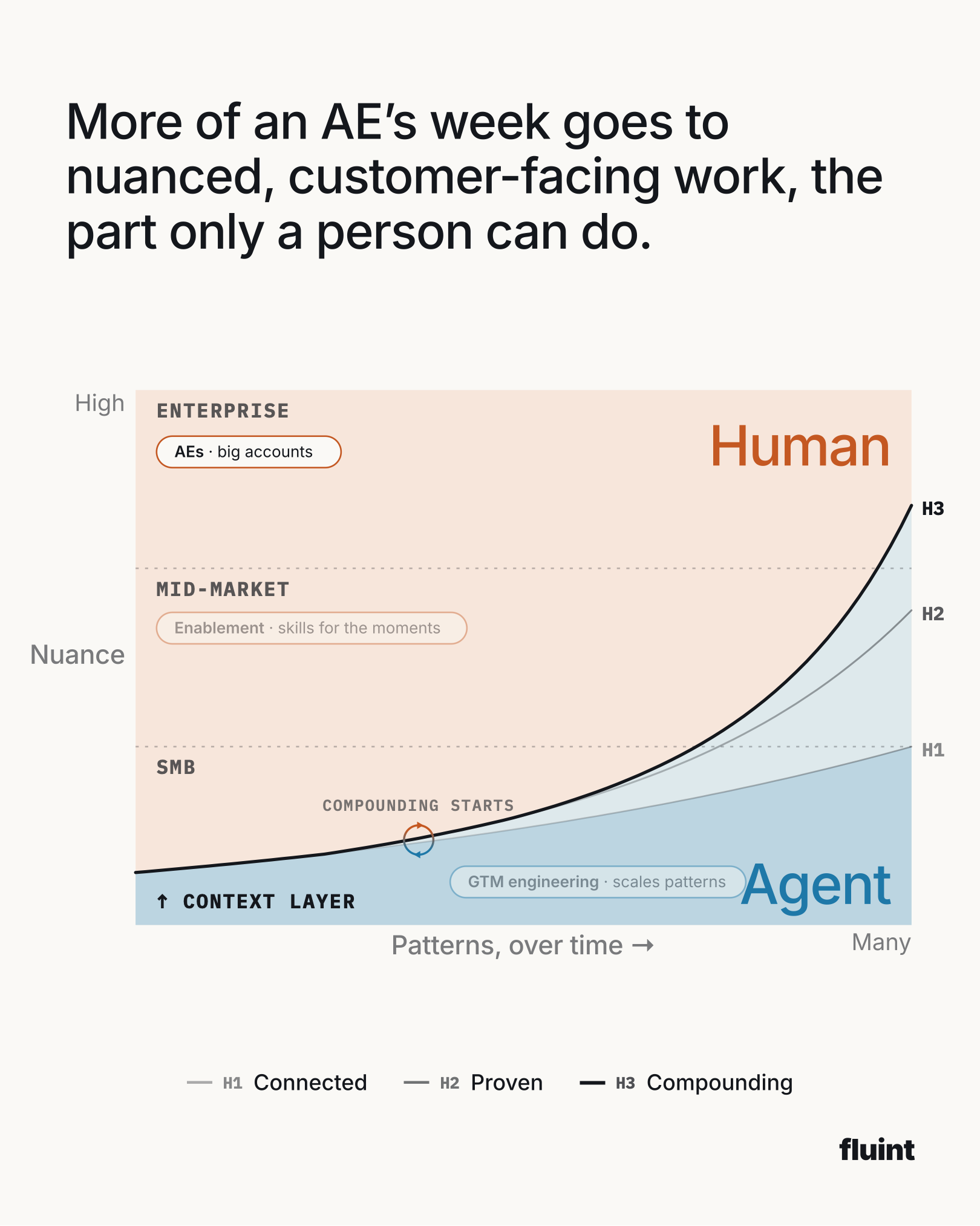
More of an AE's week goes to nuanced, customer-facing work, the part only a person can do. Research, CRM updates, recap emails, and first drafts sink below the line. What's left is reading the room, rebuilding consensus as a champion's "when" turns into "if," and editing the disputed metric live while the COO watches.
So the AE job gets more concentrated, with more of their week spent on the moments that decide the deal.
SDRs: apprentices with AEs
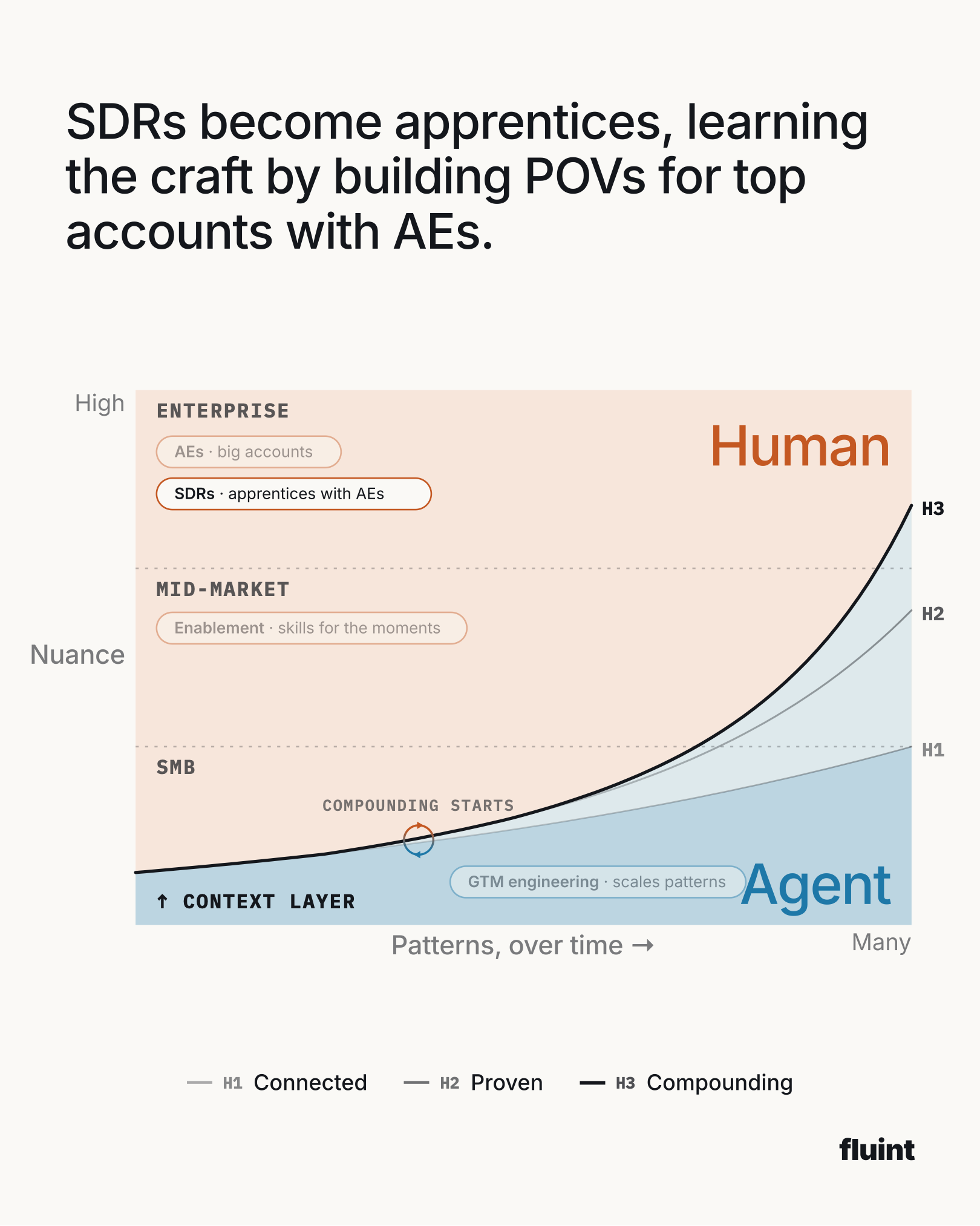
If agents own most of the low-nuance work at the top of the funnel, the traditional SDR training ground shrinks with it: the list building, the high-volume sequences, and the hundreds of reps on cold calls. That's how a lot of sellers learned the job.
So, where do your future AEs learn the craft?
Our answer is apprenticeship: SDRs spend more time early-career, further up the chart, learning by building points of view for top accounts alongside your senior AEs.
A POV is the nuanced work an AE needs to break into a top account, and building one forces an SDR to research the business, form a view on what's changing, and deliver that narrative in front of an executive. (It's also the fastest way to pick up the tacit stuff, because judgment comes from doing the reps beside someone who already has it.)
Now, this one isn't solved. Most comp plans, career ladders, and hiring profiles still assume the old SDR job. So if the training ground is sinking below the line, the apprenticeship has to be designed on purpose, or, you end up with a bench of future AEs who never practiced for the moments that matter.
What happens when the whole GTM org runs on one loop?
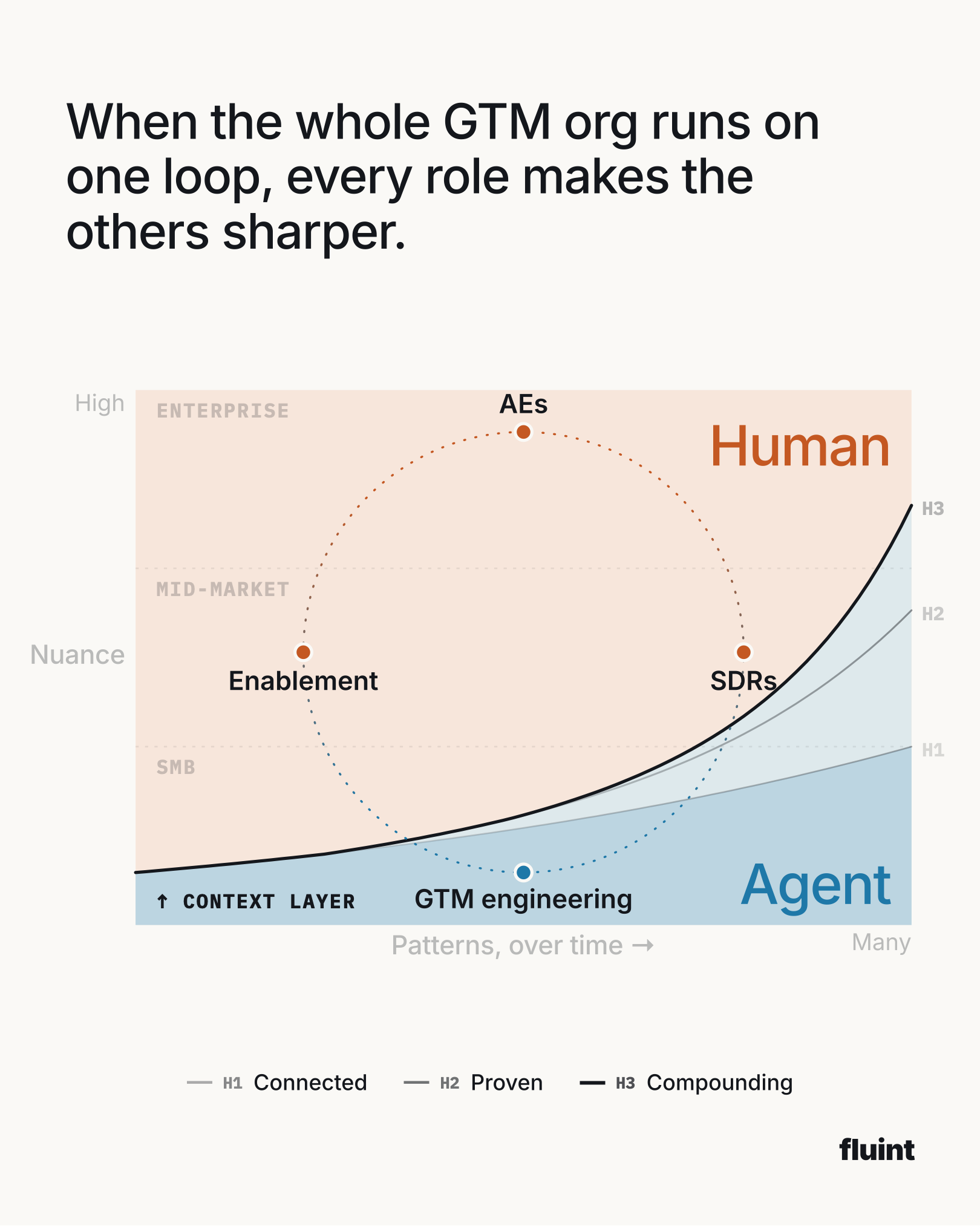
When the whole GTM org runs on one loop, every role makes the others sharper.
Look at how the loop sits on the chart: it straddles the line, with GTM engineering on the agent side and AEs, enablement, and SDRs on the human side.
Each role's output becomes another role's input:
- AEs make the judgment calls that feed the context layer.
- GTM engineering turns the patterns that prove out into agents that can own more of the sales cycle, and flag more risks to the humans:
- Those agents send the moments that matter back up, and enablement trains sellers for exactly those moments.
- SDRs learn the craft on top accounts beside AEs, and their POVs become context too.
Compare that to how most GTM orgs run today: each function has its own tools, its own data, and its own definition of what good looks like, and nobody's definition gets checked against how deals ended up.
One loop gives every role the same answer to the question that matters most: what wins deals here?
Won't the line eventually swallow the whole GTM job?
The skeptic's version goes something like:
"So give it a few years and the line hits the top of the chart, right? AI takes over?"
I don't think so, for three reasons:
- Look where the chart ends. Even at H3, with many patterns, most of the enterprise band still sits above the line.
- The line only rises because people feed it. The judgment arrows come from your sellers. Take the people out and the loop stops turning, and the line stops rising with it.
- The moments left above the line carry more of the deal. As the line climbs, each moment that still rises to a person gets rarer and matters more, so the people who handle those moments well are worth more over time.
Which means I think people are becoming more valuable in a complex sale over the next decade, and this chart is a big part of why.
Where does your line sit today?
Here's one question for you, per horizon:
- Connected: Can an agent see every deal's calls, emails, and CRM changes, resolved by entity and without reasoning over raw data?
- Proven: Can you highlight the specific plays (and when they happen) that separate your fastest and biggest deals from the rest, by segment? And how confident you are in each?
- Compounding: When a deal closes this week, does everything you'll run next week benefit? Does the system get smarter next week, even without someone writing another line of code?
And two questions for you, about the learning loop itself:
- When a seller makes a judgment call, does it get captured anywhere it can be traced back to the outcome?
- When something above the line happens in a deal, does an agent route it to a person, or does it wait for someone to notice in a pipeline review?
If you can answer the first question and not the second, you're at H1, which is right about where most context graph projects stop.
So where do you start?
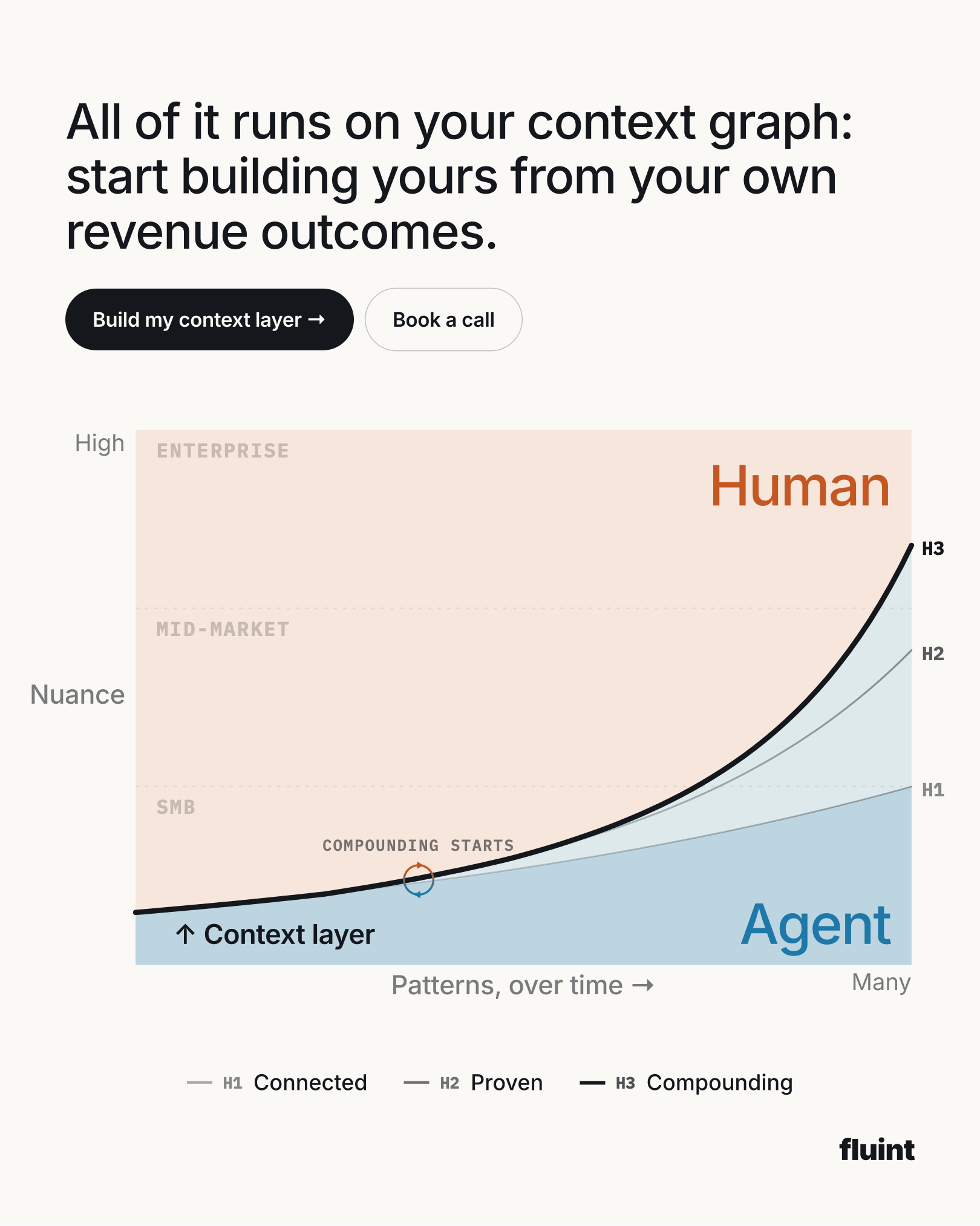
All of it runs on context built from your own revenue outcomes.
Not the playbook you inherited, and not an industry benchmark: deals that stall vs. convert by stage, the won and lost outcomes, and what separated them.
That's what Loop from Fluint does:
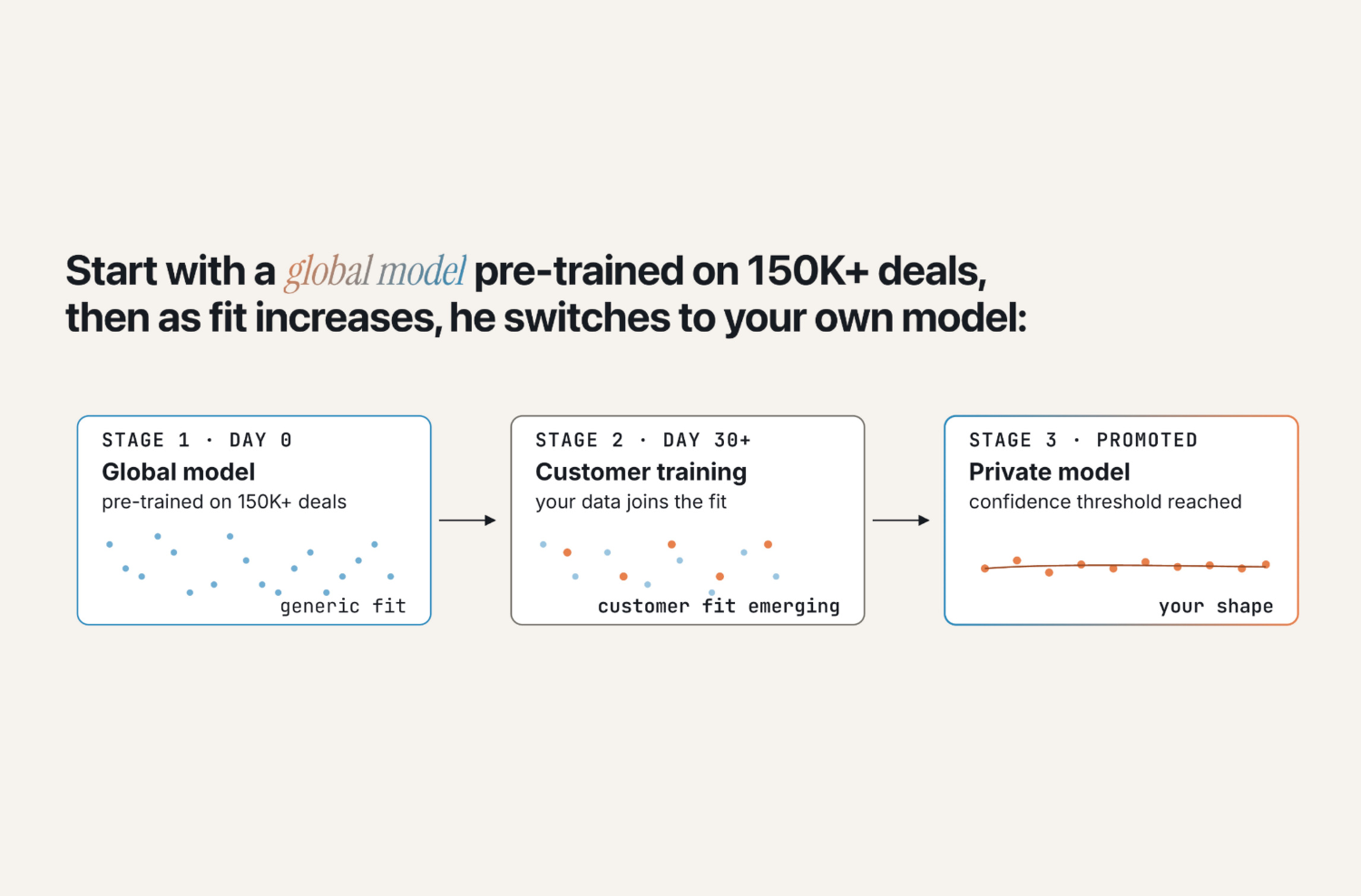
It rebuilds your deals from Salesforce, HubSpot, Salesloft, Gong and more as a time series, finds the moments where your won and lost deals diverge, then serves those findings to your reps and agents over MCP, retraining as new deals close.
Every loop lifts your line a little higher.
Build my context layer → · Book a call
Go deeper
- How to Build a Context Layer for GTM: the five-step build, from time-series capture to serving predictions back where selling happens.
- What Is GTM Judgment?: why the tacit knowledge your sellers carry is the raw material for the line.
- Outcome-Based Sales Enablement: how enablement runs sprints on the moments that rise above the line.
FAQ's on:
Context Layers
The Context Line is the boundary between what AI agents own in a go-to-market motion and what rises to a person. It's drawn on two axes: nuance (how much judgment a moment takes) and patterns over time (how many times your system has seen a situation play out and how it ended). Moments below the line can be handled by agents. Moments above it need a seller.
The context layer is the system: your GTM data captured as a time series, models trained on your won and lost deals, and the loop that retrains them as deals close. The Context Line is the result, meaning where that system lets you draw the boundary between agents and people today. A better context layer raises the line.
Start where nuance is low, volume is high, and outcomes come back fast. That usually means top-of-funnel work and SMB motions, where a loop can turn many times a quarter. Mid-funnel loops (business cases, multithreading) take a full sales cycle to resolve, so they come next.
Agents will absorb much of the low-nuance, high-volume work SDRs do today. We think the role becomes an apprenticeship instead: SDRs learning the craft by building points of view for top accounts alongside AEs, which is real work and the fastest way to build judgment.
H1, Connected, is when your systems are integrated and agents can see deal activity. H2, Proven, is when signals are tied to won and lost outcomes, so you know which moves matter and by how much. H3, Compounding, is when every closed deal retrains the model, so the line keeps rising without anyone rewriting the playbook.
Enterprise deals sit high on both axes in the wrong direction: each moment carries more nuance, and there are fewer deals, so patterns accumulate more slowly. Agents still help (research, prep, flagging moments that matter), but most of an enterprise sales cycle still rises to a person.
Why stop now?
You’re on a roll. Keep reading related write-ups:
Deal-winning context that changes the outcome






“Fluint gave us months of AI engineering work with a single integration. Now everything we build is grounded in how we win, with the right context for every agent and seller.”

“Fluint keeps our team on our sales process and calls out the gaps in every deal. Our win rate is up, and it’s helped us 6x the efficiency of our sales organization.”

“No other platform captures the right context in fewer words than Fluint.”