
Get the only AI model your competitors can't pay for
1. We turn your GTM data into a time series database for model training
2. You see what objectively drives your biggest wins (and losses)
3. Every rep and agent gets a specific next action to take








Less guesswork, more here's what works
Three gaps, that are probably
a little too familiar to you:
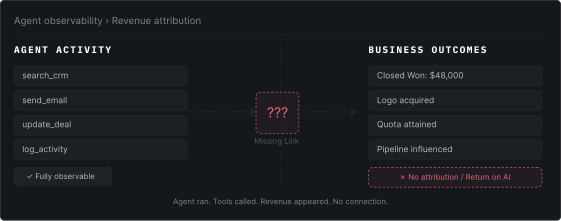
No way to tie deal activity back to revenue.
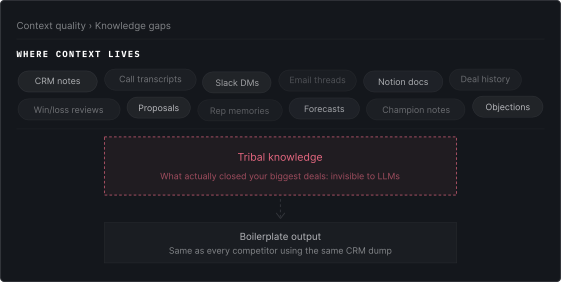
Context confetti spread across systems
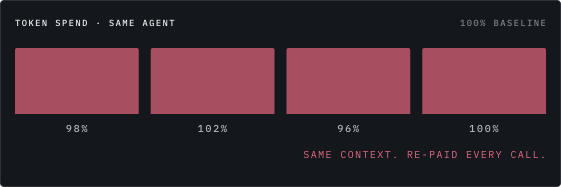
"Wait, we spent how much this month?"
Deliver the right context —
engineered from your data, to revenue, and back
.svg)
.svg)
.svg)
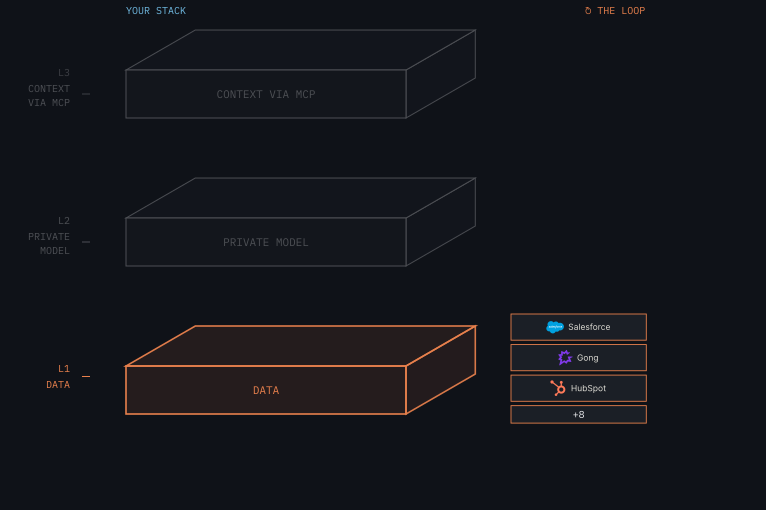
Your complete GTM dataset, in one clean and unified layer
Loop reads activities from the revenue systems you already run (CRM, conversations, emails, data warehouse) and joins them to the outcomes you already report on: cycle times, ACV, win rates, etc.
A model trained on your GTM motion, not the market's.
Loop deploys, tunes, and monitors your own private, in-house ML models for you (without needing ML engineers).
Context, pre-enriched and routed to any agent or tool.
Revenue "judgment" is pre-processed and bundled into context served to agents over MCP. So all agents (Claude, OpenAI, Glean, etc.) reads the same context the same way.
Actions, outcomes, and learning, looped back through.
Agent activity becomes new GTM data. Outcomes arejoined to the action that drove them. And the model retrains so the next request gets sharper context.
Your context, everywhere your reps work and agents run, today and tomorrow.
 Gemini
 Copilot
 Notion
 Agentforce
 Breeze
 Glean
Glean
 Claude
 OpenAI
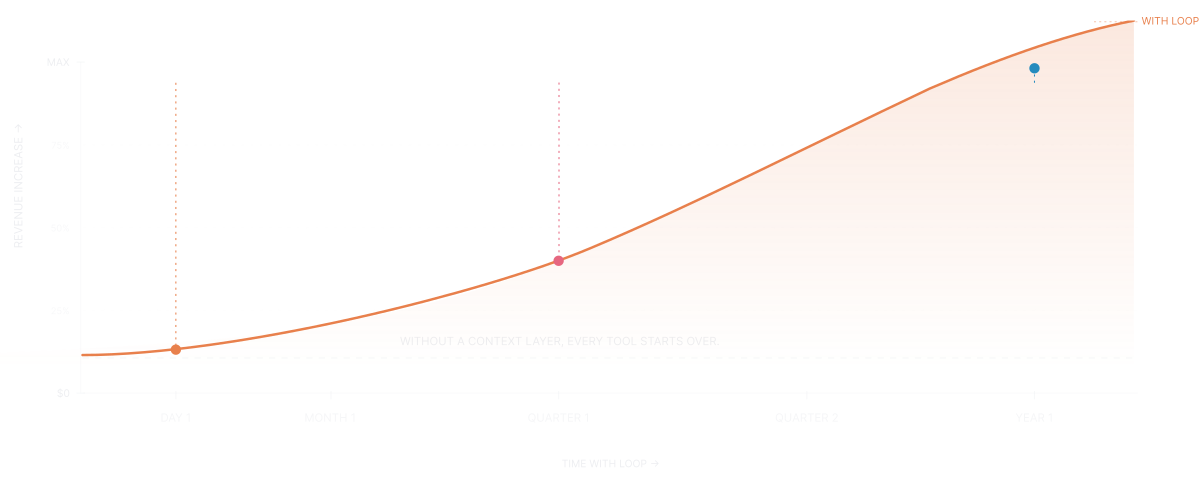
Every quarter starts at $0.
Your context layer shouldn't.
Cut token spend with pre-materialized context.
Every action tied to a revenue outcome.
A model that compounds, not dashboards that age.
Enterprise-ready from day one.
SOC 2
SAML
From signup to first context call in one session.
Sign up free
Connect your stack
Serve your first agent
Product gets a sandbox, staging, and a changelog. Why don't you?
Flag what changed.
Replay against history.
field.
Stage the rollout.
Commit the change.
Measure to $.
A changelog for revenue.
Every play attributed to $
Agents that get smarter by cycle.
Don't have a core AI provider? Get the fully managed chat.

patterns, not boilerplate. The difference was obvious in week one."
intelligence went from 'interesting' to 'how did we operate without this.'"
Context engineering is the practice of building a structured, judgment-enriched data layer that AI agents can use to make revenue-relevant decisions. Instead of dumping raw CRM data or transcripts into an agent's prompt, context engineering pre-processes your GTM data through ML models trained on real deal outcomes, then delivers pre-materialized context anywhere your agents run via MCP or API.
Pre-materialized context is data that's been processed, labeled, and enriched with revenue judgment before an agent ever requests it. When your agent calls Loop, the context is already computed and waiting. This cuts token spend and latency because the agent receives structured, decision-ready information instead of raw data it has to interpret on the fly.
RAG retrieves chunks of raw text from a knowledge base at query time and stuffs them into a prompt. Context engineering goes further: it runs ML models across your full revenue dataset to pre-compute judgment labels, pattern matches, and org-specific insights. The agent doesn't get documents to read. It gets conclusions it can act on, grounded in what actually drove revenue outcomes across your deal history.
Loop delivers pre-materialized context via MCP (Model Context Protocol) and REST API. Add Loop as a tool definition in your agent framework, and any agent on any platform can call it for judgment-enriched deal context. One MCP server config or API call. No model swap, no migration, no vendor lock-in. It works alongside whatever you're already building.
Loop connects to your full GTM stack through a single integration flow: Salesforce, HubSpot, Gong, Clari, Outreach, Salesloft, 6sense, ZoomInfo, email, calendars, and 20+ additional sources. Data is ingested continuously (not a nightly batch), with entity resolution across systems so every contact, account, and activity is matched and deduplicated automatically.
Loop deploys a stack of private ML models on your data, boosted by 150K+ deal cycles. This includes gradient-boosted decision trees for activity-to-revenue scoring, KNN for pattern matching across similar deals, time-series models for deal trajectory analysis, and org-scoped Small Language Models with private weights. Every model is trained on your data specifically, not a shared model with a customer flag.
Most observability tools tell you an agent ran and what tools it called. They can't tell you whether it moved a deal. Loop traces agent behavior across the full sales cycle and maps it back to revenue outcomes: closed-won, ACV changes, cycle time, win rate. This is the closed-loop attribution layer that RevOps teams need to prove (and improve) agent ROI.
You can, but the output will be generic. CRM fields and knowledge base articles don't carry judgment about what actually drives deals to close. They give the agent information without insight. Loop's context layer is enriched by ML models trained on real revenue outcomes, so the agent gets pattern-matched intelligence: which plays worked for this buyer type, which signals indicate risk, which deals in your history looked like this one.
Yes. Loop trains org-scoped models on your data with private weights. Your data is never shared with other customers and never used to train models for other orgs. The ML backbone is boosted by aggregate patterns learned from 150K+ deal cycles, but your org's specific model, context, and outputs are private to you.
Sign up free, connect your GTM stack through our integration flow, and Loop begins building your private context layer. You can start delivering context to your existing agents via MCP or API within the first session. No migration required, and it works alongside your existing tools.