

Outcome-Based Sales Enablement: Why Enablement's New Job Is Closing Gaps



TL;DR
- Outcome-based sales enablement = pick the one behavior that most separates your won deals from your lost ones, where your team executes it least, and work on only that until the numbers move.
- Run it as an enablement sprint: a baseline, a target set by deals that actually converted, a few weeks of practice on live deals, and a clear finish line. Then re-rank and pick the next gap.
- The Context Graph in Loop is how we map it: stack-ranked predictors → where deals drop by stage → the play that moves each predictor → team adoption vs. the won-deal benchmark → act.
A good friend who’s led enablement for her company for a few years was just acquired by a much larger firm, and now she’s acclimating to a new enablement “culture.”
She gave me a ring the other week:
“Our reps were all Slacking me saying they finished all their new enablement videos, and then were like, so that’s it? What do I do now?”
Their point was that the “big company” enablement felt… pointless. Because it was a lot of knowledge, separate from their actual job-to-be-done, and delivered outside the context of their actual deals.
Then, last week, I was at a CRO dinner in Salt Lake City, where someone asked the question:
“How should I be writing our ops and enablement job descriptions? We’re behind on hiring, but part of it is that I’m not sure we want skill enablement without tech, or tech without skills work. What’s the right structure here?”
And, I will say, the lines between the roles are getting blurrier every month as “revenue enablement” emerges. But I don’t think that’s a bad thing. Because I think it’s a major part of the shift to an outcome-based approach (vs. a knowledge-based approach) to enablement.
That’s focused on building new skills inside the actual work, using GTM data to target a handful of high-value behaviors that decide whether deals convert (or not).
Why doesn't sales training stick?
Now, follow me here:
- Knowledge isn't an output, let alone an outcome. A rep can pass a certification on MEDDPICC fields, and still never get the EB (economic buyer) to a call. So head knowledge, and executing a specific skill to a specific standard, are quite different.
- Training that lives outside daily context. Sales kickoffs and onsite workshops are great: I keynote and facilitate these for our customers, multiple times per month. But if there’s no ongoing practice after, or the practice is outside deal context, it’ll never stick.
- There's no finish line. If you never wrote down a current state and a goal state, you can't tell if the program worked, so it just keeps running (and keeps adding to the pile).
Which is why "more training" has hit a wall, but a different approach can break through it:
What is outcome-based sales enablement?
Outcome-based enablement:
- Targets a measurable revenue outcome (e.g. stage conversion, ACV, win rate);
- By finding a highly-specific rep behavior that predicts that outcome;
- Then closes the gap between how a rep actually executes that behavior today (or doesn’t), vs. how closed-won / converted deals executed it.
To contrast them:
| Knowledge-based enablement | Outcome-based enablement | |
|---|---|---|
| Starts from | Head knowledge | Behavior observed in winning deals |
| Unit of work | A course, an LMS module, a certification | One play, tied to one predictor, at one stage |
| Where skills are built | In a recording or classroom setting | On live deals, in the tools reps already use |
| Success metric | Completion, attendance, satisfaction | Play adoption vs. the won-deal benchmark, then stage conversion |
| Cadence | A program that runs | A sprint with a baseline, a target, and an exit |
Why think of enablement as a series of “sprints?”
I’ve built products, and enablement programs. Over time, I ended up adopting some paradigms from engineering rhythms that are ideal for enablement. A core primitive here is sprints:
Sprints force measurement: are we improving the one thing we prioritized, yes or no? If yes, can we lock it into the structure our reps operate with, and then move to the next gap, building on the progress over time? Or, if not, let’s stop and change the approach.
Which is more a process of continuous improvement, vs. a check-the-box approach. Because each part of the training is a single, measurable step, and the compounding comes from stacking them together over time.
How do you find the highest-value execution gaps to prioritize?
So, in designing the right enablement “sprints” to run, you're looking for the intersection of two things:
- High value: a behavior that strongly and objectively separates won deals vs. lost ones, or a stage where most of your pipeline gets stuck.
- Low execution: a behavior your team runs far less often, compared to a set of your won / converted deals.
Find the biggest gap, the root cause, and then work on that until the measure improves.
Which is similar thinking to how we’ve thought about engineering Loop, from Fluint.
So here's the five-step version of shifting your enablement to this outcome-based approach, using an example Loop workspace to bring the points and data to life.
Step 1: Stack-rank which “predictors” matter.
What are the leading indicators of win rate at your specific company, in a specific segment?
Some "leading indicators" can be semi-universal (champion, multithreading, next steps). Which are fine starting points, but the ranking has to come from your own closed deals, because the order changes WILDLY by segment, deal size, and motion.
For example, maybe you sell to engineers, and Economic Buyer access matters far less early-stage than in another setting, like more traditional HR or enterprise SaaS.
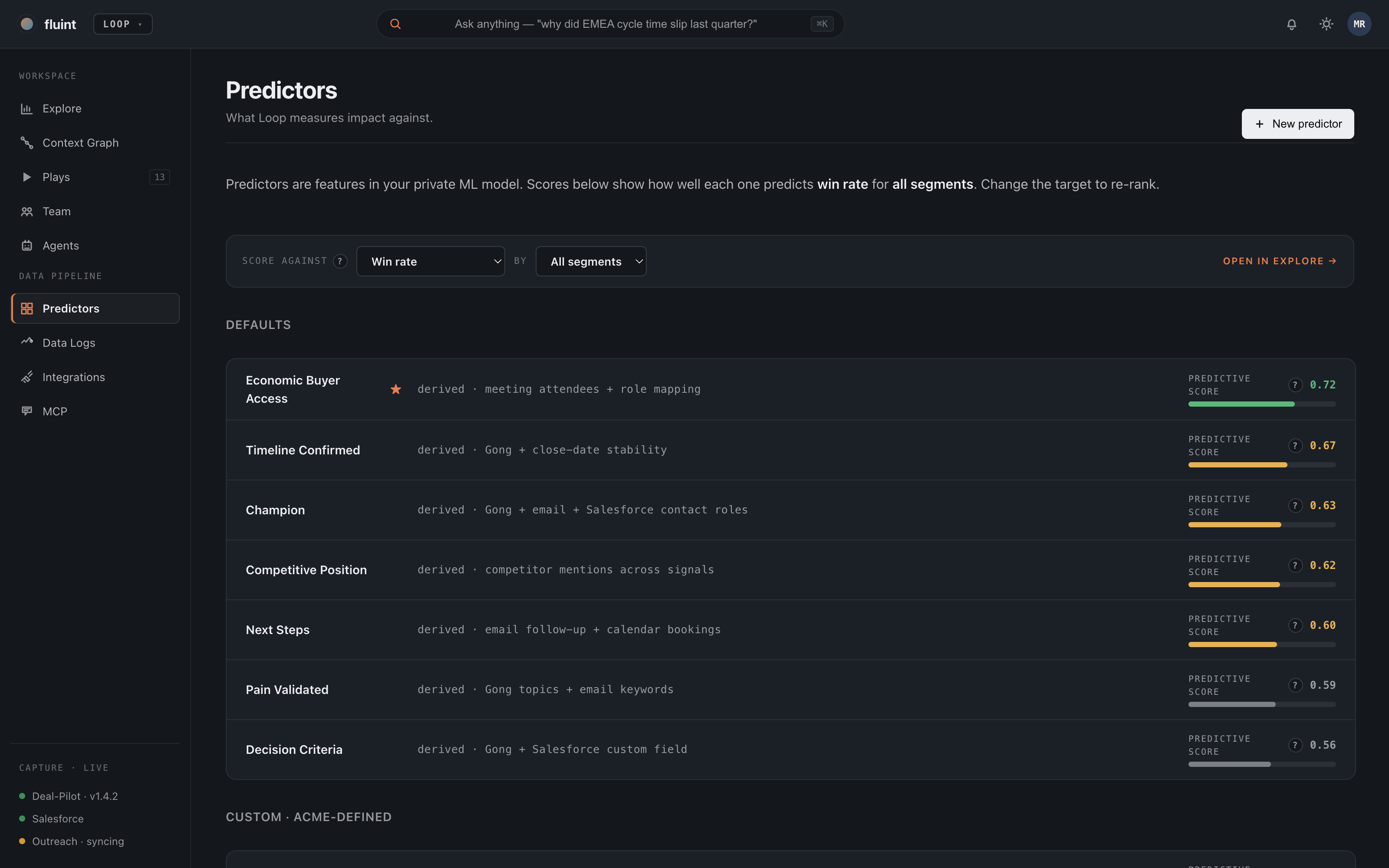
In this example, EB Access tops the default predictors at 0.72, followed by Timeline Confirmed (0.67) and Champion (0.63). But a custom predictor the team defined themselves, cfo_attended, scores even higher at 0.79.
Each score = how well that predictor separates winning deals from losing ones, based on regression testing that dimension against every other variable in a deal.
Step 2: Find where deals drop off, and which predictors drive that stage.
How do predictors show up in our stage-to-stage conversion rates?
A predictor that matters at Discovery might not matter at all by Negotiation.
So you look at them, stage by stage:
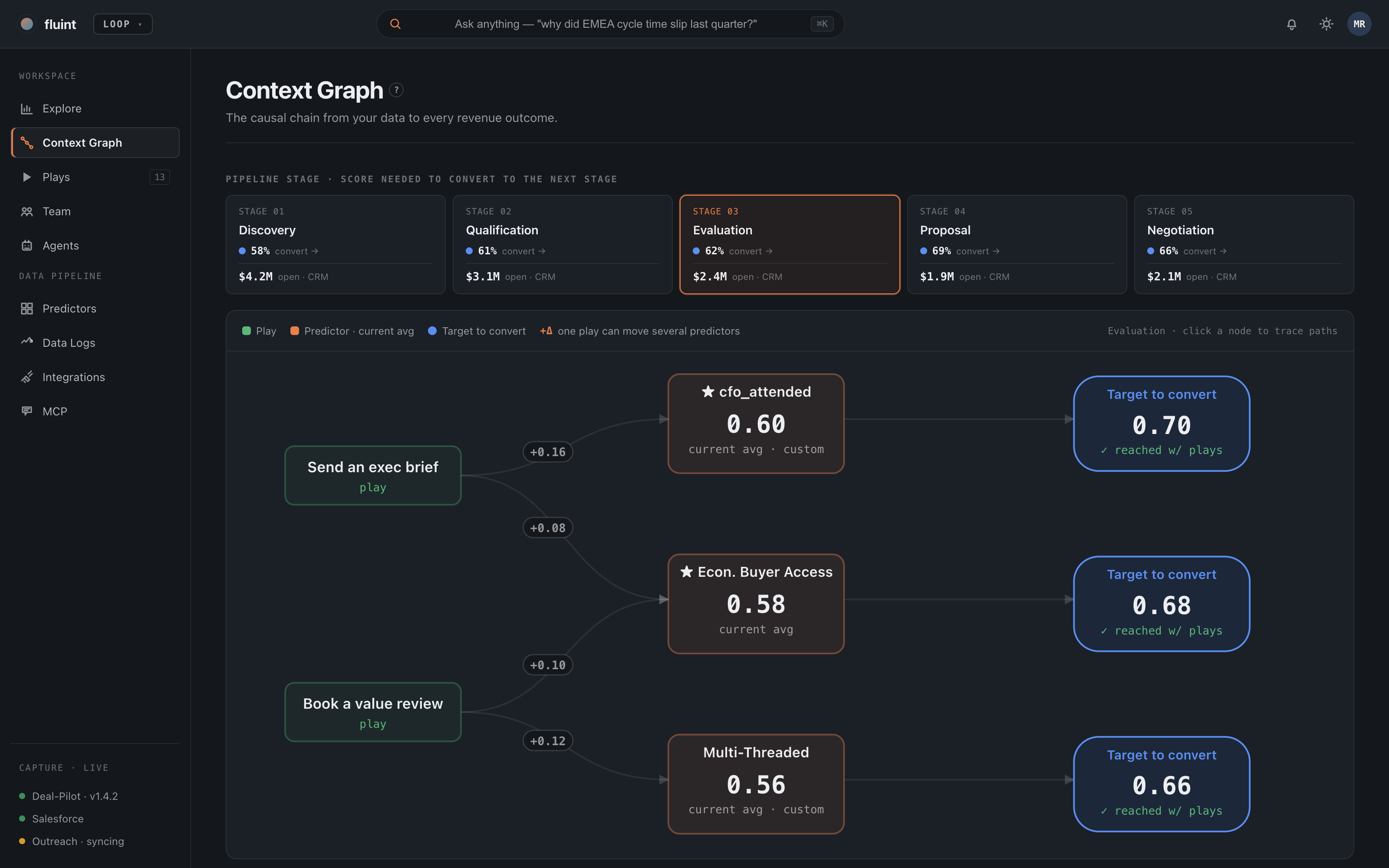
Here, Evaluation converts at 62% with $2.4M in open pipe. Three main predictors drive that stage, and all three are short of the score that deals need to convert:
cfo_attended: 0.60 today vs. a 0.70 target- Economic Buyer Access: 0.58 vs. 0.68
- Multi-Threaded: 0.56 vs. 0.66
So, the next question is: what play moves that predictor?
Step 3: Focus on a specific behavior that moves the predictor.
You can't coach a predictor, but you can coach to a “play.” The play = the output that a specific behavior creates, ideally with a set of golden examples from your own reps, which = the standard.
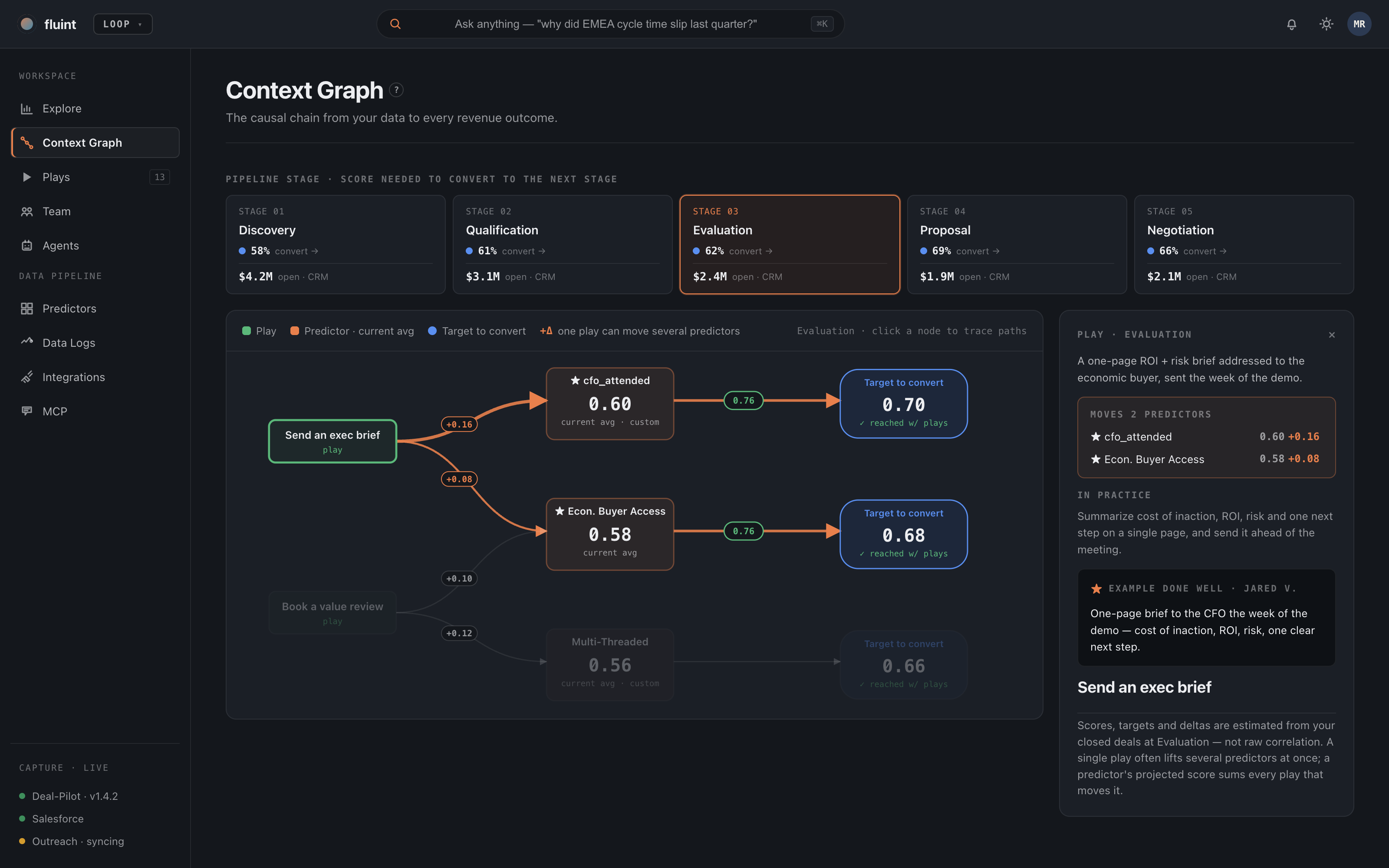
"Send an exec brief" means a 1-page, risk-focused brief addressed to the EB, with their team’s own data added, sent the week before a next conversation.
Which, in this example, moves two predictors at once: cfo_attended (+0.16) and Economic Buyer Access (+0.08). Run with the other plays at this stage, both predictors clear their targets.
And there's already one rep doing it well, producing the example of the standard: Jared V. sends a 1-page brief to the CFO the week of a demo, covering cost of inaction, risk, etc. in one clear next step.
Step 4: Compare the team to your won-deal benchmark.
How do you measure sales enablement’s impact?
Against the difference in your current vs. target outcome measure. Which isn’t… new. But the point is that it’s so rarely done in enablement that it’s difficult to know if enablement’s contributed to not just knowledge, but revenue.
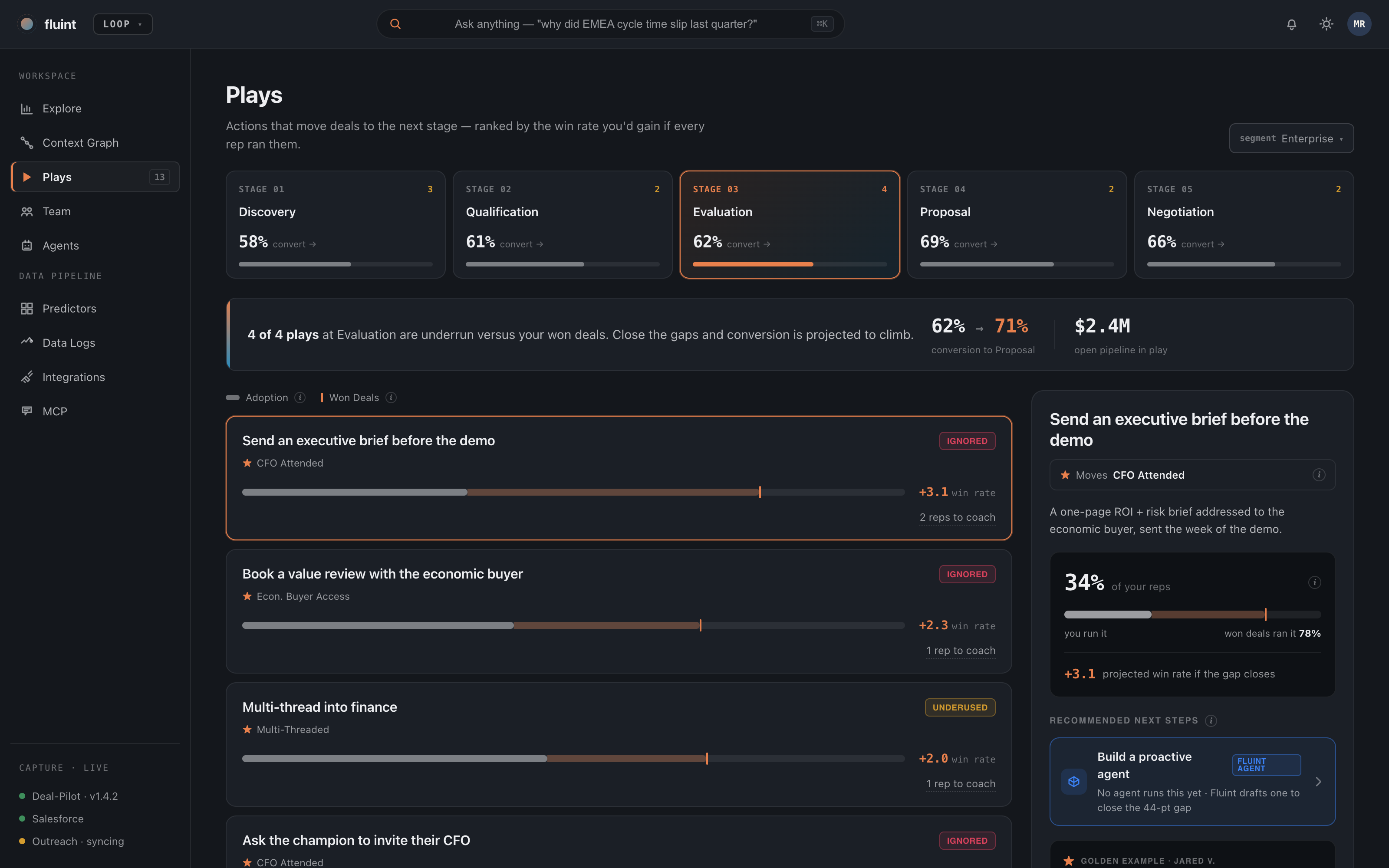
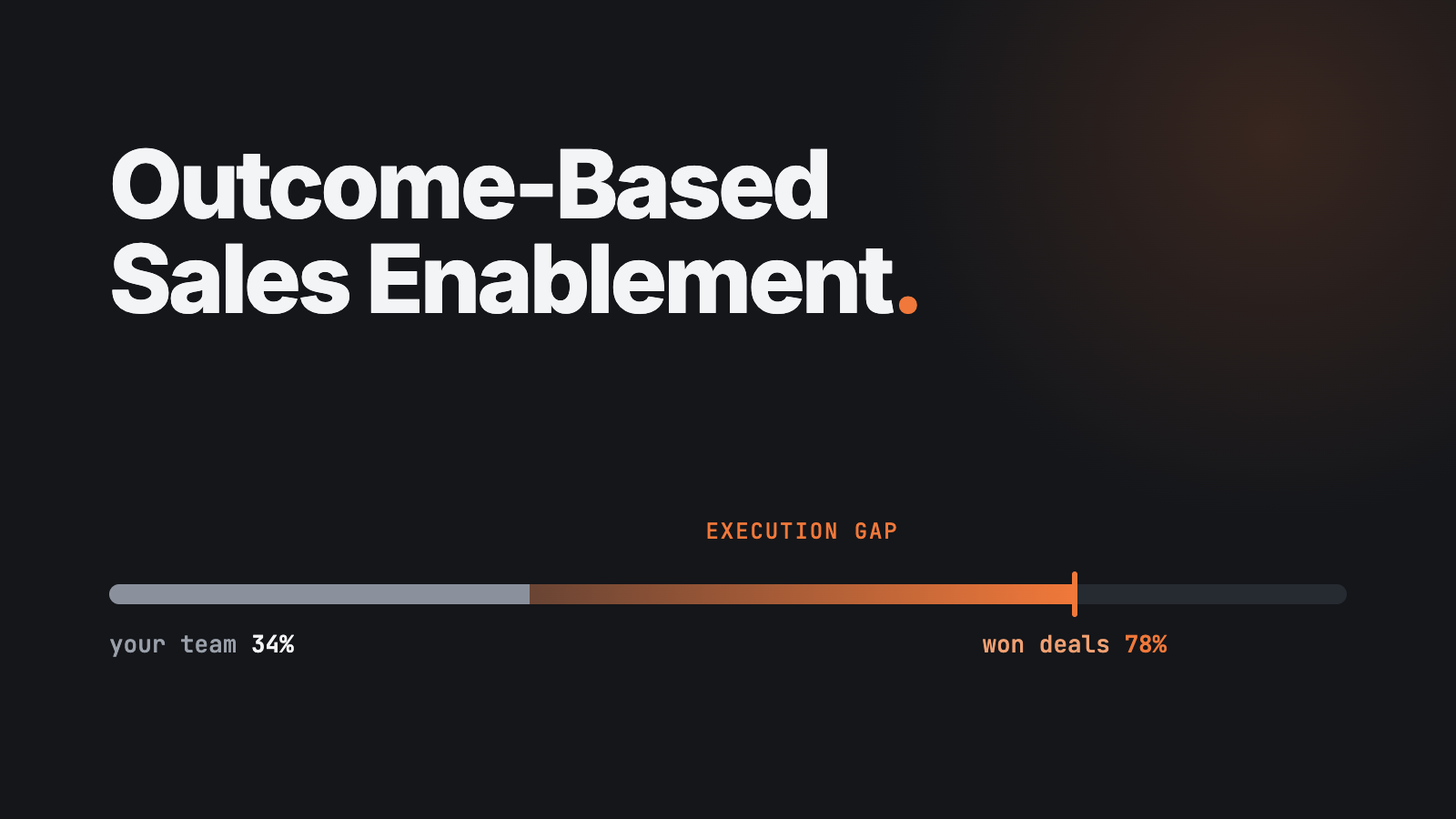
For example: only 34% of reps run the exec brief play, while 78% of won deals included it.
That's a 44-point gap, worth a projected +3.1 points of win rate if that gap closes, and it's part of what would move Evaluation from 62% to 71% conversion. (It also tells you exactly who to work with: two reps are running it far below the benchmark.)
That's your execution gap: high value, low execution, and a specific set of reps.
Step 5: Act (and there are a lot of ways to act).
Once you know the gap, the question becomes: which intervention closes this gap fastest?
Loop can build an agent that drafts the brief for reps, but that's just one option out of many. The point of backing all the above with a single context layer, engineered with your data, is that every team intervention gets sharper if it's targeted at a specific predictor and play, with a standard.
| Intervention | Use it when the gap looks like... | What it pulls from the context layer | How you measure it |
|---|---|---|---|
| Manager coaching 1:1 | A few reps are far below the benchmark, and the rest are fine | Rep-level adoption, the deals where the play was skipped | That rep's adoption on active deals, week over week |
| Simulation / role-play | Reps try the play but it falls flat (e.g. the CFO doesn't engage) | The golden example, real objections from lost deals | Scored practice reps, then live adoption |
| Peer learning | Nobody's sure what "good" looks like | The rep who runs it best and their actual artifact | Team output quality against the standard |
| Focused workshop on live deals | The whole team is under the benchmark | The open deals at this stage missing the play | Plays run on those specific deals within 2 weeks |
| In-workflow prompts or agents | Reps know how, but forget or run out of time | Stage triggers, deal context, the play template | Adoption on deals that hit the trigger |
| Process or tool fixes | Something in the system blocks the play (no template, wrong CRM field, no exec access) | Where the play stalls across deals | Time-to-run and adoption after the fix |
Notice where the practice happens: on live deals, with tooling your reps already use.
What does an enablement sprint look like?
Here's the Evaluation example as a one-page sprint card:
| Sprint card | Evaluation example |
|---|---|
| Stage | Evaluation (62% conversion, $2.4M open) |
| Predictor | cfo_attended (0.60 now, 0.70 needed to convert) |
| Play | Send a 1-page executive brief before the demo, built with customer data |
| Standard | Jared V.'s brief: one page, cost of inaction, ROI, risk, one next step |
| Baseline | 34% of reps run it |
| Target | 78% (the won-deal benchmark) |
| Interventions | Peer walkthrough of Jared's brief, 1:1s with the two reps furthest behind, an in-workflow prompt when a deal enters Evaluation |
| Leading measure | Weekly play adoption, then the cfo_attended score |
| Lagging measure | Evaluation → Proposal conversion |
| Exit criteria | Adoption reaches the benchmark, or 6 weeks pass without the predictor moving (then change the play) |
How long should an enablement sprint be?
Good question: long enough for the play to show up on real deals. For most teams that's roughly 4 to 6 weeks, depending on how fast deals move through the stage.
When do you stop a sprint?
When the gap closes, or when the data says the play isn't moving the predictor. Either way, you re-rank and pick the next gap, and that's where the idea behind “continuous improvement” comes from.
"But what about onboarding and product knowledge?"
Fair question. New hires still need to learn the product, the market, and your process.
Outcome-based enablement doesn't delete that, it just stops treating it as the main focus of enablement: knowledge becomes an input to a sprint, delivered when that play needs it, instead of the focus of the program itself.
"What if we don't have the data?"
You can start “by hand.”
Go pull your last 20 won deals and 20 lost deals at one stage, list what happened in each, and then look for the behaviors that show up most in your wins vs. losses. It'll be slower and noisier, but it's the same principle.
(Loop does this continuously from your CRM, calls, email, and calendar, with a series of ML models to objectively weight them with your outcomes. Which is the difference between a one-time analysis and a living scorecard.)
Pro tips for your first sprint
- One gap at a time. The temptation is to run three sprints at once. Don't.
- Measure outputs vs. attendance. Did the brief get sent, on which deals, to what standard?
- Pull a golden example from your own team. A peer's example > templates, every time.
- Let managers own reinforcement. Enablement designs the sprint, and first-line managers make it stick in 1:1s and deal reviews.
- Socialize the before vs. after. A sprint that moved stage conversion 4 points is the best budget defense enablement will ever have baby.
So, is enablement part of the revenue org in the future?
Back to that CRO dinner.
I think the answer is undeniably yes, but only for the enablement teams that operate with a more direct tie to revenue, not just “learning stuff.” When enablement shows up to the pipeline review with a sprint card, a baseline, a target, and a result, this really isn’t a question people are interested in or feel the need to ask in the first place.
If you want to see your own predictors, stage gaps, and won-deal benchmarks, see how Loop builds your Context Graph →
FAQ's on:
Sales Enablement
Outcome-based sales enablement is an approach that starts from a measurable revenue outcome, like stage conversion or win rate, identifies the rep behaviors that predict it, and targets the biggest gap between how the team executes those behaviors and how won deals executed them. Success is measured by behavior change and conversion, not course completion.
An enablement sprint is a time-boxed effort, usually 4 to 6 weeks, focused on closing one execution gap. It has a single predictor, one play, a standard set by a top rep, a baseline, a target from won deals, and exit criteria. When it ends, the team re-ranks gaps and picks the next one.
Sales training usually doesn't stick because it happens outside the work. Most failure traces to the environment reps return to, not the session itself: no clear standard, no prompts in the moment, no reinforcement from managers, and no measurement against real deals. Practicing a specific play on live deals changes that.
Measure sales enablement impact in layers: first, whether reps run the targeted play on active deals; second, whether the predictor it moves improves; third, whether stage conversion or win rate climbs. Compare each to a won-deal benchmark, meaning how often deals that actually closed included that behavior.
Leading indicators of win rate are deal behaviors that show up early and predict whether a deal closes, such as economic buyer access, a confirmed timeline, or a CFO attending a meeting. The right indicators differ by company, so rank them from your own closed-won and closed-lost deals rather than a generic list.
Prioritize by execution gap: how strongly a behavior predicts conversion, multiplied by how far your team's adoption trails your won deals. The behavior with high predictive value and low team execution, at a stage holding meaningful pipeline, goes first. Everything else waits for the next sprint.
Why stop now?
You’re on a roll. Keep reading related write-up’s:


Deal-winning context that changes the outcome

Now getting more call transcripts into the tool so I can do more of that 1-click goodness.



The buying team literally skipped entire steps in the decision process after seeing our champion lay out the value for them.


Which is what Fluint lets me do: enable my champions, by making it easy for them to sell what matters to them and impacts their role.

