

How to Build a Context Layer for GTM (One That Actually Predicts Wins)



TL;DR
Try predicting what someone will wear tomorrow.
You could inventory their closet. Every shirt, every jacket, every pair of shoes, tagged and cross-referenced. Pull the weather forecast. Their calendar. What's trending this season. Now you have perfect context. Every fact, connected.
You still can't predict the outfit.
Because some people wear pants in 95-degree heat. Some wear shorts in the cold. Weather drives the choice for one person and barely registers for another (dress code beats forecast, every time). The only way to know is history. Watch a thousand mornings. Record what they actually chose. Then weight each variable against the outcome. Maybe temperature explains 40% of the decision for your friend in Denver, and 5% for your friend in private equity.
The closet inventory is context. The weights are judgment. And you only get weights by training on outcomes.
Your pipeline works exactly the same way. And right now, the market is selling you a "closet organizer."
Everyone is building a context graph. Almost nobody is building judgment.
Glean, Sybill, Clearskies, Von etc... and the current AI natives are beginning to talk about their context graphs. Soon, every "AI for sales" deck in your inbox will have a slide with nodes and edges showing how your calls, emails, and CRM records connect.
A context graph is kind of like your closet: an inventory. It shows that your champion talked to the CFO three times last month, and that's a fact about a relationship. But it's not a prediction about your deal.
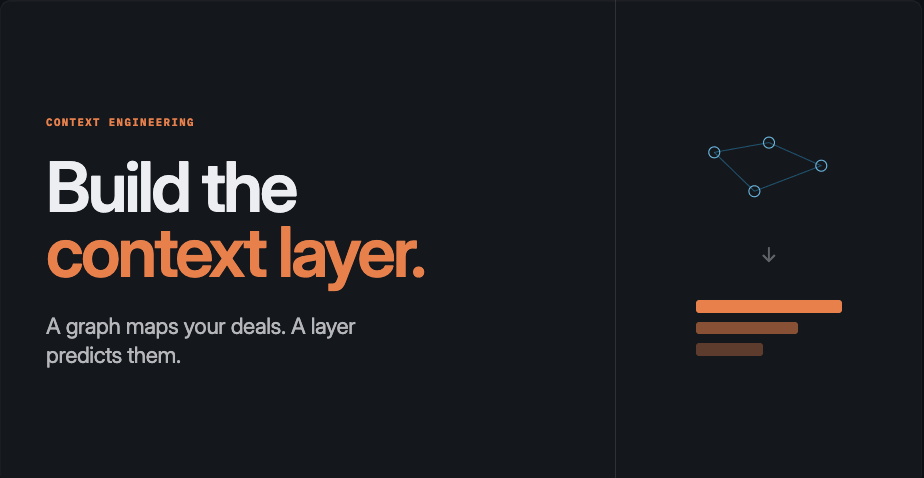
What you actually need to build a predictive model of your GTM is a context layer. A system that doesn't just store what happened, but validates what works, mathematically, against your own closed-won and closed-lost outcomes.
This post outlines the full build behind this:
How to capture deal data as time-series, engineer features from it, train models against revenue outcomes, and test whether your "win patterns" are statistically real or just "vibes." You can build all of this yourself. We'll show you how, including the stack. And along the way, we'll show you why the current wave of context graph vendors can't do it with the architecture they've chosen.
Context graph vs. context layer: the definition that matters
Let's set out some terms, because the market is blurring them:
A context layer contains a graph. But it adds three things a graph alone cannot provide:
- Time-series state capture. Not what the deal looks like today. Its full trajectory, so when things happened becomes analyzable, not just that they happened.
- A feature store. Raw events transformed into model-ready variables (engagement velocity, stakeholder breadth, stage duration) with point-in-time correctness.
- Models trained on revenue outcomes. Real, tested weights for each variable against closed-won and closed-lost.
One describes, the other shows judgment. One is a map, the other is a map with a set of turn-by-turn directions based on the destination and variables along the route. You need both, but the market is selling you a map and calling it GPS.
Why "AI context" tools plateau: won/lost labels plus an LLM is not ML
Look under the hood of most platforms claiming a context graph today and you'll find the same architecture:
Calls + emails → context graph / history → LLM → narrative answer.
The graph re-fetches conversational or deal history and injects it into the prompt. The LLM reads it, and produces an assessment in natural language. Scoring and recommendations come out of the same LLM, as opinion.
For example, Glean built genuinely good enterprise retrieval. Sybill maps buyer relationships and call signals for sales specifically. Clearskies and Von share deal context assembled from your comms. All useful. But that's very different from running dedicated ML infrastructure that scores those relationships against a revenue outcome, with tested significance.
The tell is often in how certain systems handle won/lost data: most use it as a standard label the LLM can see. "This deal is similar to ones you've lost" is a sentence an LLM will happily generate from context. But ask the follow-up questions and the architecture falls apart:
- Similar how? Across which variables?
- Weighted by what? Is stakeholder count more predictive than stage duration in my org, or less?
- At what confidence? On how many deals? Would this pattern survive a holdout test?
An LLM can't answer these, because an LLM doesn't compute. It predicts plausible language.
Which isn't a knock on LLMs. We built our own LLM, and use them heavily in our design (extraction from unstructured data, last-mile generation, translating scores into reasoning a rep can act on). It's a knock on using a language model to do a statistician's job.
So if a vendor claims their platform "learns your win patterns," ask one question: what model architecture produces the weights, and can I see the p-value on the patterns it's surfaced? If the answer is a version of "our AI analyzes your deals," you're buying narrated retrieval, not validated judgment.
Now, let's build the real thing in five steps.
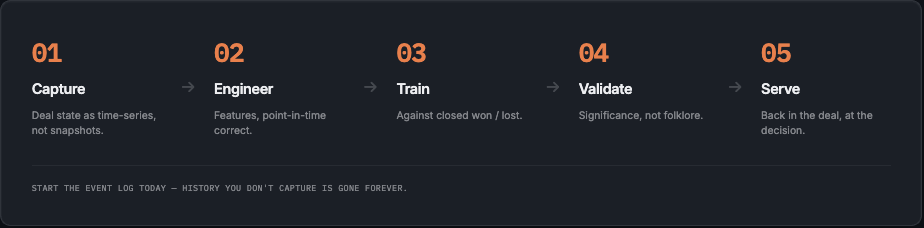
Step 1: Capture deal state as time-series, not snapshots
This is the foundation, and it's where most CRM data fails you before you write a line of ML code.
Your CRM stores current state. Stage: Negotiation. Amount: $120K. Close date: March 31. When the rep updates a field, the old value is gone. Which means you can't answer the question that actually matters for pattern analysis: what did this deal look like at day 14, day 30, day 60, and how did winning deals differ from losing deals at each of those points?
Trajectory is the signal. A deal that added its third stakeholder in week two is a different animal from a deal that added it in week nine, even if both show "3 stakeholders" today. When procurement engages matters as much as whether they engaged. A photo tells you where the deal is. You need the video.
The approach:
- Run change-data-capture on your CRM. Every field change on Opportunity, Contact Role, and Activity objects gets written as an immutable event with a timestamp. Salesforce field history tracking is a start but caps at 20 fields. A proper CDC pipeline (Fivetran, Airbyte, or native platform events into a warehouse) captures everything.
- Store as an event log, not overwritten rows. Type 2 slowly changing dimensions in your warehouse, or a straight append-only event table:
deal_id, field, old_value, new_value, changed_at, actor.
- Join in engagement events. Email sends and replies with latency, meetings with attendee lists and titles, document opens, call transcripts. Every one timestamped and keyed to the deal.
- Build a state reconstruction query. Given any
deal_idand any date, you can materialize the complete deal state as of that moment. This is the function everything downstream depends on.
If you take nothing else from this post: start the event log today. Models can be trained later. History you didn't capture is gone forever, and your first model is only as old as your oldest complete trajectory.
Step 2: Engineer features and put them in a feature store
Raw events don't go into models. Features do. A feature is a computed variable that encodes a hypothesis about what might matter.
This is where domain judgment enters the system, and it's the part nobody can copy from a vendor deck. Some features that have proven predictive across the 150,000+ B2B deal cycles our models train on:
Two engineering requirements separate a real feature store from a spreadsheet of metrics:
- Point-in-time correctness. When you train a model on a deal that closed in March, every feature must be computed as of a date before the outcome, using only information available at that moment. Compute features on final-state data and you've leaked the answer into the inputs. Your model will look brilliant in backtesting and useless in production. This is the single most common way DIY deal-scoring projects silently fail, and it's exactly why Step 1's state reconstruction function exists.
- Reusability and lineage. Define each feature once, with documented logic and version history, and serve it to every model from one source. Feast (open source) or Tecton if you're buying. A disciplined dbt layer with snapshot models if you're building lean. The lineage matters because when a score looks wrong, you need to trace it back through feature logic to raw events.
Step 3: Train against revenue outcomes, and match the model to the question
Different questions, different math. This is what "dedicated ML infrastructure" actually means, and none of it is exotic. (We wrote a full crash course on these model types because it matters that much. AI and LLM are not synonyms. It's like calling every animal a cat.)
How each earns its spot:
- Regression is your explanatory workhorse. Take 15 deal attributes, regress against closed-won. Now you know where coaching time goes and where it's wasted. Start here. It's interpretable, it's fast, and its coefficients are the beginning of your org's actual (not assumed) sales methodology.
- GBDTs are your scoring engine. Hundreds of sequential trees, each correcting the errors of the last. A new deal enters pipeline and runs through 500 rounds of gradient-boosted decisions against your feature store. The output isn't "this deal feels good." GBDTs also capture interaction effects regression misses: budget mention carries a 0.43 outcome weight, but only in enterprise deals over $100K with 3+ stakeholders. Below that threshold it's noise. A tree finds that split. A prompt never will.
- KNN is your evidence engine. "Six deals matching this profile stalled after losing champion access post-pricing" is guidance a rep will act on. Generic best practices are not.
- Survival models separate win probability from cycle time. Two different questions. Most tools conflate them.

Step 4: Validate significance, or you've just built expensive folklore
This step is what separates a context layer from a context graph with confidence issues. It's also the step the LLM-only architecture structurally cannot perform, because you can't compute a confidence interval on a narrative.
The discipline:
- Hold out a test set. Train on 70-80% of historical deals, test on the rest. Report performance (AUC for classification, calibration curves for probability quality) on data the model never saw. K-fold cross-validation if your deal count is modest.
- Demand significance before you preach a pattern. "Deals with exec sponsors win more" needs a p-value and an effect size before it becomes a stage-gate in your process. With a few hundred deals, plenty of patterns will appear by chance. Test them.
- Report confidence alongside every score. A 72% win probability on a segment with 900 historical deals means something different than 72% on a segment with 40. Surface the interval, not just the point estimate.
- Watch for leakage and drift. Leakage: any feature computed with post-outcome information (Step 2). Drift: your ICP shifted, your pricing changed, and the 2024 patterns quietly stopped holding. Retrain on a schedule and monitor feature distributions.
- Be honest about sample size. Under ~150-200 closed deals, lean on regression and KNN, keep features few, and treat outputs as directional. GBDTs on 60 deals will overfit and lie to you with confidence. (This is also where cross-org pattern seeding earns its keep. More on that below.)
Run this loop and something better than a dashboard falls out: a ranked, tested, org-specific list of what actually moves your win rate, your ACV, and your cycle time. That's a GTM model with judgment. Most orgs are running on a GTM model made of anecdotes from the last QBR.
Step 5: Serve it back where selling happens
A context layer that lives in a BI tool is a research project. The serving layer is what makes it operational:
- Push, don't publish. "This deal matches the profile of six that stalled last quarter after losing champion access post-pricing. Re-engage before the proposal goes out." Delivered in the deal, at the decision. Not in a Monday dashboard.
- Expose it over MCP. Serve scores, weights, and nearest-neighbor evidence as tools any agent or copilot can call. Your context layer becomes the judgment source for every AI touchpoint in your stack, instead of another silo. (This is how we built our own context engineering layer, pre-materialized and served over MCP.)
- Close the loop. Every recommendation, every rep action, every outcome flows back into the event log as training data. Better predictions drive more use, more use produces more traces, and the gap widens every cycle. A flywheel that doesn't complete its loop is just potential energy.
The DIY Reality
Everything above is buildable with open tooling:
If you have a data engineer and a data scientist with a couple of quarters, do it. Genuinely. Your win patterns are yours, and the org that encodes them compounds against the org that doesn't, whoever does the encoding.
What the tutorial version undersells is the operations:
- Point-in-time correctness across every feature, forever
- Retraining schedules and drift monitoring
- The cold-start problem when your org has 80 closed deals and needs cross-deal priors from somewhere
- Confidence calibration that stays honest as your segments shift
This is a permanent MLOps function, not a project. It's why the LLM-wrapper vendors skipped it. Prompting a context graph ships in a quarter. ML infrastructure trained on revenue outcomes takes years and a corpus.
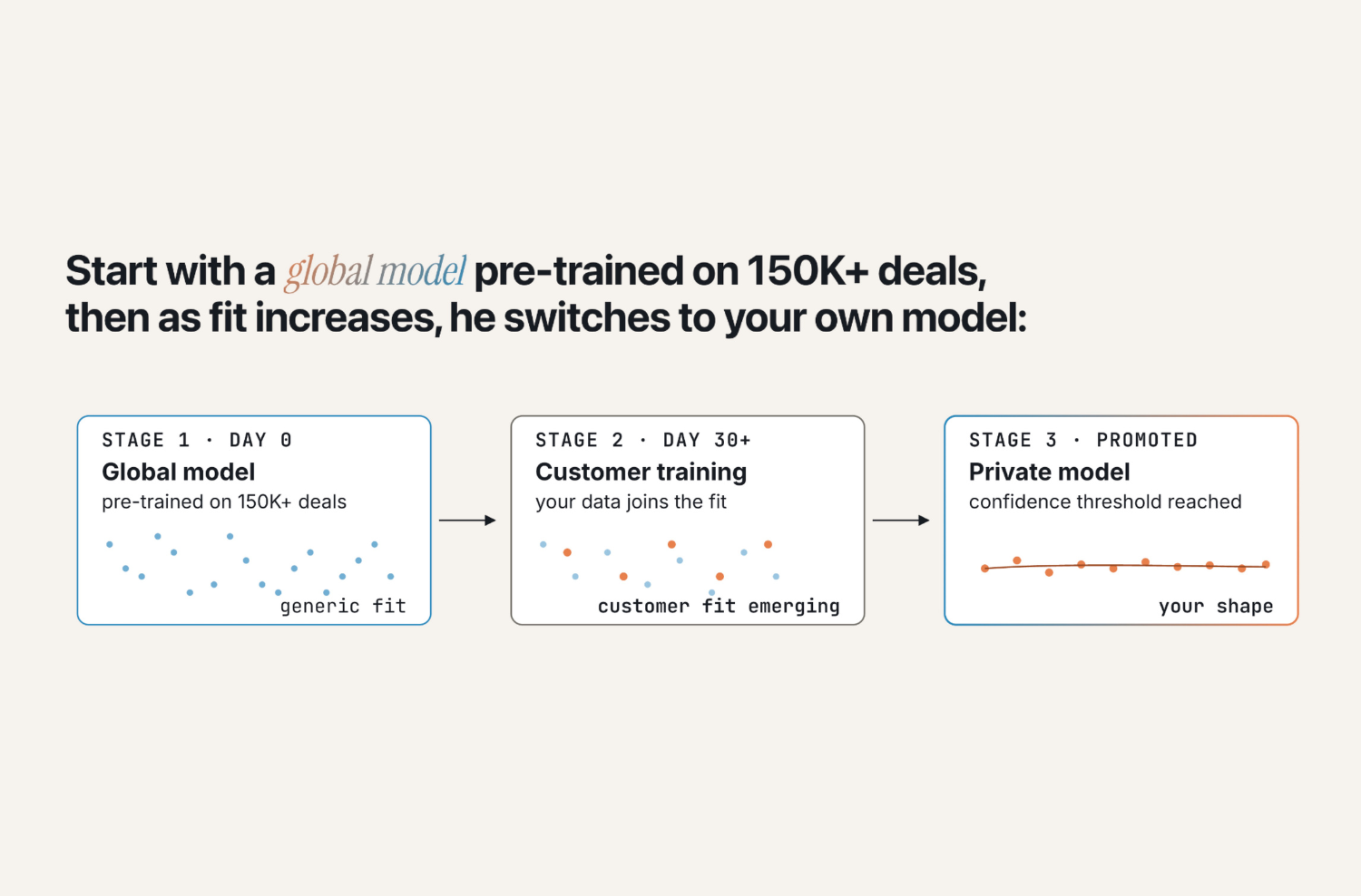
That's the gap Loop exists to close. It runs this entire pipeline as product: the time-series ETL, the feature store, and private, org-scoped models (GBDT, KNN, regression, the works) trained on your outcomes, with weights that stay yours. Seeded by Olli Mesa, a model purpose-built on 150,000+ complex B2B deal cycles, so you get statistically grounded patterns on day one instead of year two.
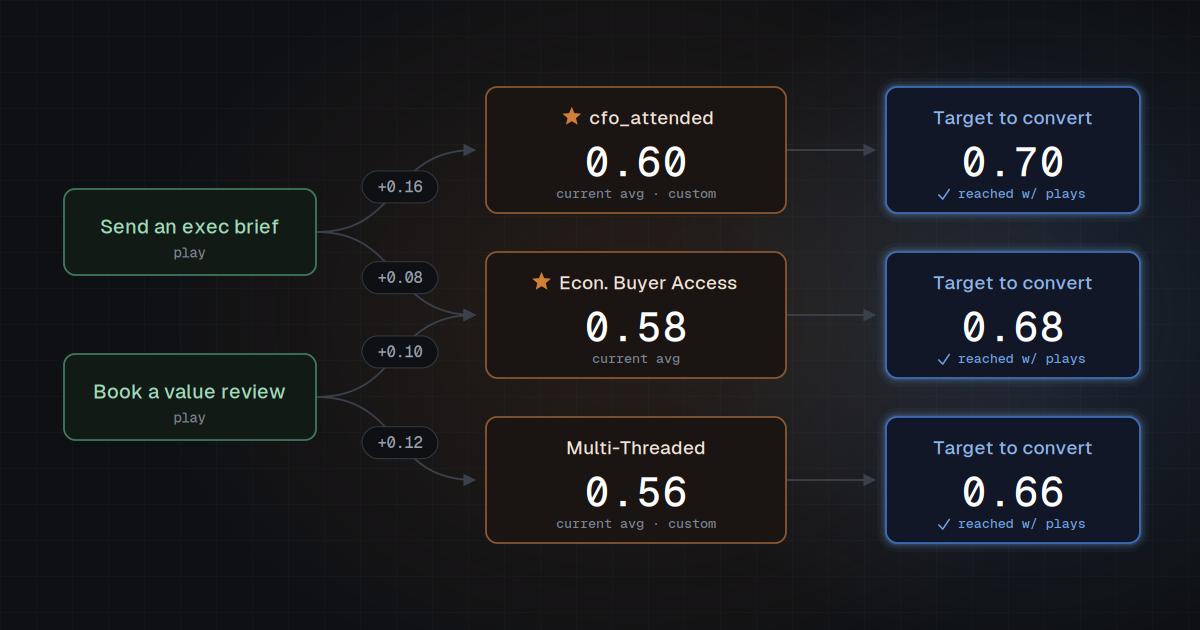
You configure predictors ("we hired a value engineer, did it move the needle?"), Loop handles the ML. No feature engineering homework. No MLOps hires.
Either way, build the layer, not just the graph. The map is table stakes now, judgment is your "moat."
See your own win patterns, validated against your own outcomes.
FAQ's on:
How to Build a Context Layer for GTM | Fluint
A context layer is the infrastructure that turns your go-to-market data into validated judgment. It captures deal state as time-series data, transforms events into model-ready features, and trains ML models (regression, gradient-boosted trees, nearest-neighbor) against your closed-won and closed-lost outcomes. The output is tested, weighted answers about what actually drives wins in your org, served back into the deal workflow.
A context graph stores facts and relationships: who talked to whom, which documents connect to which deals. It powers retrieval. A context layer adds outcome-trained ML on top: it assigns statistical weight to each variable against revenue outcomes, so it can predict and prioritize, not just describe. The graph tells you your champion met the CFO. The layer tells you how much that meeting moves win probability in your org, and at what confidence.
Not reliably. An LLM can read deal context and generate a plausible-sounding assessment, but it doesn't compute weights, can't report confidence intervals, and gives different answers to the same question. LLMs are excellent at extracting signals from unstructured data (calls, emails) and translating model outputs into readable reasoning. The prediction itself should come from trained ML models: deterministic, benchmarkable, and validated on holdout data.
Four cover most of the ground. Logistic regression calculates the explanatory weight of each variable against closed-won (which attributes matter, and by how much). Gradient-boosted decision trees (XGBoost) score live deals and capture interaction effects, like signals that only matter above a certain deal size. K-nearest neighbors finds the historical deals most similar to a live one and shows what happened to them. Survival analysis models cycle time: when a deal will close and which variables drag the timeline.
More than most teams have, honestly. Under roughly 150-200 closed outcomes, complex models like GBDTs will overfit and produce confident nonsense. Below that threshold: use regression with a small feature set, lean on nearest-neighbor comparisons, treat everything as directional, and consider seeding with cross-org patterns from a model trained on a larger corpus while your own event log accumulates.
Test it like a scientist, not a storyteller. Hold out 20-30% of historical deals the model never sees during training and measure performance there. Require a p-value and a meaningful effect size before a pattern becomes process. Report confidence intervals with every score, retrain on a schedule, and monitor for drift as your ICP and pricing evolve. If a vendor can't show you this validation loop, the "patterns" are opinions with a UI.
Why stop now?
You’re on a roll. Keep reading related write-up’s:

Deal-winning context that changes the outcome

Now getting more call transcripts into the tool so I can do more of that 1-click goodness.



The buying team literally skipped entire steps in the decision process after seeing our champion lay out the value for them.


Which is what Fluint lets me do: enable my champions, by making it easy for them to sell what matters to them and impacts their role.

