

The Ultimate Mid-Funnel Sales Plays: Top 5 Moves to Unstick Your Deals



TL;DR
Deals don't die from one big no. They die from a thousand stalled micro-decisions, and pushing harder clears none of them. Winning the mid-funnel means running the one play that unblocks the next decision, and the hard part is no longer drafting that play. It's knowing which one this deal needs, and when. Below are five plays that work, plus a repo of deployable agents that run them against your pipeline.
We like to pretend the sales process is a straight line: Stage 1 → Stage 2 → Stage 3. Check each box, revenue falls out the bottom. Anyone who has carried a bag knows that's not how buying works.
A buying decision isn't one big "Yes" at the end of the quarter. It's the product of dozens, maybe hundreds, of micro-decisions made along the way.
Should I take this meeting? Is this worth escalating to my boss? Do I have the energy to fight for budget mid-year? Does this problem matter enough to risk my reputation on?
Your job is to engineer the buying behaviors that lead to those small decisions, and to help the prospect make progress through their own internal chaos. The "standard process" breaks the moment a real human enters the equation.
Real selling is modular. You select the play that targets exactly where the friction is, then sequence the next one to cut through it. Think Lego blocks. You don't build the same castle every time. You look at the account, you look at the buying group, and you grab the components you need to build a path forward for them.
The hard part was never running the play. It's knowing which one this deal needs.
A foundation model can draft any of these in seconds. What it can't do on its own is tell you which move this deal needs, for which stakeholder, at this exact moment, based on what has closed before. That's not execution. That's judgment, and judgment is the part that stays scarce.
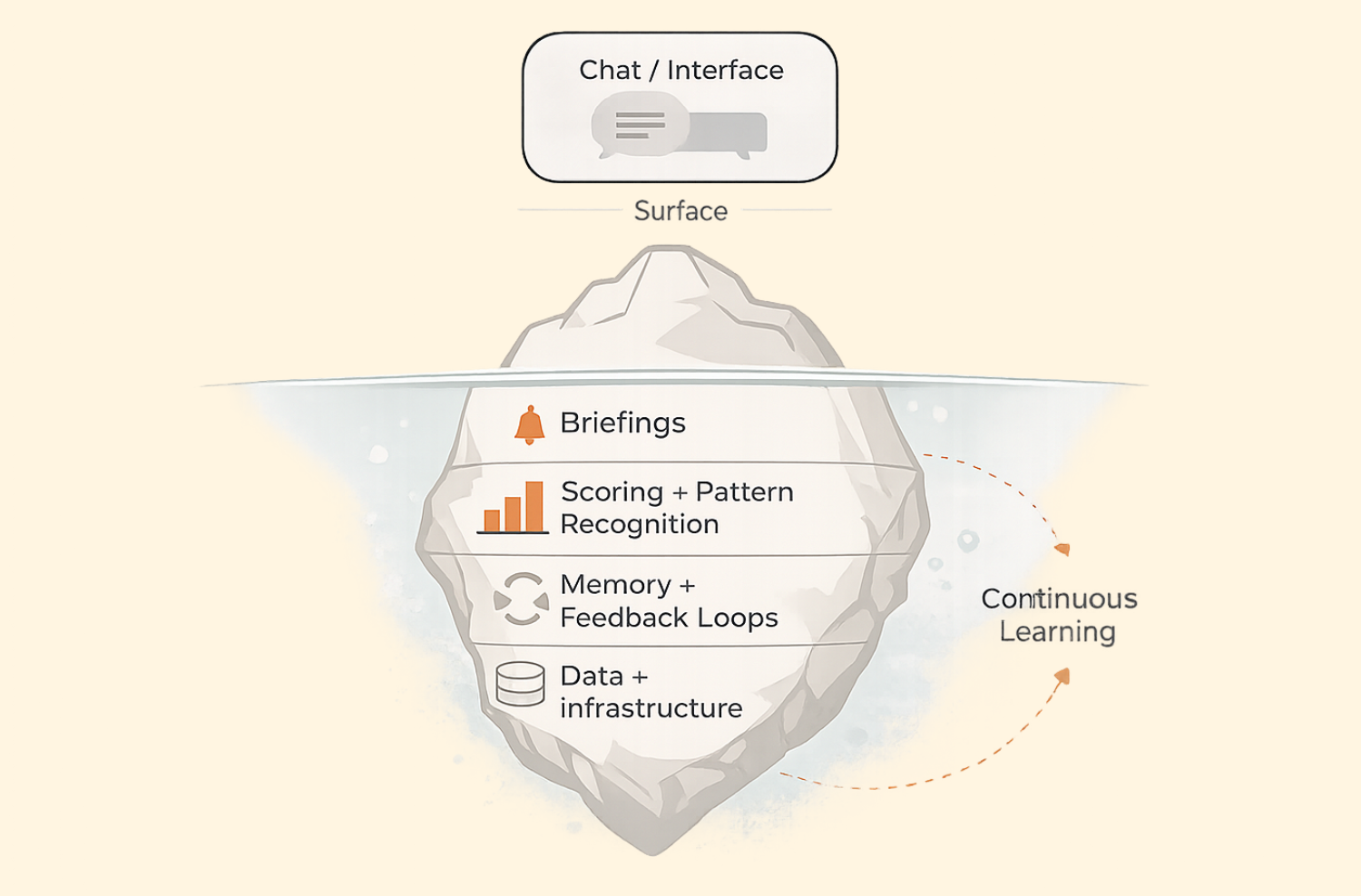
Judgment is what Fluint encodes. Loop, our context layer, sits underneath any agent and feeds it patterns drawn from 150,000+ outcome-linked deal cycles: which moves unstuck deals that looked dead, for which buyer profiles, at which stage. The five plays below are the ones that surfaced again and again across that data. Here they are, ready to deploy.
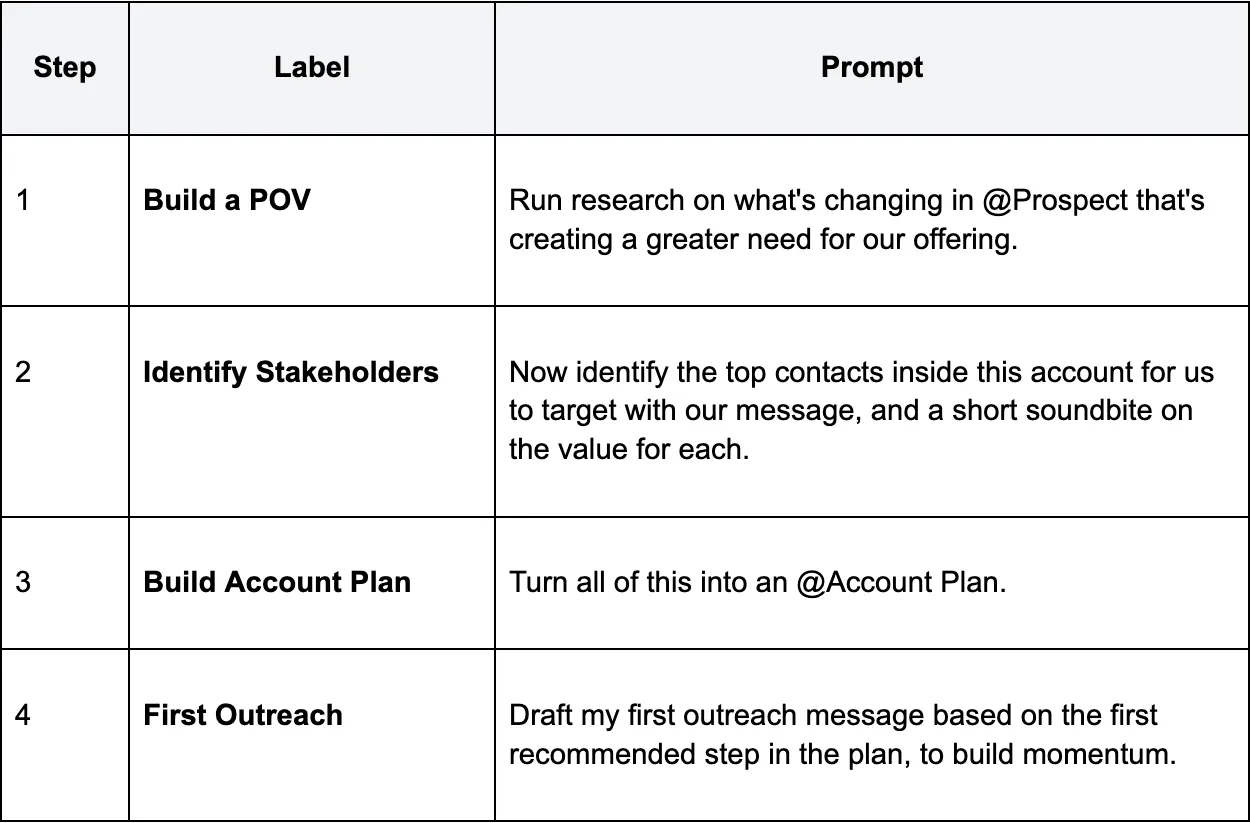
1. Building a Point of View and Account Plan
Why deals stall
Most reps show up empty-handed. They treat the first few interactions like an interrogation: "What keeps you up at night?" They ask because they haven't done the work to figure it out themselves.
Lead with questions instead of a point of view and you force the buyer to do the heavy lifting. You're asking them to teach you about their business before you've proven you understand it. That creates friction immediately. The buyer feels pitched, not advised. They disengage because they don't see a peer. They see a vendor.
Why this play
You earn the right to ask questions by leading with a Point of View.
A POV isn't a pitch about your product. It's a hypothesis about their business. It connects an external shift in the market to the internal pressure they're feeling right now. Walk in and say "I see X is changing, which usually means Y problem for teams that have Z," and you're not selling. You're guiding.
It works because it flips the dynamic. You generate interest by showing the buyer a version of their reality they may have missed.
The Play
2. The Discovery Debrief
Why deals stall
Surface-level discovery kills more deals than pricing or objections ever will.
Reps ask the standard questions, get the standard polite answers, then send the standard follow-up: "Great chatting, here's the deck." No synthesis. No business case. The buyer leaves with a vague sense that the call was nice and zero urgency to change. The deal stalls because the rep never translated the conversation into a problem statement that hurts enough to fix.
Why this play
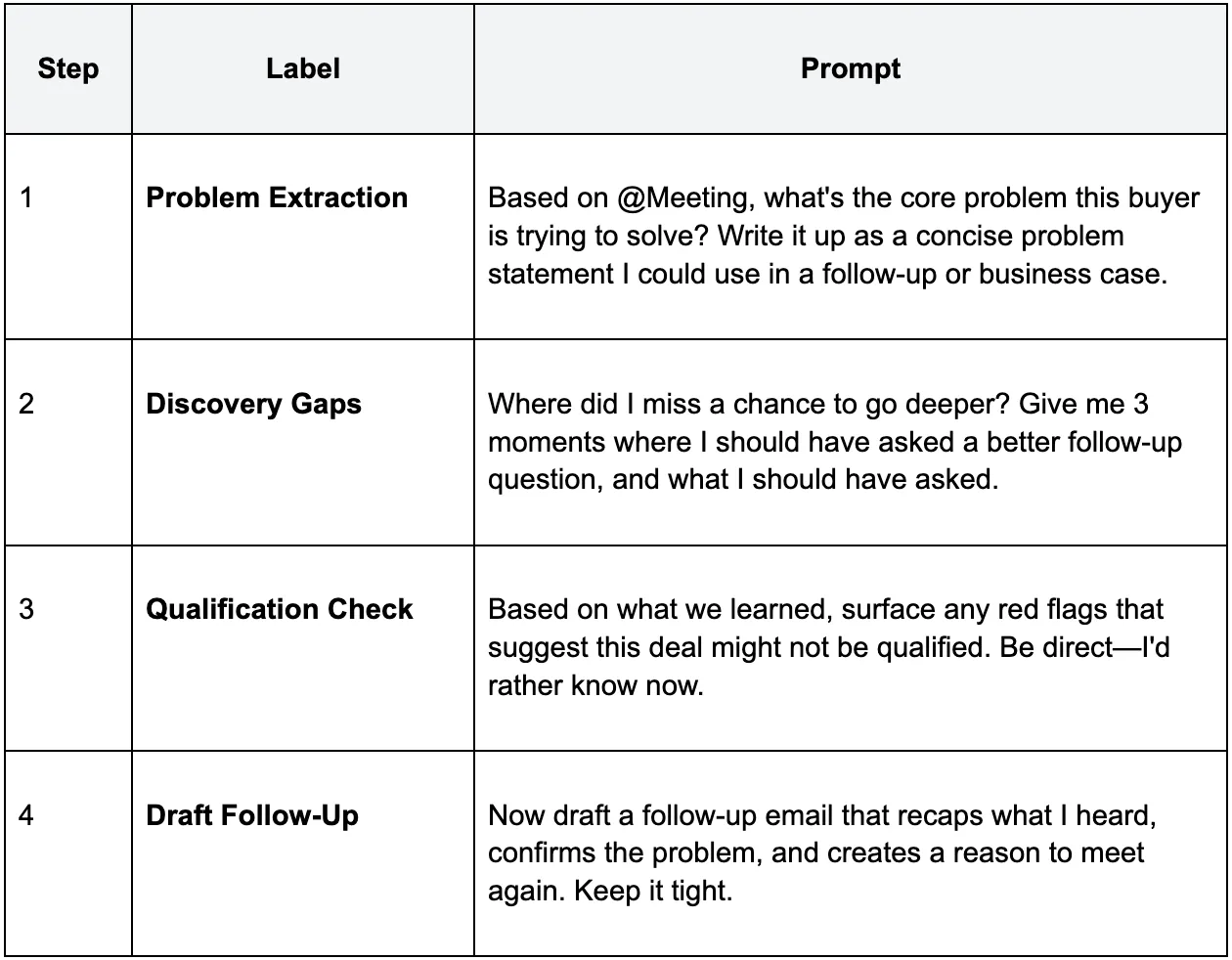
Discovery isn't over when the call ends. That's when the real work starts.
The best reps synthesize immediately. They don't transcribe notes, they hunt for gaps. They flag where they went shallow and need to go back. They sharpen a problem statement until it's something the champion would put their name on internally.
The play forces rigor. It proves you understood the buyer better than they understand themselves, and a follow-up that articulates their problem more clearly than they did is the fastest way to build trust.
The Play
3. Group Demo Follow-Up
Why deals stall
You demo for six people. One is nodding, two are skeptical, three are multitasking on mute.
Afterward, most reps send one generic "thank you" to the whole group. Nobody responds. Why would they? That email wasn't for them. It was a broadcast, and it ignores how group buying actually works: different stakeholders care about wildly different things. The CFO doesn't care about the interface. The end user doesn't care about contract terms. Treat them as a monolith and you lose the nuance that drives consensus.
Why this play
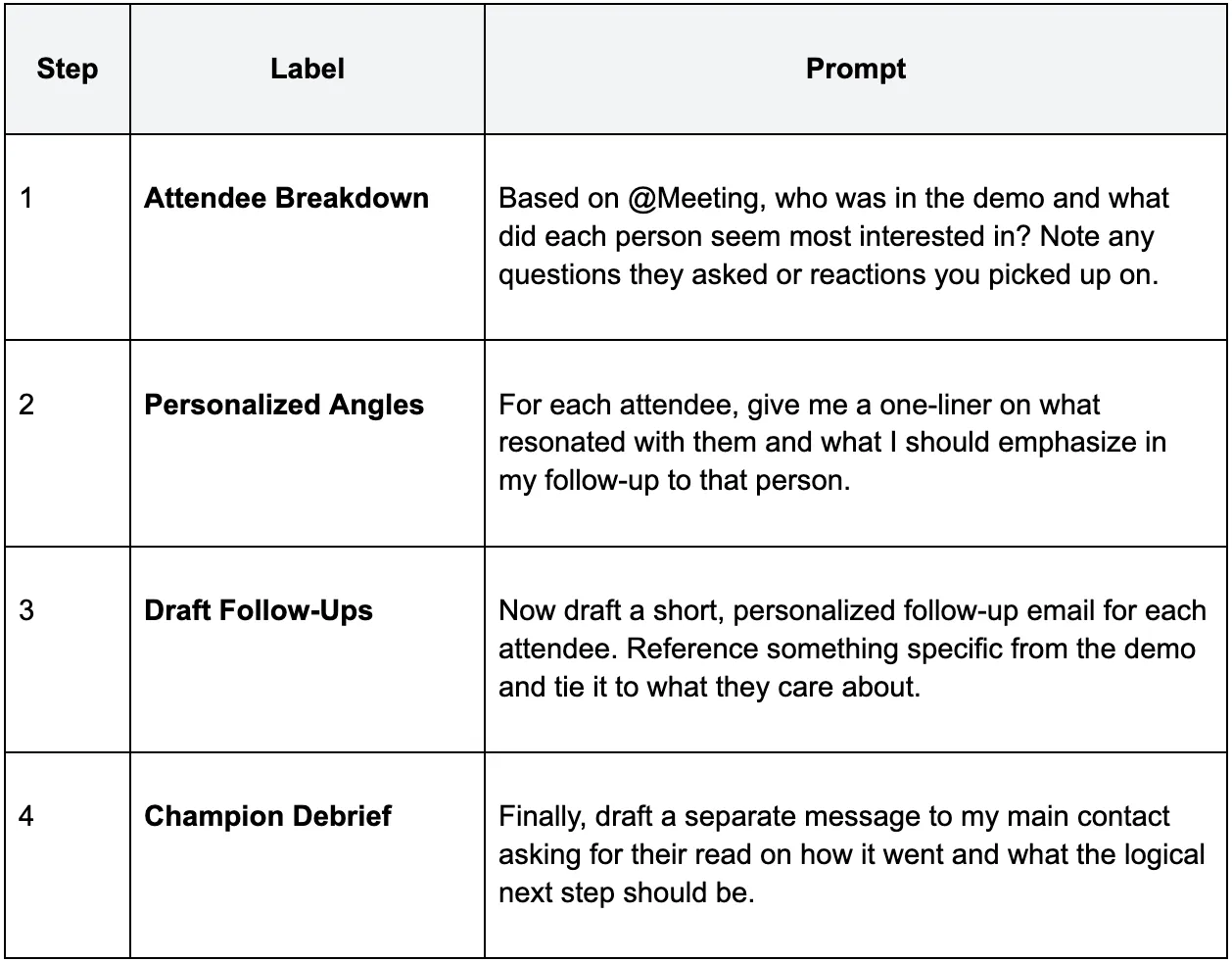
The rep who wins follows up like they were actually paying attention.
They send individual messages that reference the specific question someone asked or the reaction they had. "Susan, you perked up at the API integration, here's the documentation." "Mark, you asked about security, here's our SOC 2 report."
The play turns a demo into momentum by treating the buying committee as a collection of individuals. It proves you were listening, and it hands each person the ammunition they need to advocate for you in the rooms you're not in.
The Play
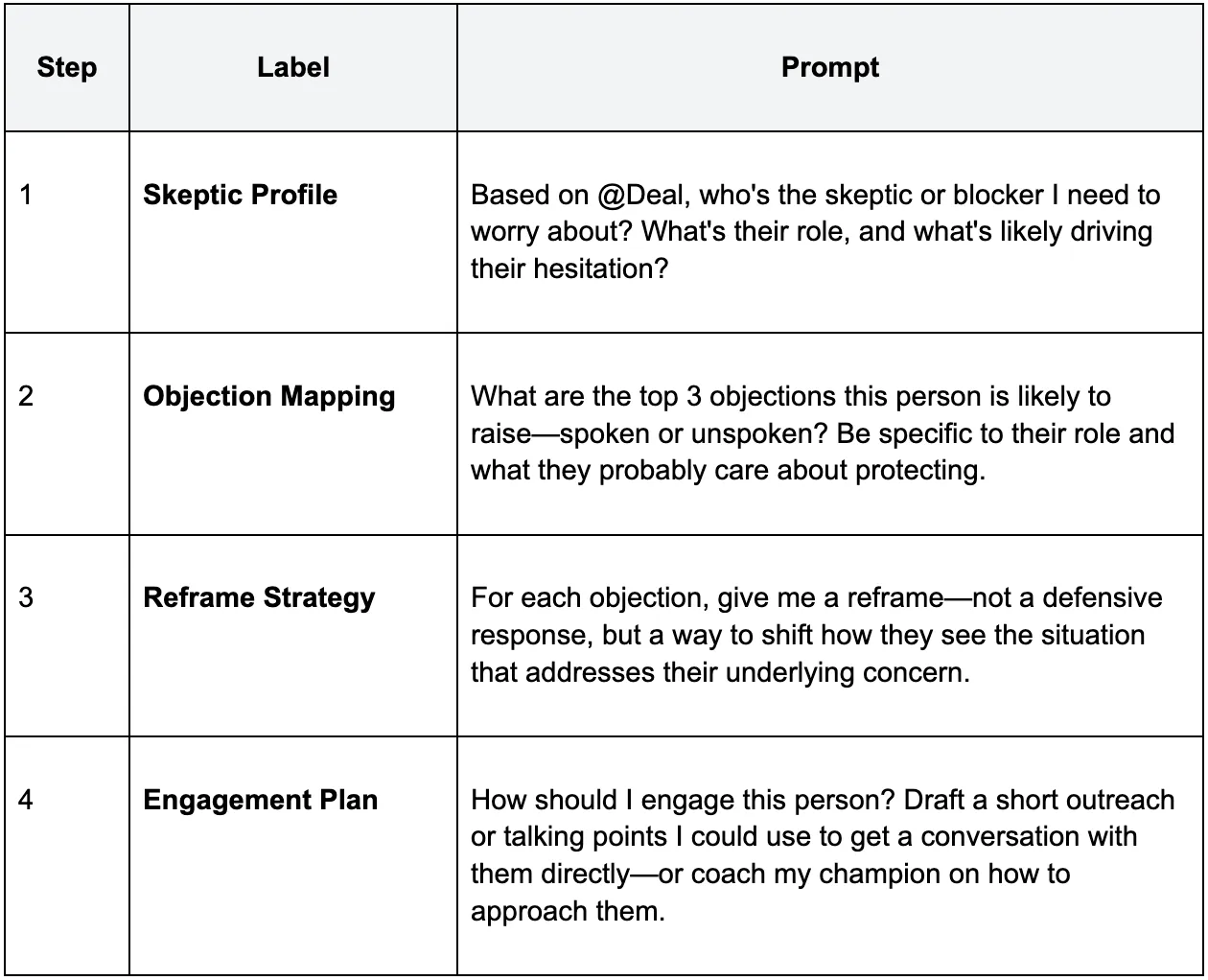
4. Targeting the Skeptic
Why deals stall
There's always someone who isn't bought in. Maybe IT is worried about implementation tickets and a backlog. Maybe a manager vouched for the legacy system. Most reps try to ignore this person and hope the champion can steamroll them. Or worse, they "handle" the skeptic with canned objection responses that sound defensive.
Ignoring the skeptic doesn't make them disappear. It guarantees they'll kill your deal in a private thread you'll never see.
Why this play
Skeptics aren't enemies. They're usually the most honest people in the deal. They're protecting something: budget, time, security, internal capital. If they're pushing back, it's because they see a risk your champion is downplaying.
The move isn't to overcome them. It's to validate them. Understand what they're protecting and reframe your solution so it serves that interest rather than threatening it. Turn a skeptic into a neutral party, or even an ally, and the deal unblocks.
This is a judgment call, not a script. The Agent profiles the hesitation against deals where the same objection showed up and drafts a strategy to address it head-on, grounded in what actually worked on those deals.
The Play
5. Stuck Deal Diagnosis
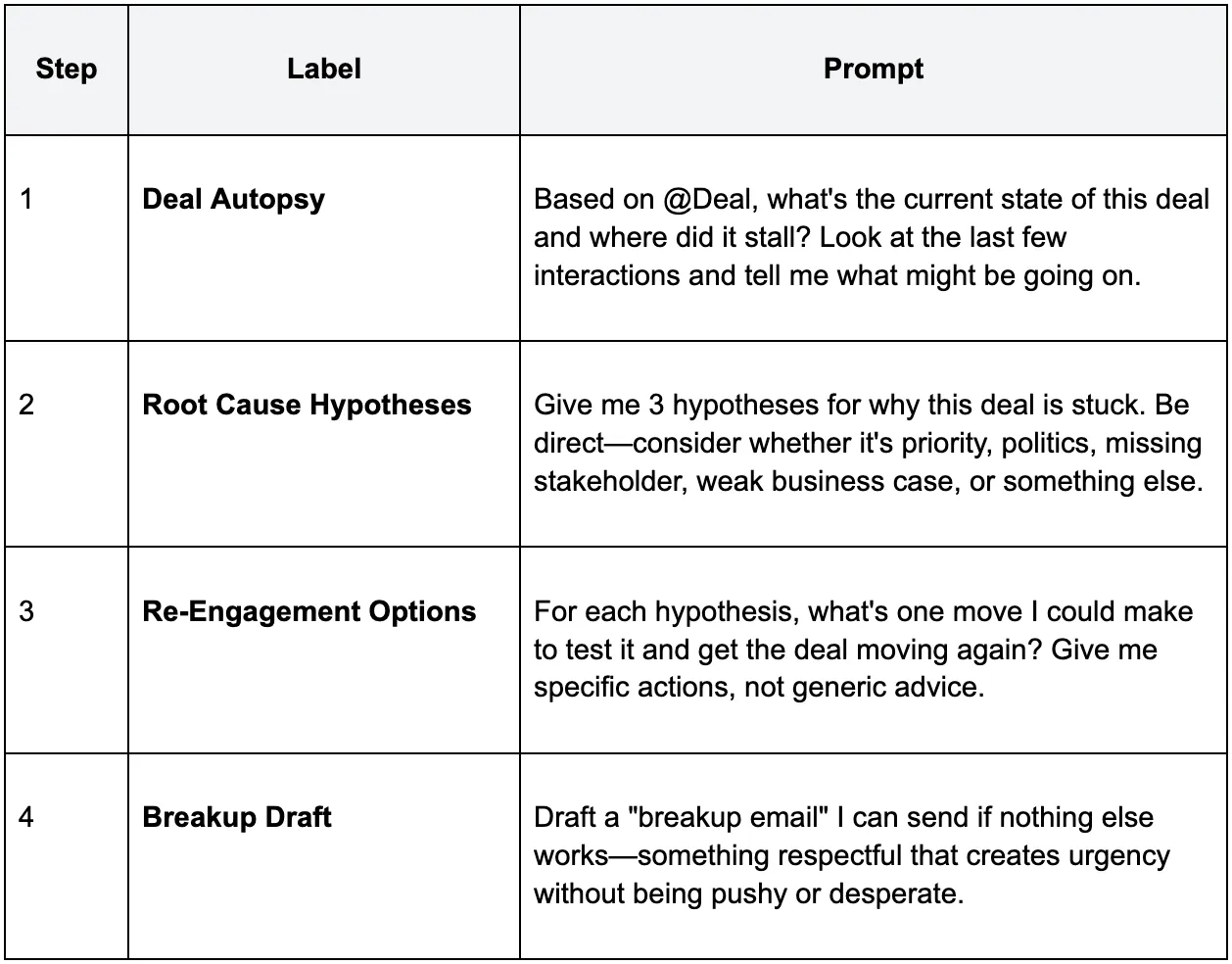
Why deals stall
You had momentum. Now you have silence. Emails go unanswered. Meetings get bumped. The champion says they're "still interested," but nothing moves.
The instinct for most reps is to push harder. "Just bubbling this up!" "Checking in!" More emails, more pressure. It doesn't work. Deals don't stall because buyers forgot. They stall because something changed internally: priorities shifted, a stakeholder pushed back, the business case didn't land. Pestering doesn't fix the blocker. It just makes you annoying.
Why this play
Stop selling and start diagnosing.
Run a deal pre-mortem before the deal dies. Hypothesize the real blocker. Is it politics? Budget? A missing stakeholder? Once you have a hypothesis, test it. Send a message that names the elephant in the room. Give them an out. Change the angle. The play breaks the mindless follow-up cycle and forces a decision: either you re-engage on new terms, or you part ways. Both beat limbo.
The Play
Build Your Own Process
These five are a slice of a much larger motion that spans the entire buying journey, from first outreach to procurement.
You don't run all of them on every deal. That's the point. You grab the block you need, when you need it.
You also don't have to run them all by hand. We put working, deployable examples on GitHub: agents that run these plays against your real stack on a webhook or a nightly schedule, then hand the output to your reps where they already work, in HubSpot, Gong, Slack, Gmail, and Drive. Fork one, point it at your tenants, and ship.
Browse the agent quickstarts on GitHub →
The types of plays an agent can run
Each of these is a self-contained project in the repo, not a concept. Several are the plays above, automated:
- Deal risk alerts to Slack. A nightly scan flags the deals going dark, stalling in stage, single-threaded, or missing a next step, then DMs each rep a prioritized list with a specific next move drafted for every one. Play 5, running before anyone opens Salesforce.
- Gong call to HubSpot summary. When a call ends, the agent synthesizes the transcript, pulls the next steps, and writes a deal note and tasks straight back to HubSpot. The Discovery Debrief, minus the manual write-up.
- Post-call follow-up email. After that same call, it drafts a forwardable recap in the customer's own language and leaves it as a Gmail draft for the rep to send.
- Multi-thread nudge. A late-stage deal that's still single-threaded triggers personalized outreach to one to three more stakeholders, with a nudge to the rep in Slack.
- Champion enablement kit. The moment a deal hits Proposal or Negotiation, it generates a business case, a stakeholder map, and an executive summary in the customer's language, saved to Drive and linked on the deal.
- Weekly pipeline digest. Monday morning, it synthesizes the whole pipeline (closed, moved, stalled, new, coverage gaps) into a written digest for the sales leader.
Each is versioned and editable. Change the system prompt, swap the trigger, add your own.
The judgment underneath the plays
Any agent can write a business case or a follow-up email. The frontier models made that part free. What separates a play that moves a deal from one that reads like every other vendor email is judgment: which move, for which stakeholder, at which moment, based on what's closed before.
That judgment is what Fluint's context layer holds. Loop pre-materializes context enriched with patterns from 150,000+ outcome-linked deal cycles, so an agent works from the deals that looked like this one and the moves that unstuck them, not a blank, generic model. The quickstarts show the workflow. Loop is what makes the judgment behind it yours.
Want to see it on real deals in your pipeline? Start an integrated pilot.
FAQ's on:
Why stop now?
You’re on a roll. Keep reading related write-up’s:

Deal-winning context that changes the outcome

Now getting more call transcripts into the tool so I can do more of that 1-click goodness.



The buying team literally skipped entire steps in the decision process after seeing our champion lay out the value for them.


Which is what Fluint lets me do: enable my champions, by making it easy for them to sell what matters to them and impacts their role.

