
The AI stack that pays for itself.

Deploy a private LLM trained on your GTM data, enriched with contextthat learns from what's actually closing deals. All for one fixed cost, and zero usage spikes.
Loop
Context Engineering
MCP + revenue attribution
See loop
Model
Private LLM
Your data, fixed cost
See Model
Agent
One agent, every seller
Fully managed, deploy today
See Agent
Trusted by

Better context. Faster. For a fraction of the cost.

Same prompt. Two paths. Watch how Fluint's pre-enriched context changes what your agent returns — and what it costs.
With Fluint
TIME
0.0s
MCP CALLS
0
TOKENS
0
"Build me the business case for Acme Corp's renewal."
context.deal Acme Corp
args: "acme_corp_renewal"
↳ returned 4 entities · 11 citations · ~2,137 tokens

Acme Corp qualifies for a 12% loyalty discount based on 3+ year tenure and ARR > $500K. source: pricing_policy_v2026.md

An account-specific override supersedes the standard loyalty tier. source: overrides/acme_corp_001.yaml

Champion Sara Chen (ex-Halliburton) is driving the renewal; CFO attended the last QBR — deals with CFO attendance close at 3.5× the rate in your history. source: loop · n=11 cohort

[done · 1 MCP call · 2,137 tokens · 2.1s]
Traditional agents
TIME
0.0s
TOOL CALLS
0
TOKENS
0
"Build me the business case for Acme Corp's renewal."
◇ I need to find Acme Corp's contract details. Let me search…
⊕ tool_call #1 search_crm
args: "Acme Corp account details"
↳ returned 3 chunks · ~4,200 tokens added to context
◇ There's a reference to a contract amendment I don't have context on.
⊕ tool_call #2 search_contracts
args: "Acme Corp amendment"
↳ returned 4 chunks · ~6,000 tokens added to context
◇ Synthesizing current contract state. Moving to usage metrics.
⊕ tool_call #3 search_usage
args: "Acme Corp consumption Q1 2026"
↳ returned 6 chunks · ~10,000 tokens added to context
◇ Reading usage data. Computing consumption vs. commitment thresholds annually…
⊕ tool_call #4 search_policies
args: "renewal discount qualification rules"
↳ returned 3 chunks · ~3,800 tokens added to context
running…
9x
Faster
11x
fewer tokens
1
call vs. 4
sourced & Cited
The problem

Your AI Stack is costing more, delivering less, and leaking data.

Generic models. Usage-based pricing that only goes up. Context scattered across tools no one governs. Sound familiar?
The Problem

Three gaps, your current AI stack can't close:

01 · CLOSED LOOP

No way to tie agent work back to revenue.
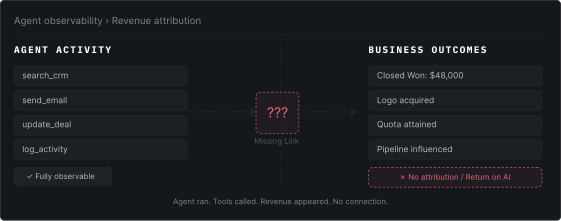
You can see when an agent ran and the tools it called. But there's no way to prove the revenue impact:
Fluint solves the problem of having no way to tie agent work back to revenue.
02 · JUDGMENT

Context confetti spread across systems
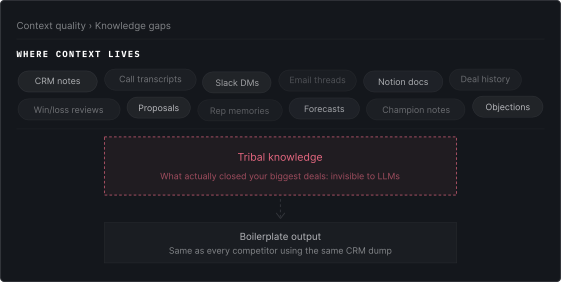
The tribal knowledge behind your biggest wins is invisible to LLM's. So reps and agents rely on generic CRM dumps and transcripts, leading to the same boilerplate output your competitors get.
Fluint solves the problem of context confetti spread across systems
03 · BURN RATE

"Wait, we spent how much this month?"
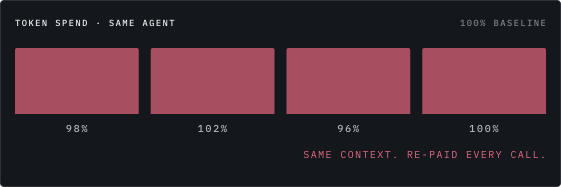
Every agent re-reasons over the same context, using premium models. Instead of matching the right model to the task, and processing it 1x across the company.
Fluint prevents runaway token usage and cost overages by agents.
HOW IT WORKS · 3 LAYERS, ONE LOOP

The right context —
engineered from your data, to revenue, and back
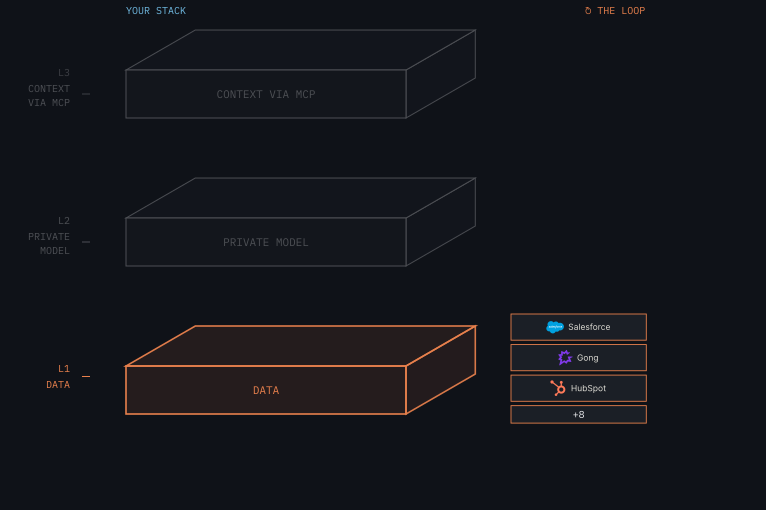
Build, test, and deploy AI agents that actually understand your revenue data — and improve every time they do.
L1
Data

Your complete GTM dataset, in one clean and unified layer

Loop reads activities from the revenue systems you already run (CRM, conversations, emails, data warehouse) and joins them to the outcomes you already report on: cycle times, ACV, win rates, etc.

How it works
01
Integrated
Salesforce, Gong, Outreach, Clari, HubSpot, Salesloft, Dynamics and more: live reads, directly from your existing systems.
02
agent activity capture
Tool calls your agents make are logged in real time and joined alongside CRM records, not stashed in a separate dashboard.
03
REVENUE IMPACT
Data ETL to create a time-series schema, to track patterns over time, instead of the flat file you typically see in tables with row IDs.
L2
Private model

A model trained on your GTM motion, not the market's.

Loop deploys, tunes, and monitors your own private, in-house ML models for you (without needing ML engineers).

How it works
01
ACTIVITY → REVENUE
Which behaviors correlate with closed-won in your business. Built from your revenue history.
02
DEAL TRAJECTORY
What healthy deals look like, vs. what drift looks like, detected weeks before deals slip.
03
VERSIONED
Built like code: each model is auditable and observable, so you see what and explain why.
L3
CONTEXT VIA MCP

Context, pre-enriched and routed to any agent or tool.

Revenue "judgment" is pre-processed and bundled into context served to agents over MCP. So all agents (Claude, OpenAI, Glean, etc.) reads the same context the same way.

How it works
01
PRE-BUILT, SOURCED
Must-know context served to your agents, conserving token counts and spreading the workload across more efficient models.
02
ONE MCP ENDPOINT
A single MCP call for critical and complex revenue work, instead of managing 4 - 5 calls across multiple separate tools in your stack.
03
CITED OUTPUT
Every tool call carries rich context traced back to a specific learning from your GTM.
L4
The loop

Actions, outcomes, and learning, looped back through.

Agent activity becomes new GTM data. Outcomes arejoined to the action that drove them. And the model retrains so the next request gets sharper context.

How it works
01
AGENT ACTIVITY → DATA
Every recommendation, draft, or score lands as new data alongside the deal it touched.
02
OUTCOMES → MODEL
Closed-won, lost, stalled: matched to the action that drove them, retrained daily.
03
MODEL → NEXT AGENT ACTION
MCP carries the patterns you just learned. Same agent, sharper context, every cycle.
No lock-in

Your context, anywhere you run agents, today and tomorrow.

Loop sits on whatever you've already built. So you can swap models, vendors, or your whole stack. Your context layer comes with you, to create flexibility as things change.
YOUR
CONTEXT
Gemini logo Gemini
Microsoft Copilot logo Copilot
Notion logo Notion
Salesforce Agentforce logo Agentforce
HubSpot Breeze logo Breeze
Glean logo Glean
Claude logo Claude
OpenAI logo OpenAI

Every quarter starts at $0.
Your context layer shouldn't.
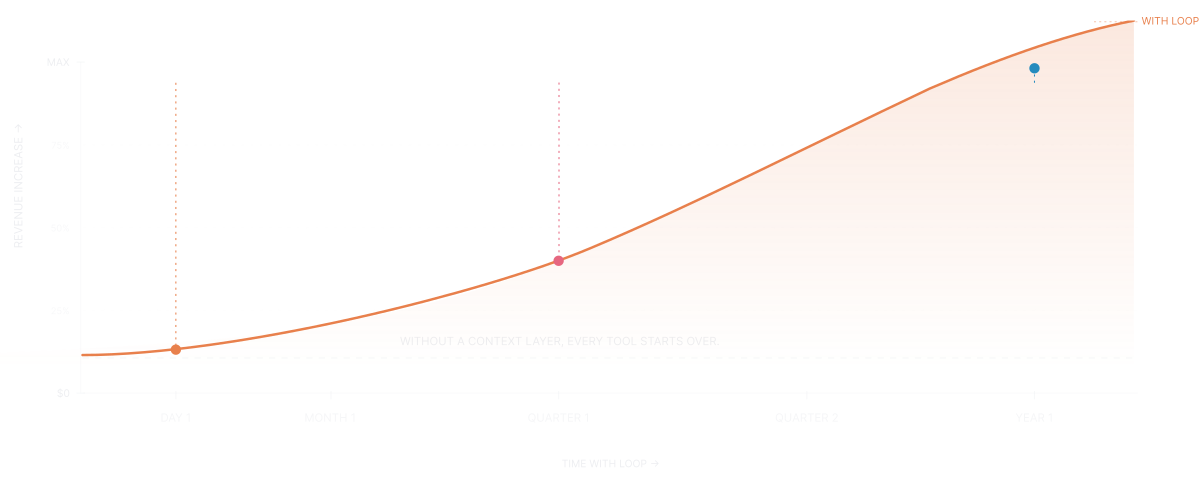
A self-improving system that learns from every closed deal and lifts the floor for every agent that calls it.
A graph showing how Fluint's loop agent can improve over time.
Day 1
-30%
token spend
Quarter 1
92%
plays acted on
year 1
3.5x
close-rate
Day 1

Cut token spend with pre-materialized context.

Same agents. Sharper output. You pay for the answer, not the inference Loop already did this morning.
quarter 1

Every action tied to a revenue outcome.

Tool calls map to closed-won, ACV, cycle time. The data your CRO actually wanted when they asked about AI strategy.
year 1

A model that compounds, not dashboards that age.

A private model trained on every hard-won outcome your team's earned. The longer you run it, the further ahead it puts your team vs. the competition.
Security

Enterprise-ready from day one.

Your revenue data is the most sensitive asset you have. SOC 2 Type II, SSO/SAML, role-based permissions, private org-scoped models, and dedicated support.
SOC 2 Type II
SSO / SAML
Role-based permissions
Private weights, never shared
AICPA
SOC 2
aicpa.org/soc
SSO
SAML
Getting Started

From signup to first context call in one session.

1

Sign up free

Free workspace, no credit card. We provision your private model namespace.
~ 2 min
2

Conenct your stack

Salesforce + one call source gets you to a working context layer.
~ 10 min
3

Serve your first agent

Drop the MCP tool into Claude, Copilot, or in-house. First context call live.
Same session
What's next · Coming soon

Product gets a sandbox, staging, and a changelog. Why don't you?

Introducing REP: the Revenue Engineering Platform. It's like DevOps for RevOps — a full development lifecycle purpose-built for revenue teams working to ship faster, and ship safer.
01 · Observe
LOOP

Flag what changed.

Surface the spike in your pipeline before it shows up at QBR.
⚠ Signal · 2m · stage-time spike · 23 deals
02 · Build & test
Sandbox

Replay against history.

Test the fix on real deals before it ships to the
field.
REPLAY · 2024-Q4 · N=47
win_rate +14.2%
03 · Deploy
REP CLI

Stage the rollout.

Ship to a pilot cohort first. Auto-rollback if it doesn't perform.
ROLLOUT · 10%
8 reps · auto-rollback ready
↻ Every cycle compounds
05 · record
changelog

Commit the change.

Every shipped change versioned. Roll forward, or roll back — anytime.
v1.4.2 · 14M AGO
v1.4.1 · 6H · COHORT 47→53
04 · Evaluate
Attribution

Measure to $.

Tie every change to closed-won, cycle time, and ACV — not vanity metrics.
Win rate +11.8%
Revenue +$1.4M
Outcome 01

A changelog for revenue.

Outcome 02

Every play attributed to $

Outcome 03

Agents that get smarter by cycle.

Also available

Don't have a core AI provider? Get the fully managed chat.

A managed chat assistant for teams that need one on day one —without building it themselves.
Customize the name, prompt, and personality
Same judgment-enriched context as MCP
We handle infrastructure, notifications, and interface
No agent build required — ship in a week
acme · #deals-enterprise
Online
Olli agent by Fluint
Olli
Acme's assistant
2:14 PM
"Hey, our ‘champion’ hasn't responded in 11 days, that’s our top predictor of deal slippage. Let’s ghost-write a CFO-to-CFO email to highlight the SOX audit timeline."
n=11 cohort
14 citations
|Message
Trusted by
"We were building agents internally and the context layer was the hardest part. Fluint gave us months of work in a single integration."
Head of GTM Engineering
Series C · $85M ARR
"Our reps actually trust the output because it references real deals, real
patterns, not boilerplate. The difference was obvious in week one."
VP Revenue Operations
Public · $400M ARR
"We plugged Fluint into our Claude agent via MCP and the quality of deal
intelligence went from 'interesting' to 'how did we operate without this.'"
Director of RevOps
Series B · $30M ARR

Qestions we hear from the RevOps team.

Context engineering
What is context engineering for revenue teams?

Context engineering is the practice of building a structured, judgment-enriched data layer that AI agents can use to make revenue-relevant decisions. Instead of dumping raw CRM data or transcripts into an agent's prompt, context engineering pre-processes your GTM data through ML models trained on real deal outcomes, then delivers pre-materialized context anywhere your agents run via MCP or API.

What is pre-materialized context?

Pre-materialized context is data that's been processed, labeled, and enriched with revenue judgment before an agent ever requests it. When your agent calls Loop, the context is already computed and waiting. This cuts token spend and latency because the agent receives structured, decision-ready information instead of raw data it has to interpret on the fly.

How is context engineering different from RAG?

RAG retrieves chunks of raw text from a knowledge base at query time and stuffs them into a prompt. Context engineering goes further: it runs ML models across your full revenue dataset to pre-compute judgment labels, pattern matches, and org-specific insights. The agent doesn't get documents to read. It gets conclusions it can act on, grounded in what actually drove revenue outcomes across your deal history.

How does Loop work with AI agents on Claude, OpenAI, or custom platforms?

Loop delivers pre-materialized context via MCP (Model Context Protocol) and REST API. Add Loop as a tool definition in your agent framework, and any agent on any platform can call it for judgment-enriched deal context. One MCP server config or API call. No model swap, no migration, no vendor lock-in. It works alongside whatever you're already building.

Integrations & Models
What data sources does Loop integrate with?

Loop connects to your full GTM stack through a single integration flow: Salesforce, HubSpot, Gong, Clari, Outreach, Salesloft, 6sense, ZoomInfo, email, calendars, and 20+ additional sources. Data is ingested continuously (not a nightly batch), with entity resolution across systems so every contact, account, and activity is matched and deduplicated automatically.

What ML models does Loop run?

Loop deploys a stack of private ML models on your data, boosted by 150K+ deal cycles. This includes gradient-boosted decision trees for activity-to-revenue scoring, KNN for pattern matching across similar deals, time-series models for deal trajectory analysis, and org-scoped Small Language Models with private weights. Every model is trained on your data specifically, not a shared model with a customer flag.

How do I measure AI agent impact on revenue?

Most observability tools tell you an agent ran and what tools it called. They can't tell you whether it moved a deal. Loop traces agent behavior across the full sales cycle and maps it back to revenue outcomes: closed-won, ACV changes, cycle time, win rate. This is the closed-loop attribution layer that RevOps teams need to prove (and improve) agent ROI.

Why not just connect my CRM and knowledge base directly to my AI agent?

You can, but the output will be generic. CRM fields and knowledge base articles don't carry judgment about what actually drives deals to close. They give the agent information without insight. Loop's context layer is enriched by ML models trained on real revenue outcomes, so the agent gets pattern-matched intelligence: which plays worked for this buyer type, which signals indicate risk, which deals in your history looked like this one.

Privacy & Getting started
Is my data private?

Yes. Loop trains org-scoped models on your data with private weights. Your data is never shared with other customers and never used to train models for other orgs. The ML backbone is boosted by aggregate patterns learned from 150K+ deal cycles, but your org's specific model, context, and outputs are private to you.

How do I get started with Loop?

Sign up free, connect your GTM stack through our integration flow, and Loop begins building your private context layer. You can start delivering context to your existing agents via MCP or API within the first session. No migration required, and it works alongside your existing tools.