
Revenue attribution for AI agents: measure your ro(a)i.
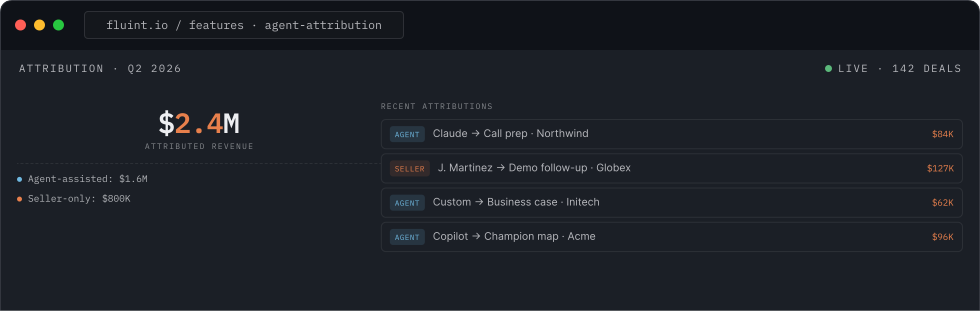
Capture every agent and seller action, then trace it back to the revenue they create.
Do you know when your agents help close deals?
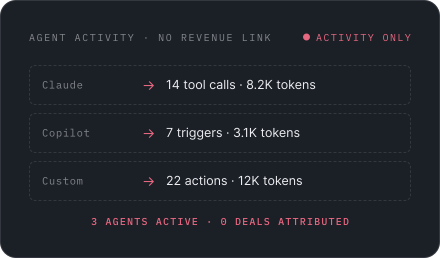
Your agents log activity: triggers, tool calls, and tokens spent. But it's all just an activity metric, while your CRO's asking about the revenue outcomes.
- Agent activity · no revenue link Activity only
- Claude → 14 tool calls · 8.2K tokens
- Copilot → 7 triggers · 3.1K tokens
- Custom → 22 actions · 12K tokens
3 agents active · 0 deals attributed
Observability watches the agent. It never watches the revenue.
LLM observability tells you latency, error rates, and token spend. But it never joins an action to a deal, an account, or a closed-won dollar.
Agent Attribution in three steps.
Log every agent and seller action.
Match each action to its revenue outcomes.
Report impact in revenue.
Teams that ship attribution see compounding results.
Fluint vs. AI observability tools. Why telemetry isn't enough.
Questions about Agent Attribution.
AI agent attribution ties every action an agent takes — tool calls, emails, prep work — to the revenue outcome it influenced. Instead of knowing an agent ran, you know what it helped close and how much revenue it drove.
Observability tools track latency, errors, and token spend — engineering metrics. Fluint joins every agent action to a CRM deal and attributes it to closed-won revenue. One watches infrastructure; the other watches the business outcome.
Yes. Any agent that speaks MCP or sends actions through the Loop API is captured and attributed. Claude, OpenAI, custom-built — it doesn't matter. If it touches a deal, Fluint traces it.
At minimum, your CRM (Salesforce or HubSpot) and one agent source. Loop also ingests call transcripts, emails, and calendar data to build the full picture of rep + agent activity on every deal.
Yes. Fluint models both agent and seller actions on the same deal, so you can see exactly which actions — human and AI — contributed to the outcome and how much each drove.
See what your agents actually closed.
Connect your CRM and one call source and get your first attributed outcome the same session.