FLUINT · LOOP

Attribute every AI agent, activity, and token to revenue.

Run a private AI model that proves what's working, then routes the right context to every agent and seller in one MCP call.
With Fluint
TIME
0.0s
MCP CALLS
0
TOKENS
0
"Build me the business case for Acme Corp's renewal."
context.deal Acme Corp
args: "acme_corp_renewal"
↳ returned 4 entities · 11 citations · ~2,137 tokens

Acme Corp qualifies for a 12% loyalty discount based on 3+ year tenure and ARR > $500K. source: pricing_policy_v2026.md

An account-specific override supersedes the standard loyalty tier. source: overrides/acme_corp_001.yaml

Champion Sara Chen (ex-Halliburton) is driving the renewal; CFO attended the last QBR — deals with CFO attendance close at 3.5× the rate in your history. source: loop · n=11 cohort

[done · 1 MCP call · 2,137 tokens · 2.1s]
Traditional agents
TIME
0.0s
TOOL CALLS
0
TOKENS
0
"Build me the business case for Acme Corp's renewal."
◇ I need to find Acme Corp's contract details. Let me search…
⊕ tool_call #1 search_crm
args: "Acme Corp account details"
↳ returned 3 chunks · ~4,200 tokens added to context
◇ There's a reference to a contract amendment I don't have context on.
⊕ tool_call #2 search_contracts
args: "Acme Corp amendment"
↳ returned 4 chunks · ~6,000 tokens added to context
◇ Synthesizing current contract state. Moving to usage metrics.
⊕ tool_call #3 search_usage
args: "Acme Corp consumption Q1 2026"
↳ returned 6 chunks · ~10,000 tokens added to context
◇ Reading usage data. Computing consumption vs. commitment thresholds annually…
⊕ tool_call #4 search_policies
args: "renewal discount qualification rules"
↳ returned 3 chunks · ~3,800 tokens added to context
running…
9x
Faster
11x
fewer tokens
1
call vs. 4
sourced & Cited
The catch

Your agents don't carry a quota.

So how do you prove when they're actually impacting revenue, and capture why when they do?
The Problem

Three gaps, that are probably
a little too familiar to you:

01 · CLOSED LOOP

No way to tie deal activity back to revenue.
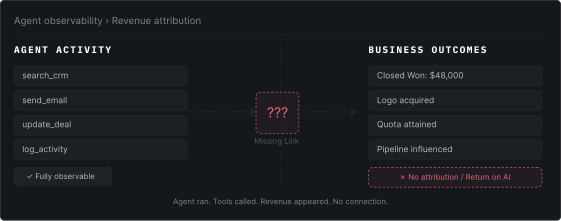
You can see when a rep or agent works. But there's no way to prove if that specific action made the difference.
Fluint solves the problem of having no way to tie agent work back to revenue.
02 · JUDGMENT

Context confetti spread across systems
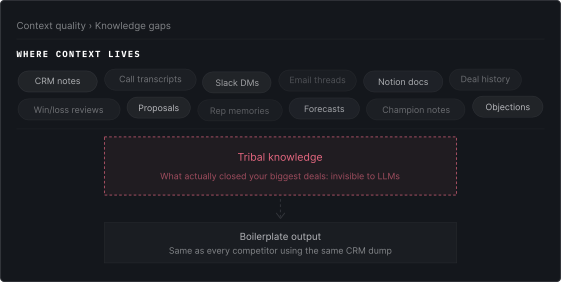
The tribal knowledge behind your biggest wins is invisible to LLM's. So reps and agents rely on generic CRM dumps and transcripts, leading to the same boilerplate output your competitors get.
Fluint solves the problem of context confetti spread across systems
03 · BURN RATE

"Wait, we spent how much this month?"
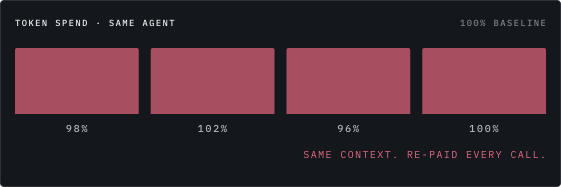
Every agent re-reasons over the same context, using premium models. Instead of matching the right model to the task, and processing it 1x across the company.
Fluint prevents runaway token usage and cost overages by agents.
HOW LOOP WORKS · 3 LAYERS, ONE LOOP

The right context —
engineered from your data, to revenue, and back.

Build, test, and deploy AI agents that actually understand your revenue
data — and improve every time they do.
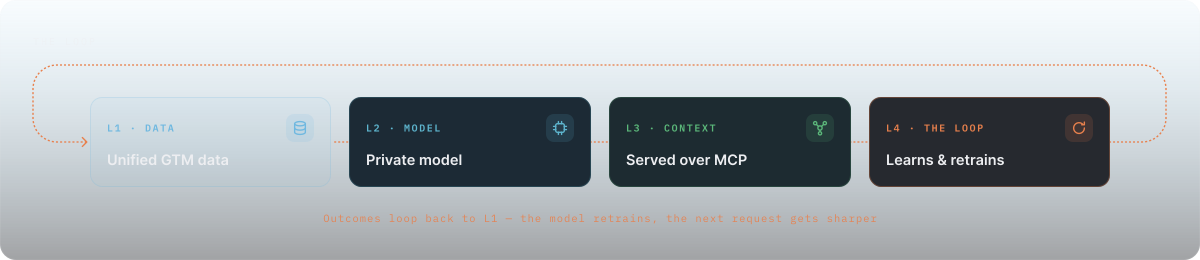
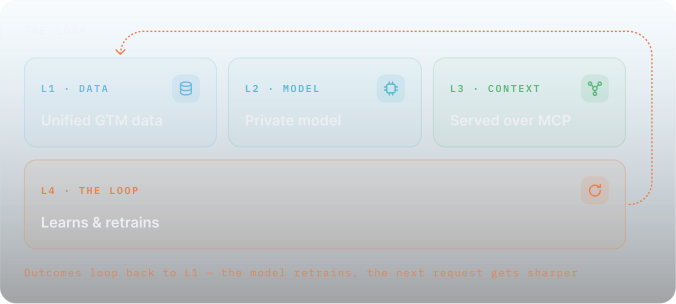
L1 · Data
Your complete GTM dataset, in one unified layer.
Loop reads from the revenue systems you already run (CRM, conversations, emails, warehouse) and joins them to your unique entities: deals, accounts, reps, stages, metrics.
L2 · PRIVATE MODEL
A model trained on your GTM motion, not the market’s.
Private ML models trained on your deal cycles. Private weights are org-scoped, observable, and never shared across customers.
L3 · CONTEXT VIA MCP
Context, pre-enriched and routed to any agent or tool.
The model’s judgment is pre-built into the right context, and served over MCP. Any agent (Claude, OpenAI, Glean, Notion, etc...) and LLM gets the right context, with ~30-70% less token spend.
L4 · THE LOOP
Actions, outcomes, and learning, looped back through.
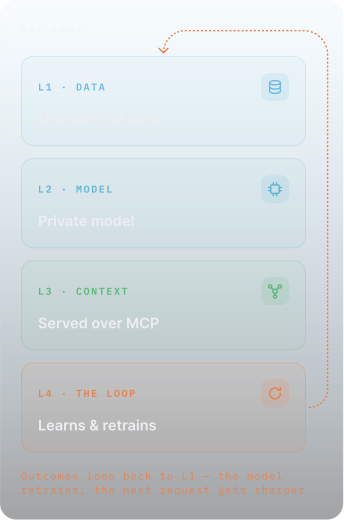
Agent and rep activity become new GTM data. Outcomes join to the actions that drove them. The model retrains itself with that, so the next request gets sharper context.
No lock-in

Connects to everything you already run.

Data is ingested continuously with entity resolution across systems — every contact, account, and activity matched and deduplicated automatically.
YOUR
CONTEXT
Gemini logo Gemini
Microsoft Copilot logo Copilot
Notion logo Notion
Salesforce Agentforce logo Agentforce
HubSpot Breeze logo Breeze
Glean logo Glean
Claude logo Claude
OpenAI logo OpenAI

Questions about Loop.

What it is
What is Fluint Loop?

Loop is the context engineering layer for revenue teams. It unifies your GTM data, trains a private model on your deal outcomes, pre-builds enriched context, and serves it to any agent over MCP. Every agent action is traced back to revenue so the model gets sharper every cycle.

How does Loop attribute agent actions to revenue?

Loop captures every agent and seller action, joins it to the deal it touched, and maps the outcome — closed-won, ACV, cycle time — back to the specific play that drove it. You get attributed revenue, not activity reports.

What is pre-materialized context?

Pre-materialized context is deal context enriched and built ahead of time by your private model. When an agent calls Loop via MCP, the context is already computed — champions, comparable deals, risk signals — so the agent gets decision-ready information instead of raw data.

How it works
How does Loop work with AI agents?

Loop serves context via MCP and REST API. Add it as a tool in your agent framework and any agent — Claude, OpenAI, Glean, custom — pulls the same enriched context. No SDK, no lock-in.

What data sources does Loop integrate with?

Salesforce, HubSpot, Gong, Clari, Outreach, Salesloft, 6sense, ZoomInfo, email, calendars, and 20+ additional sources. Data is ingested continuously with entity resolution across systems.

Get started

See what your agents are actually closing.

Start free, connect Salesforce and one call source, and get your first attributed outcome the same session.