
The context layer for revenue: one MCP call, every agent.
Deliver the right context pre-enriched with your won/loss patterns. Soevery model reads your deals, plays, and guardrails the same way.
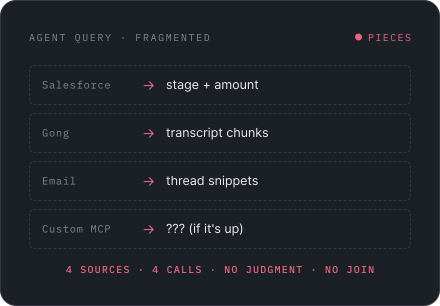
Querying connectors one by one creates fragmented context.
When a model hits each connector separately, the picture arrives in pieces. And every custom MCP script you wire by hand is one more thing your best operator has to monitor and keep alive.
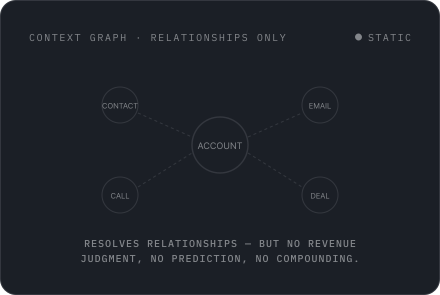
Context graphs resolve relationships. They don't create judgment.
Enterprise search and knowledge graphs map what exists. But they can't tell you which patterns predict wins, because they don't train on the outcome.
Context API in three steps.
Unify your revenue data into one layer.
Add the judgment a context graph can't create.
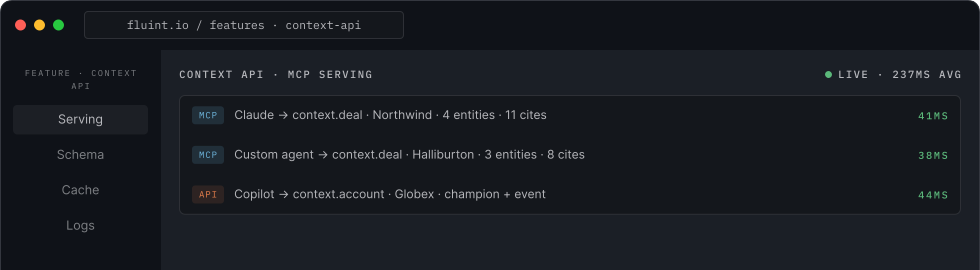
Deliver that context to your agents and reps in one MCP call.
Teams that ship Context API see compounding results.
Fluint vs. Context Graphs & Search. Why resolving context isn't enough.
Questions about AI for RevOps.
A context API is a single endpoint that serves structured, enriched context to AI agents on demand. Instead of each agent querying raw data sources, it calls one API and receives decision-ready context — champions, comparable deals, risk signals — already enriched by a model trained on your revenue outcomes.
A context graph resolves relationships between entities. Fluint goes further: it trains a private model on your closed-won history to add revenue judgment — which patterns predict wins, which signals indicate risk — then serves that enriched context over MCP. Graphs map what exists; Fluint predicts what matters.
It means the context your agents receive has been processed by ML models trained on your revenue data. Instead of raw CRM fields, agents get labeled deal dimensions — champion strength, compelling event, comparable cohort — each scored by their actual impact on closed-won outcomes in your business.
MCP is an open protocol that AI agents already speak. Using it means any agent — Claude, OpenAI, Glean, custom — can pull your context without a proprietary SDK or custom integration. One endpoint, no lock-in, and it survives model swaps.
Yes. Because the context layer is powered by a closed-loop model, every outcome — closed-won, lost, stalled — feeds back into training. The model retrains on new labels each cycle, so the context served to agents gets sharper automatically.
Give every agent context worth reading.
Start free, connect your stack, and serve enriched context to your firstagent today.