
What revenue teams do with a context layer built from their outcomes
Your agents don't carry a quota.
Built for RevOps and Enablement teams engineering revenue:
Know for a fact what's working in your pipeline
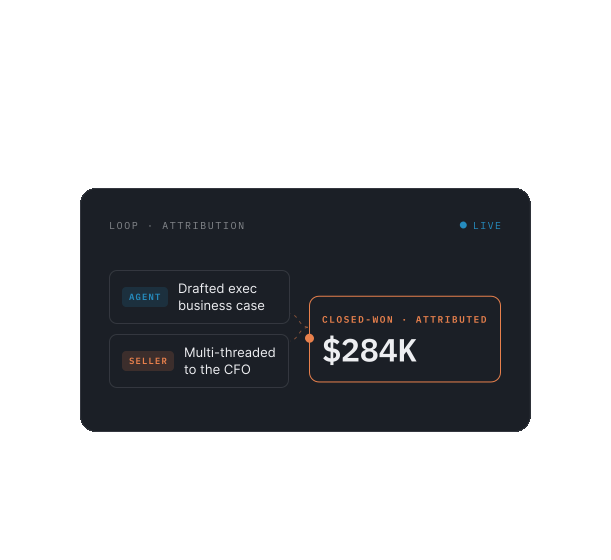
Fluint measures how much each selling behavior changes a deal's odds of closing, and how that shifts as the deal moves, for every segment and stage.
Put your winning plays to work on every deal.
Once Fluint knows what wins, proactive agents watch every open deal and step in with a draft when one drifts off the path your best deals took.
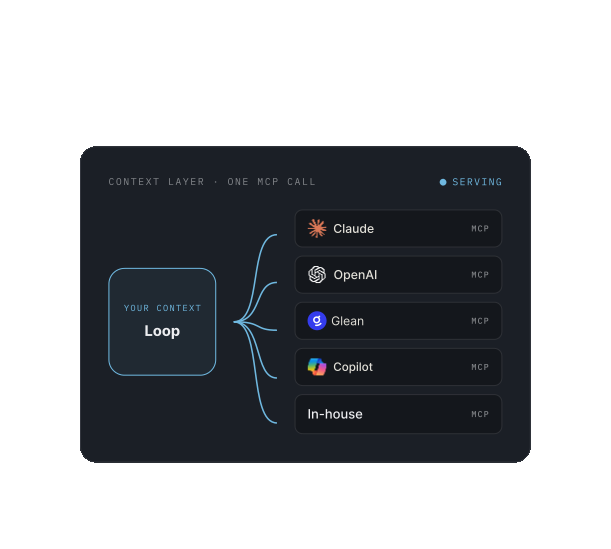
One source of trusted context for every agent you run.
Your CRM, calls, and email, cleaned, scored against real outcomes, and cited, then served to any model or tool over one MCP connection.
Revenue teams shipping AI that earns its seat.
“Fluint gave us months of AI engineering work with a single integration. Now everything we build is grounded in how we win, with the right context for every agent and seller.”

“Fluint keeps our team on our sales process and calls out the gaps in every deal. Our win rate is up, and it’s helped us 6x the efficiency of our sales organization.”

“No other platform captures the right context in fewer words than Fluint.”







Questions about context layers.
It's the layer between your revenue systems and the AI tools your team uses. A context layer takes your CRM, calls, and email, resolves them into one consistent picture of each deal, and serves that picture to every rep and agent. Fluint's context layer also grades that context against your won and lost deals, so your agents work from what's proven to win in your pipeline.
Most context graphs store relationships, like which people, accounts, and conversations are connected. Fluint's is built on a time series of events, and Fluint trains a private model on it to prove which behaviors predict a closed-won deal. So you get predictors ranked by measured win-rate lift, and plays to act on them.
Measure them like any other play. Fluint compares the deals an agent touched with similar deals it didn't, in the same segment and stage, and reports the difference in win rate. If a play stops helping, Fluint flags it so you can pause or replace it.
Yes. Each customer gets a private model trained only on their own deals. Your data and model weights are never shared with other customers or used to train anyone else's model.
MCP (Model Context Protocol) is an open standard that lets AI tools request context from a service like Fluint through one connection. Which matters because your team probably runs more than one AI tool already. With the Context MCP, Claude, ChatGPT, Cursor, and your own agents all get the same predictors, plays, and cited deal context, and you maintain one connection instead of one per tool.
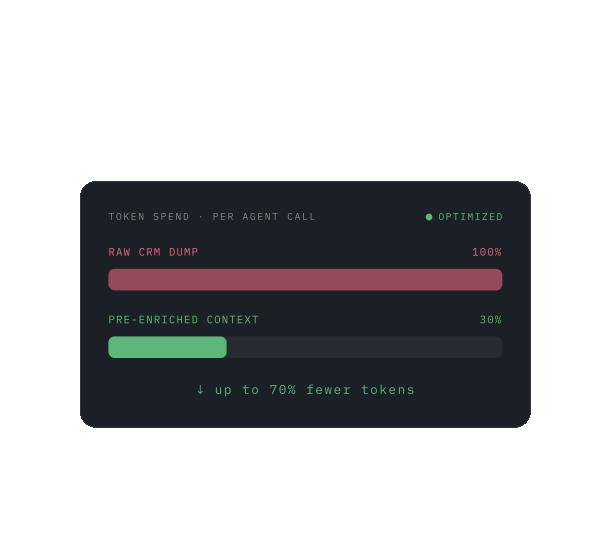
It can, since most of the work happens before an agent asks. Fluint builds each brief and refreshes it when your data changes, so an agent gets ready context in one call instead of re-reading raw records and reasoning it out every time, which cuts latency and token cost.
Put your won and lost deals to work for every rep and agent.
Start free. Connect Salesforce and your call recorder, and you'll see your first predictors in one session.