
Run a private AI model that predicts your revenue outcomes.
Trained on your entire GTM dataset, Fluint surfaces the predictors that actually drive your deals, so you don't rely on an LLM's opinion.
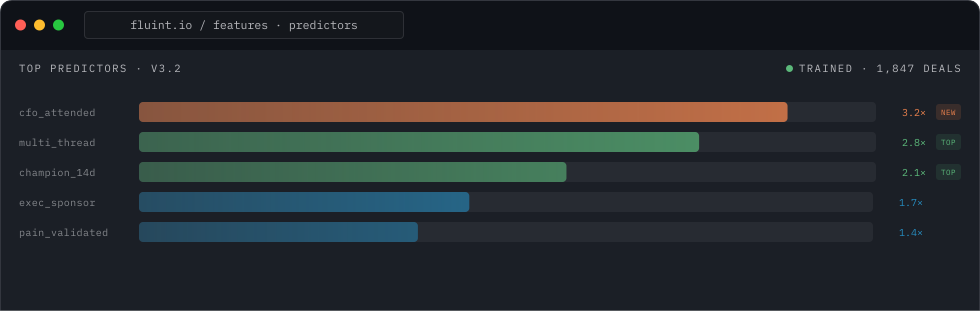
From a map of your data to a model of your outcomes.
Context graphs capture the relationships you already know. LLMs give you opinions on a limited set of data. Neither proves your specific win patterns with facts, like "CFO-attended deals close at 3.2×."
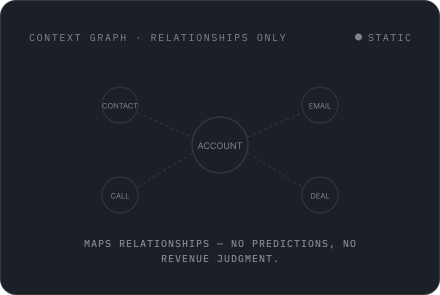
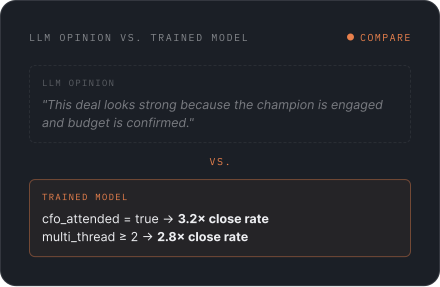
An LLM gives you opinions. A model gives you facts.
General models guess at what matters. Fluint trains on your closed-won history to prove which behaviors and signals actually predict wins — with statistical significance, not a prompt.
Private Model in three steps.
Learn from your entire GTM dataset.
Surface predictors on its own.
See deal health and its trajectory, live.
Teams running the model see compounding results.
Fluint vs. knowledge and context graphs. Why graphs aren't enough.
Questions about Predictors.
Fluint trains gradient-boosted and regression models on your deal history. These are purpose-built ML models that learn which behaviors and deal signals statistically predict revenue outcomes — not a general-purpose LLM prompt.
When the model detects a new variable — like CFO attendance or multi-threading — that starts predicting wins with statistical significance, it automatically promotes that variable to a top predictor and surfaces the lift it creates.
Einstein uses fixed rules and basic scoring. Fluint trains a private model on your outcomes and continuously discovers new predictors as your motion evolves. It's the difference between a static rubric and a learning system.
The model starts learning with as few as 100 closed deals. Prediction quality improves as more outcomes flow through the loop — every closed-won, lost, or stalled deal makes it sharper.
Yes. Every outcome feeds back into training. As your market shifts and your motion evolves, the model retrains on new labels and updates its predictors to reflect what's working now, not what worked last year.
Get the model that predicts your wins.
Start free and go beyond a simple graph to a model that learns.