How to Sell to Executives: 3 Uncommon Tactics That Get Deals Unstuck




TL;DR
The best enterprise sellers don't show up with better slides. They show up with a sharper point of view, delivered before they even walk in the room. Everything else follows from that.
Selling to executives is a different sport. You get fewer minutes, the stakes are higher, and the generic pitch that worked on your day-to-day champion will absolutely fall flat.
I've watched this play out hundreds of times. A rep finally gets the meeting with the SVP or the CXO, and they generally run through the same talk tracks they'd use with anyone else. So the execs check out in 90 seconds, the deal stalls, and the rep wonders what went wrong.
So here are three things I'd actually do (and that I coach our sellers to do) to work at an executive level. I'm going to walk through a real example to make it concrete, too.
The Setup: Selling Into Starbucks
Let's say I'm selling Punchh, a loyalty rewards membership platform that powers programs for major national and international restaurant and grocery chains. The technology behind the rewards experience.
Our target account? Starbucks. Here’s the situation:
- Now if you've been a Starbucks Rewards member and tried to redeem star points during peak hours, you've probably experienced what Howard Schultz himself called "the mosh pit." Mobile orders piling up, people giving up and walking out. Not a great experience.
- So Starbucks brought in Brian Nichols from Chipotle to turn things around with the "Back to Starbucks" initiative, and a core piece of that is relaunching the loyalty program, at “Chipotle speed.”
- Here's the tension: Starbucks' loyalty platform was built 15 years ago. It now has 34 million active members driving 60% of revenue. But any significant change takes 6 to 9 months. That doesn't match the speed Brian's publicly committed to.
And the downstream numbers make it worse:
Over 10% of mobile orders are abandoned — people literally walk out. When members aren't redeeming stars, those unredeemed points sit on the balance sheet as a liability that can't be recognized as revenue until an order is completed. That's real financial drag.
This is the business case. And it's where we’ll start.
1. Create a Sharp Point of View Around the Executive's Own Initiative
This is the thing most sellers skip entirely. They lead with what their product does, instead of leading with what the executive is already trying to accomplish. So:
- The move here is to build your entire message around the exec's core initiative, using their language, the way they talk about it to their own team and their board.
- In this case, everything centers on the Back to Starbucks plan and Brian's push to move at Chipotle speed. That's his phrase, his priority, his public commitment. Your point of view has to live inside that frame.
- So instead of pitching "our platform enables faster loyalty program iteration," you're framing the conversation around a specific tension:
How do you execute a loyalty relaunch at Chipotle speed when the current platform takes 6 to 9 months to make changes?
That's a point of view worth engaging with. It tells the exec you've done the work. You understand the business problem, not just the technical one.
2. Get a Concise Business Case in Front of the Exec Before the Meeting
Here's something that seems obvious, but almost nobody does well: get a pre-read to the executive before you walk into the room.
Most execs show up a couple of minutes late to your meeting anyway. Because they're scanning the calendar invite trying to figure out what this is even about. If all they see is "Demo — Punchh" they're already halfway checked out.
What I'd do instead is write a forwardable email to my champion: the person inside the account who got me the meeting, and ask them to attach the business case to the calendar invite itself.
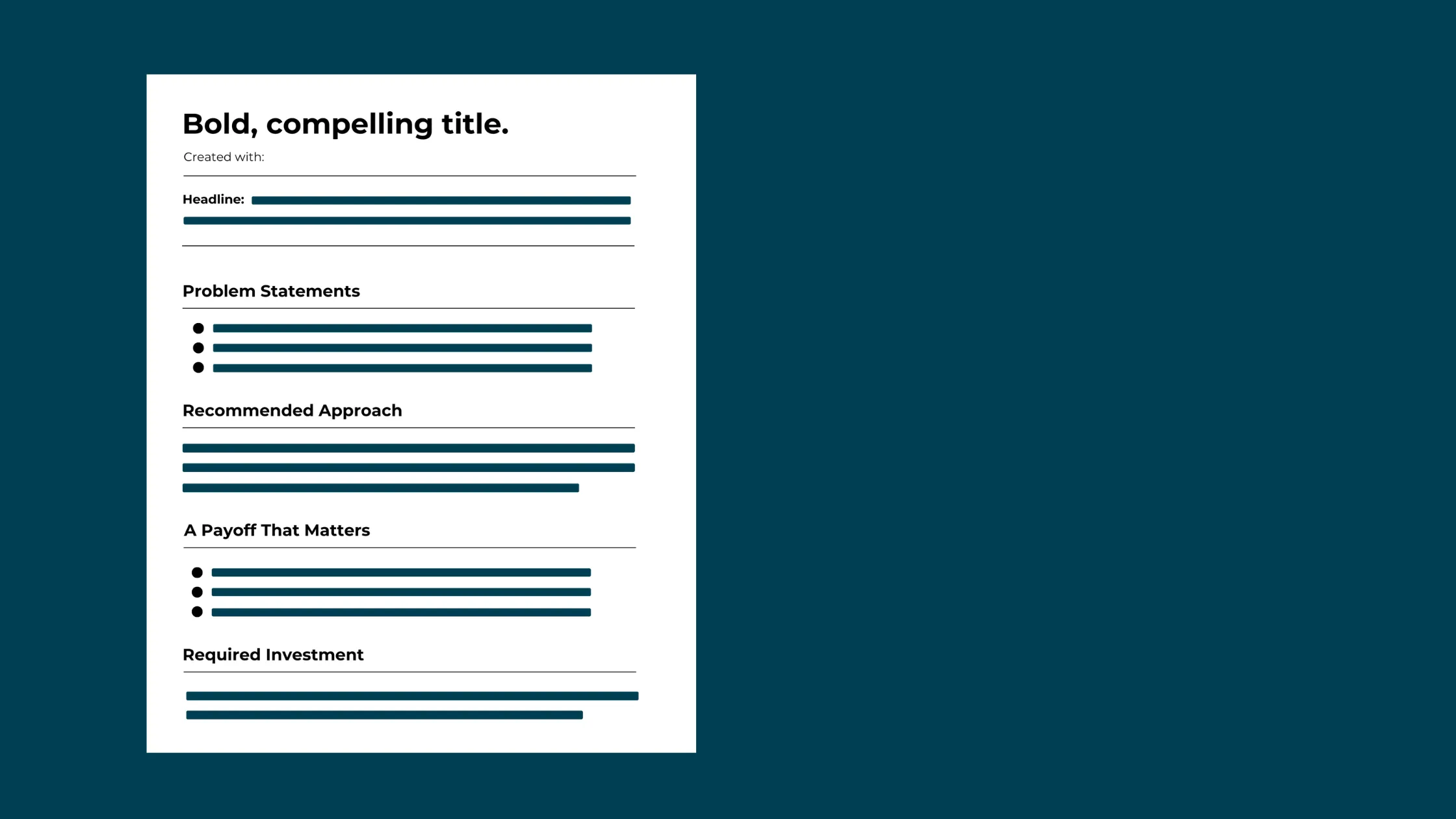
Which isn't a 30-page document. It's a concise business case that hits the key points: the initiative, the tension, the financial impact, and where your solution fits. Something the exec can scan in two minutes and walk in already thinking about the right questions.
The key word is "forwardable." Your champion needs to feel comfortable putting their name on it and sending it up. If it reads like a sales pitch, they won't forward it. If it reads like a sharp business analysis that makes them look smart, they will.
3. During the Meeting: One Visual, One Discovery Question, Maximum Tension
Now you're in the room. You've got the exec's attention because they read the pre-brief. Here's where most reps blow it by pulling up a 40-slide deck.
Don't do that.
Bring one, maybe two simple visuals. That's it. Something that makes the core tension impossible to ignore.
- For example, a simple visual showing the gap between the quality of the loyalty relaunch Starbucks wants and the velocity they need to move at — Chipotle speed — with a clear mismatch in the timeline. One slide. One tension. One conversation starter.
- Then pair it with a sharp discovery question. Not "tell me about your challenges" — something specific that shows you understand the business:
"The mobile order abandonment rate is above 10%. today Walk me through the downstream impact. What are you seeing on loyalty behavior after that? Are members skipping visits entirely? Placing orders differently?"
Or maybe:
- "If we want to ship a tier-based program in the window you've publicly committed to, the 6-to-9-month deployment timeline creates some real issues. Do you have contingency plans? What are you thinking?"
Notice the phrasing. You're not interrogating. You're pulling the exec into a conversation about a tension they already feel.
When an executive feels that urgency personally, they start giving your deal priority. Blockers get moved. Approvals get fast-tracked. That's how deals actually close at the enterprise level.
The Exec Selling Playbook, Summarized
Here's the pattern:
- Before the meeting: Build a point of view rooted in the executive's own initiative, their own language, their own public commitments. Package it as a concise, forwardable business case that goes through your champion and onto the calendar invite.
- During the meeting: One simple visual that makes the tension undeniable. One sharp discovery question that pulls the exec into the problem. That's it. No 30-slide deck. No feature walkthrough. Just tension and conversation.
After the meeting: The exec feels urgency. They give priority. Deal blockers start disappearing.
How Olli Makes This Actually Happen
I walked through this example using Olli, and here's where it gets practical (because knowing the playbook and actually executing it every week on every deal are two different things).
- Olli drafts the business case for you, pulling from your call recordings and research to build the narrative around the executive's initiative, not your product pitch. He writes the forwardable champion email so you're not staring at a blank screen trying to figure out the right tone.
- But the part that changes behavior is the nudging. If Olli sees a meeting on your calendar, he’ll ping you: "Hey, we should probably get a forwardable email over. I wrote a draft, what do you think?" He doesn't wait for you to remember to do the prep work.
- When he builds slides, it pulls the customer's own branding so the visual looks and feels like them, not like your company's marketing collateral. And he deliberately limits you: you're picking between 1 to 3 slides or maybe 5, not 30. Olli won't let you build the bloated deck that kills exec meetings.
He also studies your calls to learn what phrasing works to go deeper in deals, then leaves you specific discovery questions prepped for the next conversation. The kind of questions that pull out executive-level tension, not surface-level pain.
If you want to start working with Olli, you can jump into a free version at app.fluint.io/signup.
FAQ's on:
Why stop now?
You’re on a roll. Keep reading related write-up’s:



Draft with one click, go from DIY, to done-with-you AI
Get an executive-ready business case in seconds, built with your buyer's words and our AI.
Meet the sellers simplifying complex deals
Loved by top performers from 500+ companies with over $250M in closed-won revenue, across 19,900 deals managed with Fluint

Now getting more call transcripts into the tool so I can do more of that 1-click goodness.



The buying team literally skipped entire steps in the decision process after seeing our champion lay out the value for them.


Which is what Fluint lets me do: enable my champions, by making it easy for them to sell what matters to them and impacts their role.

