

RevOps Just Became the Most Important Function in Revenue. Here's Why.




RevOps Just Became the Most Important Function in Revenue. Here's Why.
Gordon Ritter, the founder of Emergence Capital, published a piece last month called Above the Model. In it, he makes a case that runs counter to most of what the AI industry has been saying:
The most automated decade in business history is less about rewarding companies that replace their people. It's more about capturing how their people think.
He's right. And if you run RevOps, it's your new job description, in short.
It's what we fundamentally believe and have built around for the last 4 years, too: the most valuable thing in a revenue org isn't a tool, a process doc, or even an individual "closer." It's the accumulated judgment of how your team sells.
Here are eight takeaways we'll walk through:
- Rep knowledge is the most perishable thing in revenue, and it doesn't have to be.
- Your sellers aren't leaking data into public AI tools. They're leaking process.
- "Above the model" has a specific meaning in selling: we'll show you where it runs in a sales cycle.
- AI is not just LLMs. The market has gotten dangerously narrow in how it defines intelligence.
- A flywheel that doesn't complete its loop is just potential energy. The pieces exist... but they're not flying yet.
- Ritter published the platform scorecard. Eight requirements for the layer that compounds. We'll grade ourselves against every one.
- This has to be a vertical vs. horizontal system design. Horizontal tools can't capture tacit selling knowledge.
- RevOps is the engineering function for revenue.
Let's get into it.
1. Rep knowledge is the most perishable thing in revenue
"The durable layer is how your people think, decide, and work together, captured and sustained within the company."
– Gordon Ritter, Above the Model
You've lived this. Your best AE leaves. They take with them instincts about which deals are real and which are theater, when to push a champion wider and when to hold, how to read a procurement stall caused by budget versus one caused by politics. None of it is written down. Not in your CRM. Not in your playbook. Not in the call recordings nobody rewatches.
What makes it urgent now: it no longer has to be this way.
Think about your last QBR. Someone told a story about saving a deal by going around a blocker to a different stakeholder. Everyone nodded. By next quarter, that insight is gone. The rep might be too. Now imagine that pattern, going around a blocker at a specific stage when certain signals are present, gets captured and surfaced to every rep facing a similar situation. Not as a training video. As a recommendation inside the deal they're working right now.
14% of reps generate 80% of revenue. What they know, nobody else does. The institutional selling intelligence of your organization is the most valuable thing inside revenue. It far outlasts anyone's tenure. RevOps is the natural owner of the infrastructure that captures and compounds it.
2. Your sellers aren't leaking data. They're leaking process.
"The exposure most leaders worry about is data, the sensitive file leaving the building. The subtler exposure is process."
– Gordon Ritter, Above the Model
In revenue, this exposure is worse than almost anywhere else. Reps are running deal strategy through ChatGPT. Pasting in competitive positioning, pricing frameworks, negotiation logic. Building business cases that encode your entire commercial approach. And 77% of employees paste data into generative AI tools, with 82% of that running through personal accounts nobody manages.
A multi-step AI session doesn't just share information. It encodes your sequencing, priorities, and decision logic. RevOps owns the systems where this happens. Not by locking tools down (your reps will just use personal accounts). By building internal infrastructure that makes public tools unnecessary for the high-judgment work.
3. "Above the model" has a specific meaning in selling
"AI is extraordinary at optimization. What it does not do is decide which goal is worth pursuing or make the judgment call in the moment when the model has no answer."
– Gordon Ritter, Above the Model
Ritter draws a line between optimization work (below the model) and judgment work (above it). In go-to-market, that line runs right through a deal cycle. Get it wrong and you automate the stuff that doesn't matter while ignoring the stuff that does.
Everything on the left will be automated soon. Everyone will have it. Table stakes.
Everything on the right is where revenue is actually won. We call it GTM judgment. The job isn't to automate judgment. It's to build infrastructure that frees sellers to live above the line and captures what they do there.
4. AI is not just LLMs
"The traces that encode how your analysts build a model, how your operators make a call, how your team actually decides, belong to whoever builds the system to capture them."
– Gordon Ritter, Above the Model
When most people say "AI for sales," they mean an LLM copilot that drafts emails or summarizes calls. That's useful. It's also a fraction of what's required for the compounding system Ritter describes.
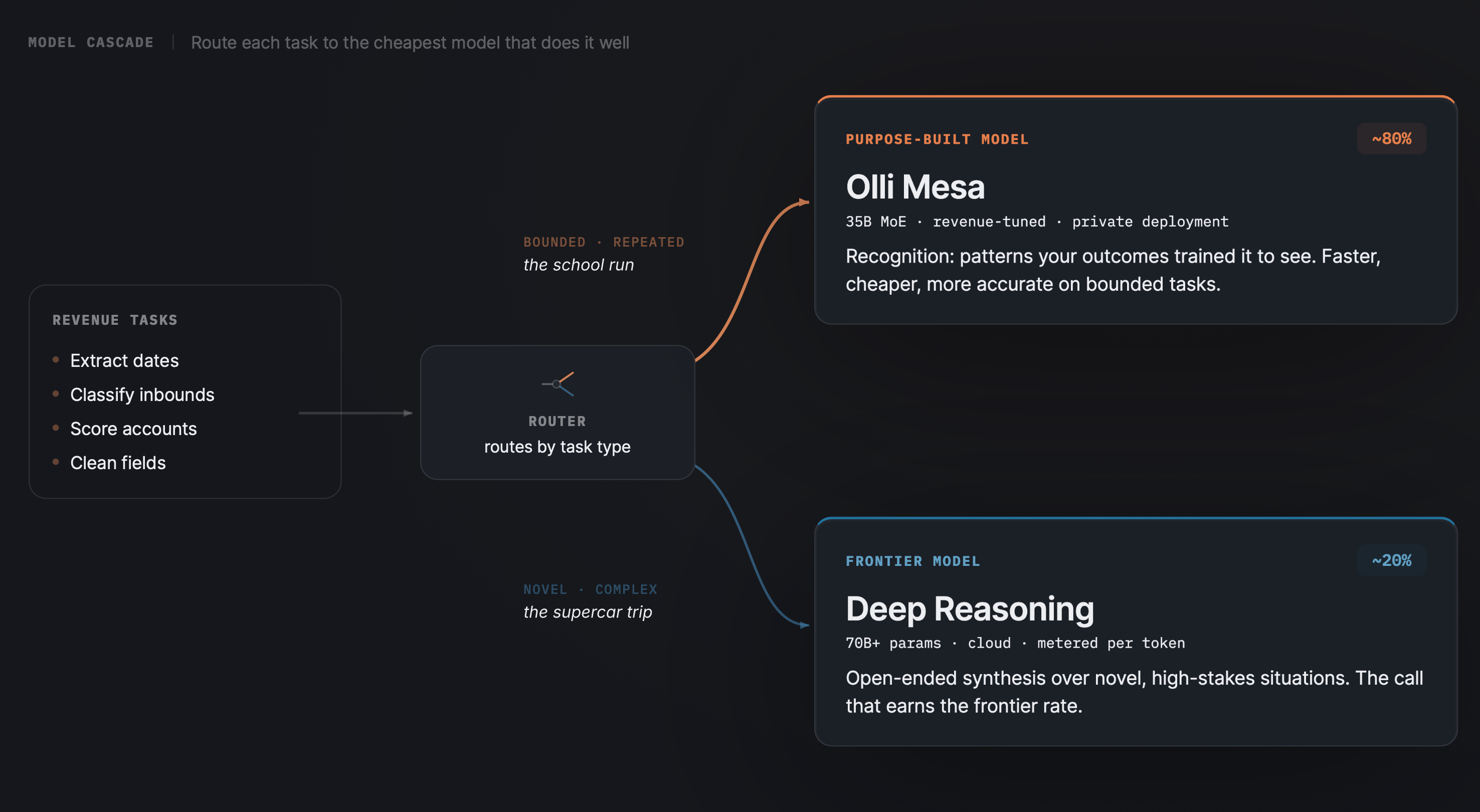
We wrote a full crash course on this because it matters that much. Short version: AI and LLM are not synonyms. It's like calling every animal a cat. The trace flywheel requires purpose-built models across the broader ML landscape:
- Regression (linear, logistic) for calculating explanatory weight. You have 15 deal attributes. Regression tells you stakeholder count contributes 34% of the explanatory weight against closed-won. Stage 2 duration, 22%. Whether the rep sent a mutual action plan, 3%. Now you know where to focus.
- XGBoost / decision trees for scoring. Not one tree. Hundreds of sequential trees, each correcting the last. A new deal enters pipeline and gets run through 500 rounds of gradient-boosted decisions. Output isn't "this deal feels good." It's a mathematically validated weight for each variable against the outcome.
- KNN for pattern matching. A deal hits Stage 2. KNN asks: of the 4,000 deals we've seen, which 15 look most like this one across size, industry, stakeholder count, velocity, and engagement? What happened to them?
- Graph models for mapping how influence flows through a buying committee.
- LLMs for generation and reasoning, but only after the hard math upstream has decided what to say and why.
This is why most "AI for sales" tools plateau. They bolt an LLM onto a workflow and call it intelligence. It's renting a supercar to do the school run. Olli Mesa, the model at the core of Fluint, was purpose-built on 150,000+ complex B2B deal cycles using this full stack working together.
5. A flywheel that doesn't complete its loop is just potential energy
"Better performance drives more use, more use produces more traces, and the gap widens with every cycle."
– Gordon Ritter, Above the Model
The pieces of Ritter's compounding flywheel already exist in most revenue orgs. Somewhere you're capturing interactions. Somewhere you have past deal data. Somewhere you have a way to surface insights. But those pieces are scattered across a dozen tools that don't talk to each other.
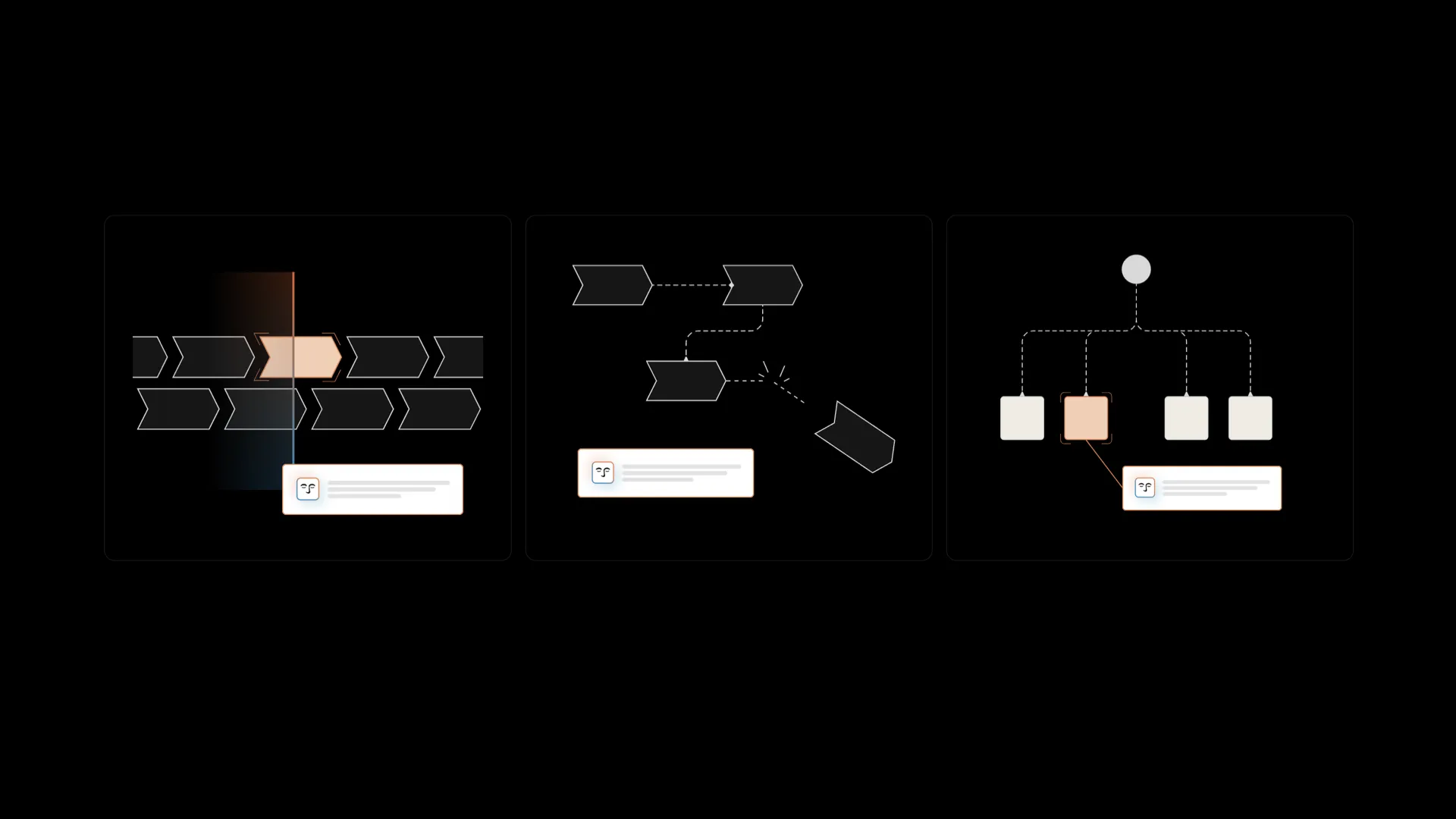
A flywheel that doesn't loop is potential energy that never becomes kinetic. This is why we took a platform approach:
These aren't three products bolted together. They're one line. Loop captures. Mesa processes. Agent delivers and captures the response, which flows back into Loop. Remove any segment and the wheel stops. That's the difference between a platform and a stack of disconnected tools paying the orchestration tax.
6. Ritter published the platform scorecard
Ritter's piece includes eight requirements for the platform layer that sits underneath any agent. Not features. Architectural principles. They read like a grading rubric, so here's our honest self-grade:
Use this as a scorecard for any platform you evaluate. Not just ours.
7. This has to be vertical
"The traces are structurally exclusive. This is real intellectual property that grows on its own."
– Gordon Ritter, Above the Model
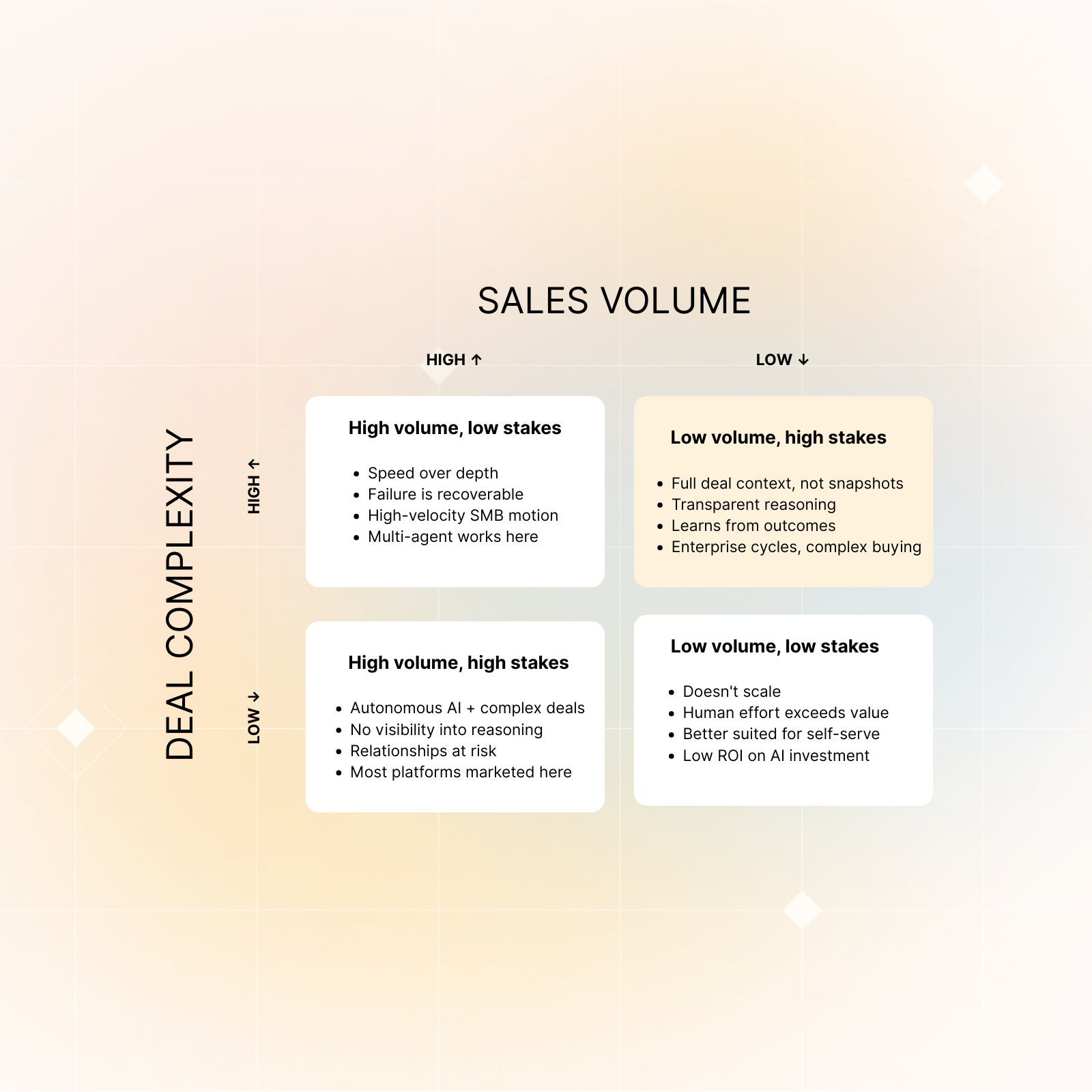
There's a tempting shortcut: take a horizontal AI platform, connect it to your CRM and conversation intelligence tool, build a knowledge graph, call it revenue intelligence. It doesn't work. The reason is structural.
The judgment that matters in selling is tacit. Converting it into explicit signals is a math problem that requires a schema built for how revenue actually works.
The time-series problem horizontal tools miss:
Revenue data isn't a static relational graph. It's a time-series. When things happen carries as much signal as that they happen.
Procurement responds to your proposal at 8 p.m. on a Friday, same day as your executive meeting. A horizontal system logs: "Procurement engaged." It would log the same thing if procurement responded the following Wednesday at 3 p.m. But those are completely different signals. An 8 p.m. Friday response after an exec meeting? Someone went home, kept thinking about it, came back to their laptop. That's urgency. A 3 p.m. Wednesday reply? That's routine.
Simply mapping nodes in a relational graph (who talked to whom, what was shared) isn't the same as learning from a time-series against an outcome. A knowledge graph tells you your champion talked to the CFO three times. A discriminant model on time-series data tells you CFO engagement has a 0.92 explanatory weight on closed-won in your org, and champion-to-CFO threading drives a 23% ACV lift when it happens before Stage 3. Not just that it happened, but when, how quickly relative to other deal events, and how much of the outcome variance it explains after isolating it from every other variable.
One is a map. The other is turn-by-turn directions that update every time a deal closes.
Olli Mesa is seeded on broad, cross-account data to eliminate the cold start. Advanced from day one. From deployment forward, it adapts inside a private deployment, learning from that specific org's patterns. Cross-account learning captures structural patterns without exposing anyone's proprietary process. From that point on, the AI points inward, compounding exactly the way Ritter describes.
8. RevOps is the engineering function for revenue
"The human being is the mutation engine in the system. The genuinely new ideas, the moves no model could have predicted, come from creative people finding a better way. The system spreads those beneficial mutations to everyone else."
– Gordon Ritter, Above the Model
Ritter first wrote about this in 2017: software that learns what actually works from a distributed network of people and guides them toward doing their jobs better while they're doing them. That's the transition from enablement to engineering. One we tried to reverse-engineer with off-the-shelf tools to see if it could be replicated. It couldn't.
Same paradigm shift as platform engineering for developers. DevOps for RevOps. RevOps owns this transition because it already sits at the intersection of people, process, and systems. The job is expanding from managing the stack to engineering the intelligence layer on top of it.
Build the layer. Keep the mutations yours.
Automate everything below the model. Take the free money. But the edge isn't optimization. Everyone's going to have that.
The edge is the judgment that happens above it. Your people generate it every day. The question is whether you're capturing it or letting it evaporate into tools you don't own.
We built Fluint because we believe the answer should be obvious. The platform to complete the flywheel is here. The function best positioned to own it is RevOps. The only question is whether you start now, or wait and try to buy what someone else's traces already taught them.
That's not a gap you close with a purchase order.
FAQ's on:
RevOps as AI infrastructure owner
Why stop now?
You’re on a roll. Keep reading related write-up’s:

Deal-winning context that changes the outcome

Now getting more call transcripts into the tool so I can do more of that 1-click goodness.



The buying team literally skipped entire steps in the decision process after seeing our champion lay out the value for them.


Which is what Fluint lets me do: enable my champions, by making it easy for them to sell what matters to them and impacts their role.

