

What Is the Orchestration Tax? The Hidden Cost of Multi-Agent AI in Enterprise Sales



TL;DR
Multi-agent AI platforms create a hidden layer of reconciliation work, the orchestration tax, every time their specialized agents disagree. The cause is fragmented context: each agent works from its own snapshot, so someone has to settle the conflict before anything ships. The same fragmentation makes the stack impossible to observe: RevOps can't see what any agent did, attribute the outcome, or feed the result back, so the agents never learn. For high-volume SMB sales, that overhead is manageable. For enterprise deals where relationships are irreplaceable, it's a liability, and it lands on your token bill as much as in your stalled pipeline. The fix isn't a smarter orchestrator. It's a shared context layer every agent reads from, and that RevOps can see into. This post breaks down where the tax shows up, why it compounds, and what to ask before you buy.
When your research agent flags one priority, your content agent writes to a different angle, and your CRM shows a third version of the truth, who wins?
This isn't a hypothetical. It's what happens every day inside the multi-agent stacks RevOps teams are now buying and running. And the answer to that question, who reconciles the conflict and whether you can even see it happen, tells you whether the AI you bought is saving work or just hiding it somewhere you can't observe.
Key Terms
Orchestration tax: The hidden layer of reconciliation work created when multiple AI agents disagree. In a multi-agent system, agents optimized for different tasks regularly produce conflicting outputs. Someone, human or machine, has to resolve those conflicts before anything ships. That resolution layer is the orchestration tax. It wasn't in the demo. It's in your workflow now, on your token bill, and in every outcome you can no longer trace back to the agent that caused it.
Multi-agent orchestration: An architecture where separate agents handle separate tasks and an additional layer coordinates their outputs. Each agent is optimized for its narrow function and operates without shared context across the others, and without a shared record of what each one did.
Observability gap: What RevOps loses when agents run across a fragmented stack. No single record of what each agent did, no way to attribute a closed or stalled deal to the action that moved it, and no signal to feed back. The agent runs, a dashboard says it ran, and the loop stops there.
Shared context layer: One pre-materialized, judgment-enriched view of the deal that every agent reads from before it acts. No reconciliation layer, because there's nothing to reconcile. Each agent is working from the same picture, and that picture already carries the patterns that say which play tends to work for this kind of buyer. Because every agent reads and writes through the same layer, you can also see what each one did and tie it to the outcome.
White box AI: Systems where the reasoning is visible. You can see why the system recommended a specific play, not just what it recommended. Essential for RevOps teams who have to attribute, defend, and improve what the agents do, and for reps who have to explain the approach to a buyer.
Black box AI: Autonomous systems that produce outputs without visible reasoning. Appropriate for high-volume, low-stakes sales where speed matters more than explainability.
Snapshot vs. video: The difference in how AI systems understand a deal. Fragmented systems work from snapshots, static data optimized for each agent's narrow function. A shared context layer works from a video: time-series data that shows how the deal has changed, who said what, and what's actually moving it.
The Orchestration Tax
Most AI sales platforms are built like committees. A research agent gathers intelligence. A content agent drafts messaging. An outreach agent handles sequencing. Each one optimized for its narrow function, each working in isolation.
Committees need project managers. When agents disagree, and they will, someone has to run the vote. Is that another AI layer making judgment calls? Or a human reviewing every output before it ships?
Either way, you've added a new layer of work. That isn't automation. That's the orchestration tax.
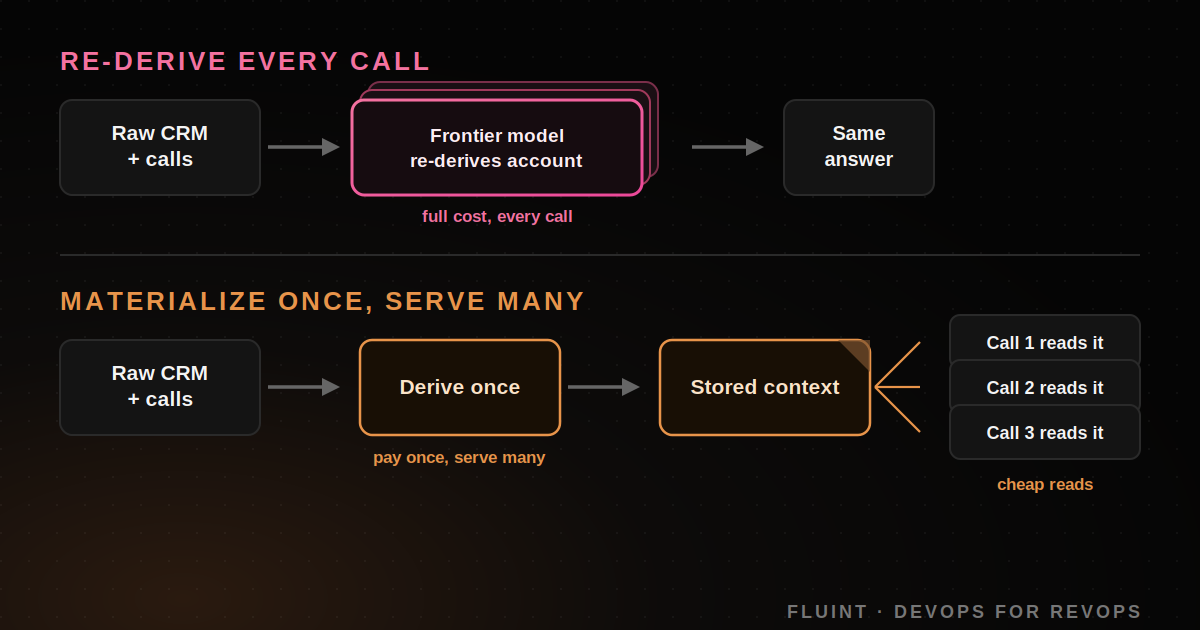
And it compounds in a place most buyers don't check until the invoice arrives. Every reconciliation pass is another round of tool calls. Every agent re-fetching the same deal because it can't see what the others already pulled is more tokens spent recreating context that should have been sitting there ready. The tax shows up three times: once as the hours your team burns settling conflicts, once as the AI spend finance can't tie to a single closed deal, and once as the cost RevOps feels most, you cannot see what any agent actually did, so you cannot tell what worked, what to fix, or what to feed back.
If I'm paying for intelligence, why am I also paying for the reconciliation layer that makes it usable, paying again in tokens to rebuild context on every call, and still unable to see what any of it did?
Why Multi-Agent Systems Break Down in Enterprise Sales
The appeal of multi-agent orchestration is intuitive. Break the problem into parts. Specialize each agent. Assemble the output. It's how people work in large organizations. Why wouldn't it work for AI?
Because AI doesn't carry the implicit context people hold between conversations.
When your Head of Sales talks to your Head of Enablement, they both already understand the competitive landscape, the deal history, the strategic priorities. They don't need an orchestration layer to reconcile their perspectives. They're operating from shared context.
Multi-agent systems don't have that. Each agent operates on a snapshot of data optimized for its narrow function. The orchestration layer is trying to recreate the shared context people have natively, after the fact, every time, with incomplete information, and it leaves no record anyone can inspect afterward.
The alternative is to put the context in front of the agents instead of behind them. One shared layer with access to every meeting, email, CRM update, and document across every deal, pre-computed and enriched with the patterns that say what's worked before. Not a snapshot. A video. Time-series data that shows how a deal changes, stacked against every other deal in the pipeline.
That layer is what Loop is. It isn't another agent competing for the answer. It plugs into the agents you already run, your own, or Claude, or ChatGPT, through MCP, and serves all of them the same judgment-enriched context. One agent or five, they read from the same source, so there's nothing left to reconcile. And because every agent reads and writes through that one layer, RevOps finally has a single place to see what each agent did and whether it moved the deal.
Most teams building multi-agent systems are solving the wrong problem. They're optimizing for task decomposition when they should be optimizing for judgment under uncertainty.
Three Scenarios Where the Orchestration Tax Hits RevOps
Scenario 1: When Agents Disagree on a $500K Deal
You're working a $500K enterprise deal. The system drafts an executive brief that misreads a stakeholder, framing cost savings to a VP who cares about innovation velocity, or pitching operational efficiency to someone measured on strategic transformation.
In a multi-agent system, which agent got it wrong? The research agent that profiled the stakeholder? The content agent that chose the framing? The orchestration layer that weighted one input over another?
The harder question, for the person who owns the stack: can you even tell which agent made the call, and why? In a fragmented stack there's no shared record to trace. By the time the deal wobbles, the agent that caused it has moved on, and so has the context.
Enterprise buyers are sophisticated. When they ask how this works and no one on your side can explain the reasoning, trust evaporates. The tax here isn't measured in hours. It's measured in deals you couldn't see going sideways until they already had.
Scenario 2: When Generic Content Reaches a Sophisticated Buyer
Your champion forwards your business case to their CFO. That CFO has seen dozens of AI-generated documents this quarter and can spot the pattern on sight: generic value props, templated ROI math, copy that reads like it came from a vendor rather than a trusted advisor.
A shared context layer with full deal history knows this CFO capped projections at 8% across the last three business cases they approved, and it can pattern-match the deal against others that closed for this kind of buyer. A multi-agent content generator can't. It's optimized for the generic CFO persona, not this specific person in this specific deal.
This version of the tax is invisible until the deal stalls. The content looked right. It just wasn't right for this stakeholder, in this deal, at this moment. No single agent knew enough to catch it, and no one watching the stack could see it was off before it went out. When the deal stalls, you still can't point to what did it.
Scenario 3: The Maintenance Burden Nobody Budgeted For
Your business changes. A new competitor enters the market. Your messaging shifts. A new methodology rolls out.
How many agents need retraining? How many prompts need rewriting? Who on your team owns the recalibration?
In a multi-agent system, every agent updates independently. The research agent needs new competitive intelligence. The content agent needs new messaging. The outreach agent needs new sequencing logic. Three maintenance streams, three failure points, all of them yours to keep in sync.
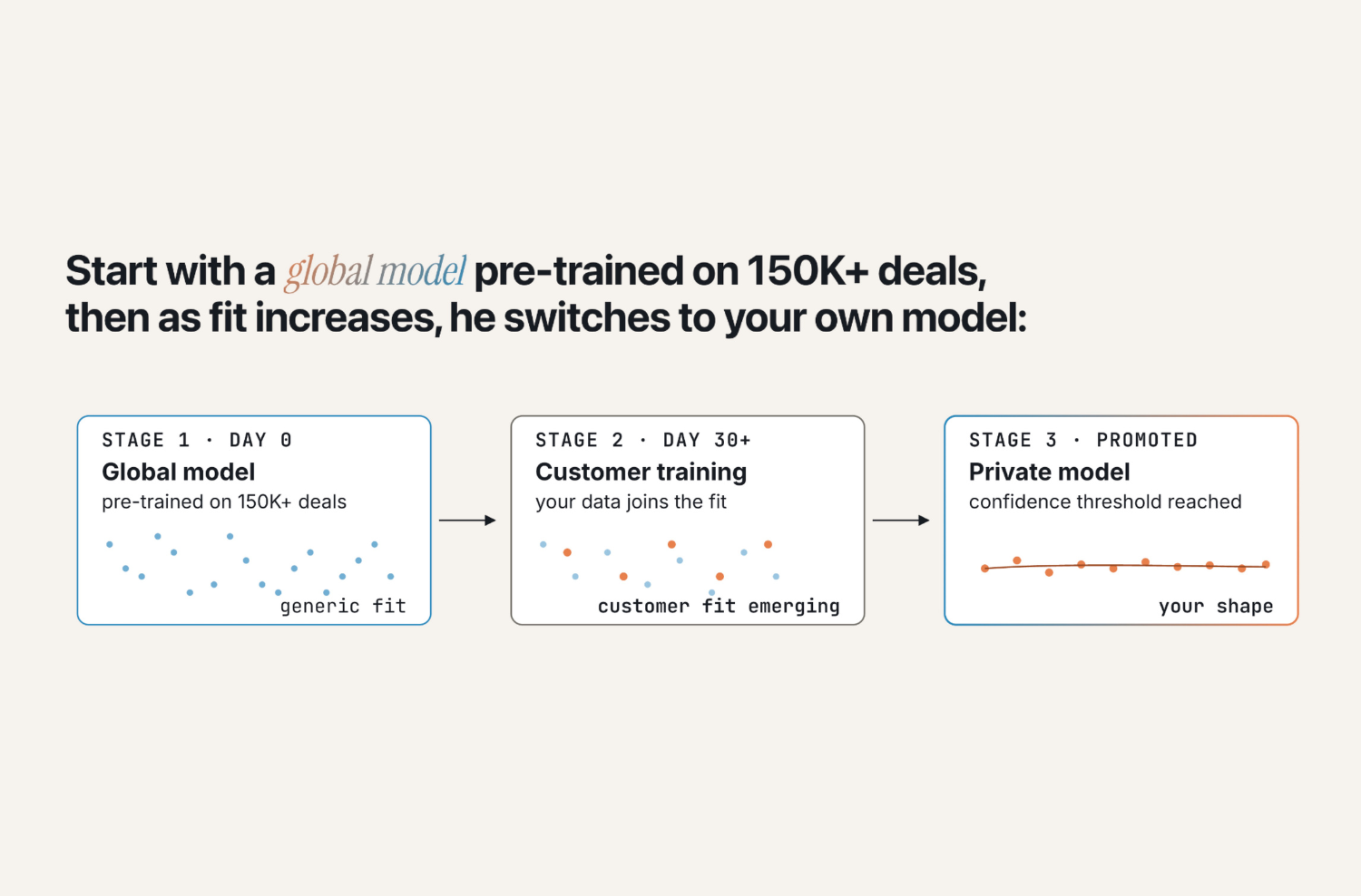
A shared context layer works the other way. It learns from outcomes. When deals close or stall, the layer joins the agent's actions back to what actually happened in the CRM, labels the result, and updates the patterns underneath, all of it visible to RevOps as it happens. You change the layer once, and every agent reading from it gets the new judgment. No prompt engineering required.
Are you buying intelligence that gets smarter as deals close, or infrastructure that needs a dedicated team to keep it running?
The Risk Profile Question
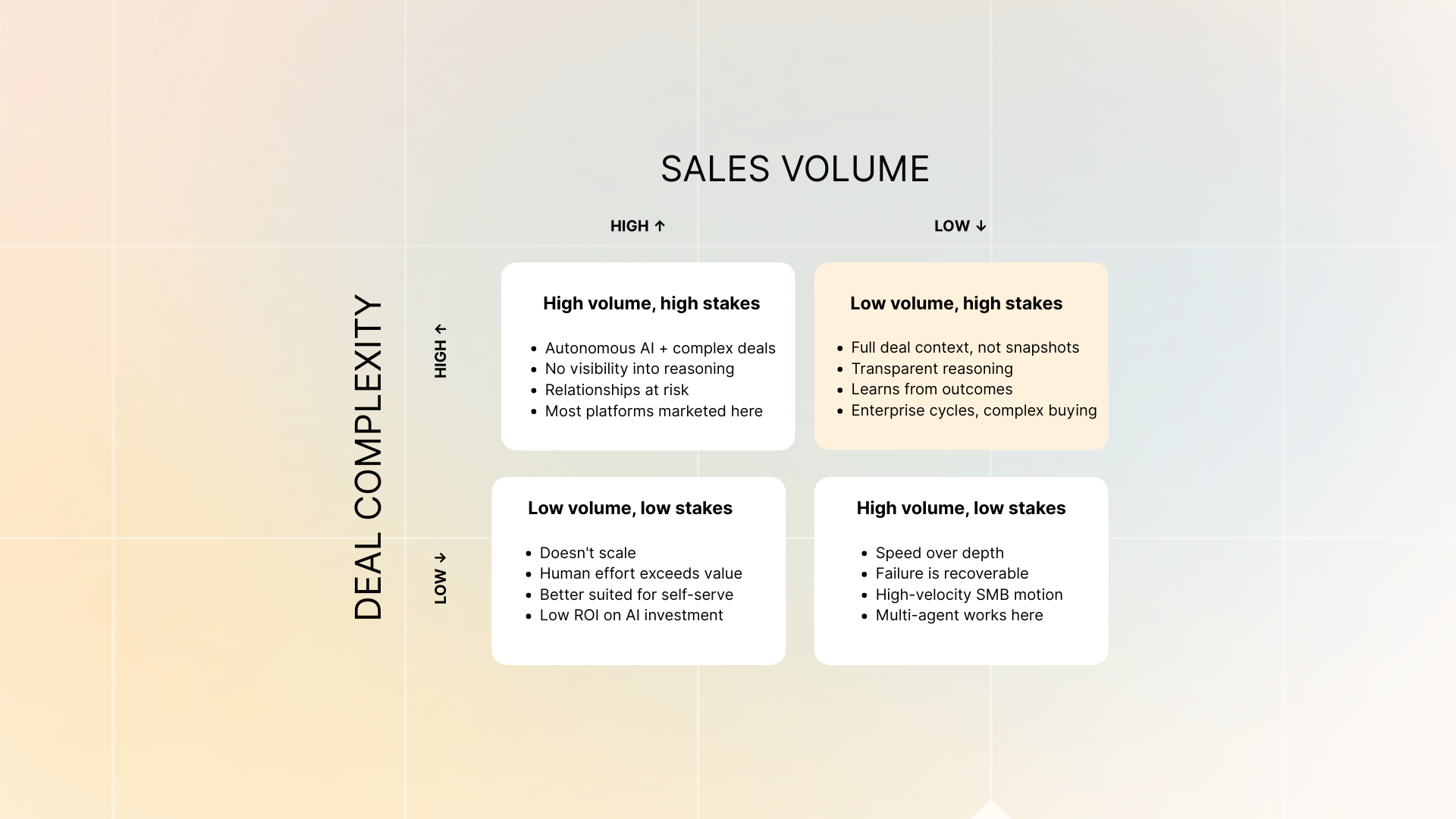
Not every AI architecture carries the same risk. The right choice depends entirely on what failure costs you.
For high-volume SMB sales, short cycles, low ACVs, high account counts, black box autonomous systems optimize for speed and throughput. Get it wrong on one account and you move to the next. The orchestration tax stays manageable because any single failure is cheap.
For enterprise accounts, a few hundred strategic logos, 11 to 22 stakeholders per deal, relationships that took years to build, the math inverts. You can't afford to burn a relationship because an agent did something you didn't expect and couldn't control. You need to see the reasoning behind every judgment call, and keep a record you can audit when one goes wrong.
The problem is that most platforms are built for the first motion and sold to teams running the second.
Observability as a Business Requirement
RevOps is under more scrutiny than anyone in revenue right now, and you can't defend what you can't see. Enterprise sales runs on trust too. Your rep earns it with the buyer. The buyer earns it with their internal stakeholders. That trust compounds, or it snaps.
Black box autonomy snaps it. Your rep becomes a messenger for recommendations they can't account for. When the buyer asks why this approach, the rep has nothing. The chain breaks.
White box transparency keeps the chain intact. The system shows its work: "I'm recommending this because seven of ten similar deals stalled at this stage when we didn't engage the CFO early, and here's what moved in the deals that closed." The rep understands the reasoning. The buyer sees the judgment. Trust holds.
The question was never whether AI can do the work. It's whether AI can do the work in a way that makes your team smarter, your buyers more confident, and your numbers something RevOps can see, attribute, and defend in front of a board.
The Real Product Isn't the Content
Sophisticated buyers already understand something most vendors won't say out loud: they can estimate the token count. They can see the API calls. They know roughly what it costs to generate a document.
When the production process is transparent and reproducible, pricing power disappears.
Foundation models commoditized execution. Anyone can draft an email or a business case now. What they didn't commoditize is judgment: which case to write, for which stakeholder, at which moment, based on what's worked before. That's the accumulated context behind a nuanced decision. The pattern recognition that says this deal looks like these eleven others, and here's what closed them.
You don't pay a lawyer $1,000 an hour for the documents. You pay for the judgment behind them: the read on what's likely to happen next, the sequencing of decisions, the recognition of patterns across hundreds of situations like yours.
So the question for anyone evaluating AI for enterprise sales isn't "can it write a business case?" It's "can it make the judgment call about which business case to write, for which stakeholder, at which stage in the deal?" Models supply the words. The context layer supplies the judgment.
How to Evaluate AI Sales Platforms: The Questions to Ask
On orchestration: When your agents produce conflicting recommendations, what resolves the conflict? Human review, another AI layer, or a defined rule? What does that resolution cost in time, and in tokens?
On observability: Can you see what each agent did across a deal, not just what the system finally recommended? Is there one record, or a different log per agent and nothing that ties them together?
On attribution: When a deal closes or stalls, can you tie the outcome to the agent action that moved it, or does the trail go cold at "the agent ran"?
On context: Does the system work from a snapshot of each deal, or a full time-series history? Does it know how this exact stakeholder responded three months ago?
On maintenance: When your messaging changes, how many agents need updating, and who owns that work?
On learning: When deals close or stall, does the system label those outcomes and improve on its own? Or does better output mean your team rewriting prompts?
On spend: How many tool calls does a single answer take, and can your finance team tie that AI spend to a closed deal?
If the AI does something unexpected in your most strategic deal, can you afford the time it takes to find out why? If the answer is no, you need observability and shared context built into the architecture, not bolted on afterward.
See How Fluint Handles It Differently
Fluint is the engineering layer for revenue operations. Loop is the shared context layer underneath it: pre-materialized, judgment-enriched context that plugs into the agents you already run, or into a managed Agent we brand as your own, and serves all of them the same view of the deal.
No orchestration layer. No reconciliation tax. Every agent works from one source of judgment, every action is visible and tied back to the deal it touched, and the loop closes so the whole stack gets sharper as your deals close.
FAQ's on:
The orchestration tax is the hidden reconciliation work created when multiple AI agents disagree. In a multi-agent system, separate agents handle research, content, and sequencing, each optimized for its narrow function, each working from a different snapshot of deal data. When they produce conflicting outputs, someone has to resolve the conflict before anything ships. That resolution layer is work that wasn't in the original automation pitch, and it shows up three ways: in your team's hours, in token spend as agents re-fetch the same context on every call, and in lost observability, since no single record shows what each agent did or whether it worked.
Multi-agent systems don't share context. Each agent operates on a snapshot of data optimized for its own function, so the research agent sees one version of the deal and the content agent sees another. Without a continuous, shared view, agents surface different priorities, different stakeholder reads, and different recommended plays. A shared context layer avoids this by holding one pre-materialized view of the deal that every agent reads from before it acts.
For enterprise accounts, the criteria that matter most are observability, context depth, maintenance burden, and spend. Observability means you can see what each agent did and tie outcomes back to the action that caused them. Context depth means the system works from the full history of a deal, not the most recent activity. Maintenance burden means knowing how many agents need updating when your messaging changes, and who owns that. Spend means knowing how many tool calls each answer costs and whether finance can tie that to revenue. The tell: if the AI does something unexpected in your most strategic deal, how long does it take to find out why?
Multi-agent systems break the workflow into parts and assign a specialized agent to each. The tradeoff is context: every agent works from a snapshot, and an orchestration layer tries to reconcile their outputs. A shared context layer flips that. It holds one judgment-enriched view of every meeting, email, CRM update, and document in a deal, and serves it to whichever agents you run, so they make judgment calls from a complete picture with nothing to reconcile. For enterprise deals where relationships and context are irreplaceable, that produces more defensible, deal-specific output.
Yes, for the right motion. High-velocity SMB sales with standardized processes, short cycles, and low cost-per-deal suit multi-agent systems well. The failure cost is low, the volume is high, and the orchestration overhead stays manageable against the throughput. The problem is that most multi-agent platforms are built for that motion and marketed to enterprise teams who need something different. Before evaluating any platform, get clear on what failure costs you. That question decides which architecture fits. Project contentDevOps for RevOps Positioning Content UpdateCreated by you
When RevOps runs several agents that don't share context, there's no single record of what each agent did, no way to attribute a closed or stalled deal to the action that moved it, and no signal to feed back. The agent runs, a dashboard confirms it ran, and the loop stops there. Closing the gap takes a shared context layer that every agent reads and writes through, so each action is visible and tied to an outcome.
Why stop now?
You’re on a roll. Keep reading related write-up’s:

Deal-winning context that changes the outcome

Now getting more call transcripts into the tool so I can do more of that 1-click goodness.



The buying team literally skipped entire steps in the decision process after seeing our champion lay out the value for them.


Which is what Fluint lets me do: enable my champions, by making it easy for them to sell what matters to them and impacts their role.

