How to Unstick Deals, Close Faster, and Write AI Content That Sounds Human




TL;DR
Most AI sales tools promise to automate your pipeline. What they actually deliver is faster mediocrity — and a hidden reconciliation problem that shows up in your deals before it shows up in your invoice. This post breaks down three of the most common deal problems and what actually fixes them.
You have a deal stuck. The champion is responsive but the evaluation is frozen. So you turn to your AI platform.
Here's what happens next, inside a typical multi-agent system:
- The research agent pulls context on the account — deal stage, industry, persona.
- The content agent uses that to draft a reengagement document.
- The sequencing agent decides when and how to send it.
Each one doing its job. None of them are talking to each other.
The document comes out looking right. Professional framing, clear structure, logical argument for urgency. But it's built on a snapshot, meaning: the deal stage as of the last CRM update, the stakeholder persona from a template, the objection category the system inferred from the stage name. It doesn't know that this specific deal stalled because the champion's company is mid-ERP evaluation and the exec team has frozen all new vendor decisions until Q3. It knows the deal is stalled. It doesn't know why.
So the document argues for urgency in the abstract. It sounds like every other AI-generated reengagement email the champion has seen this quarter. It doesn't move anything.
Now multiply that across your three scenarios: the stalled deal, the slow enterprise cycle, the business case that needs to reach a CFO. In every case, the multi-agent system is producing output that looks like work but is missing the one thing that actually drives action — context. Not just what's in the CRM. The full picture: every meeting, every email, every document, every stakeholder reaction, stacked against every other deal that looked like this one.
That's the orchestration tax in practice. If you want the full architectural breakdown of why multi-agent systems create this problem, we wrote about it here. What follows is what it means for your actual deals — and what fixes it.
How to Get a Stalled Deal Moving
A deal goes quiet. The champion is still responsive, but the evaluation is frozen. You hear things like: "We're waiting on the ERP decision," "this quarter isn't the right time," "let's reconnect in Q2."
And you've heard it before.
So you send a check-in, but the check-in doesn't move anything.
What moves a stalled deal is reframing the decision: giving your champion something concrete to carry internally that makes the cost of waiting visible to stakeholders who aren't in your conversations.
That requires a document with a tightly reasoned argument for why now, addressed to the actual objection, written in a voice that sounds like it came from within your champion's own company — not your vendor template.
A single-agent system with full deal context knows all of that. And that context is what turns a generic "here's why you should act now" into a document that gets forwarded to an exec team and changes a Q2 next year into next week:
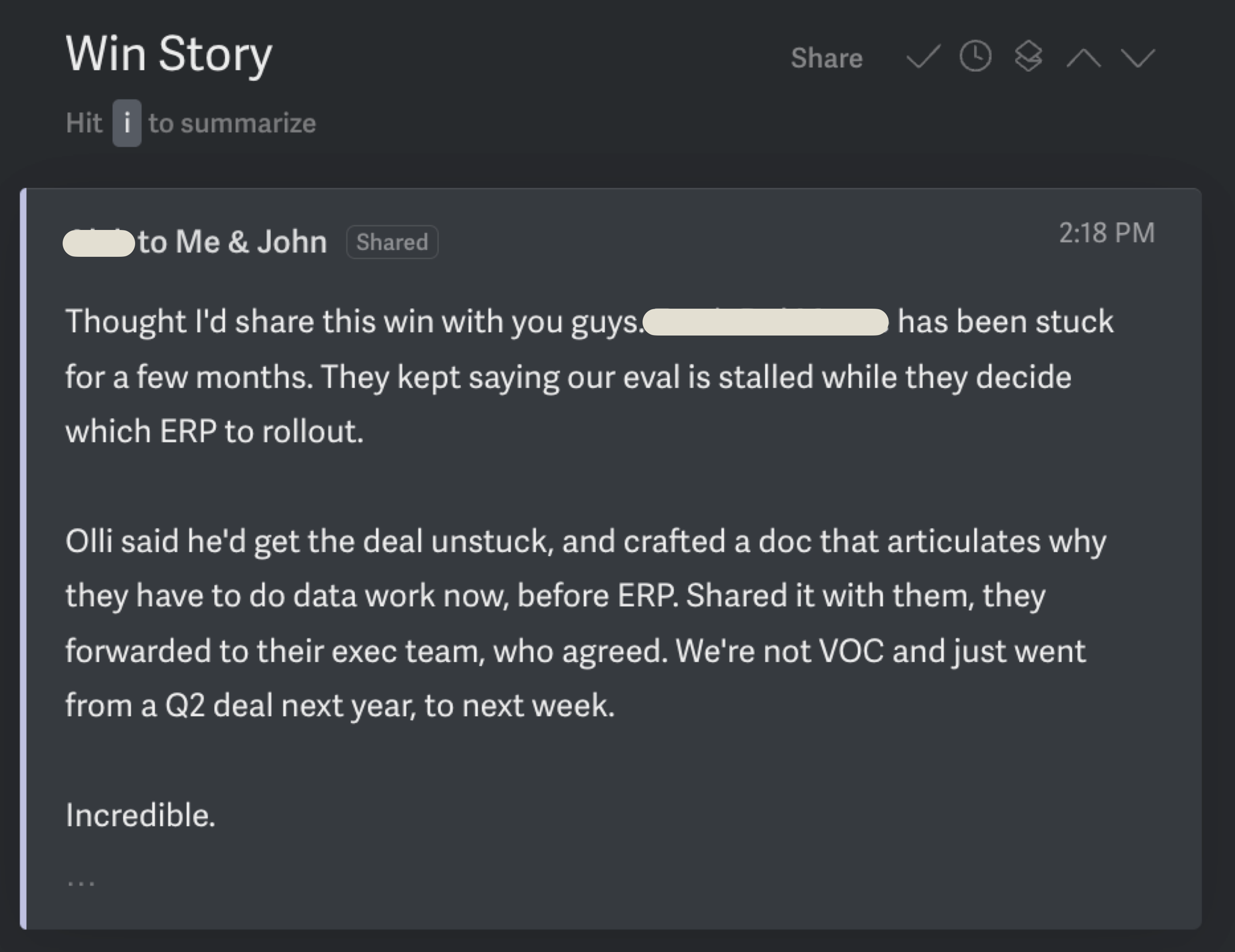
The difference isn't the document. It's the reasoning inside the document that could only come from someone who understood the full context of that specific deal.
Ask your AI vendor: If my deal is stalled on a specific objection, can the system produce a reframe that addresses that exact objection — or does it produce a generic urgency template?
How to Shorten Your Enterprise Sales Cycle
Enterprise deals are slow by design. Multiple stakeholders, long evaluation windows, procurement layers. Most sales teams accept this as fixed.
It isn't.
The variable isn't the number of stakeholders. It's how well-aligned they are, and how quickly your champion can move information through their organization. Every time your champion has to translate your value prop into language that works for a different internal audience, the deal slows down. Every time a new stakeholder enters the conversation without a document that speaks to their specific priorities, you're starting over.
The reps who compress enterprise cycles aren't doing more outreach. They're giving their champion better tools to close internally — documents that are specific enough to be credible, concise enough to actually get read, and framed correctly for each stakeholder receiving them.
Not a long deck. Priority, problem, metrics, a couple of quotes. That's it. Done right, it's the one thing that comes back to every conversation throughout the deal:
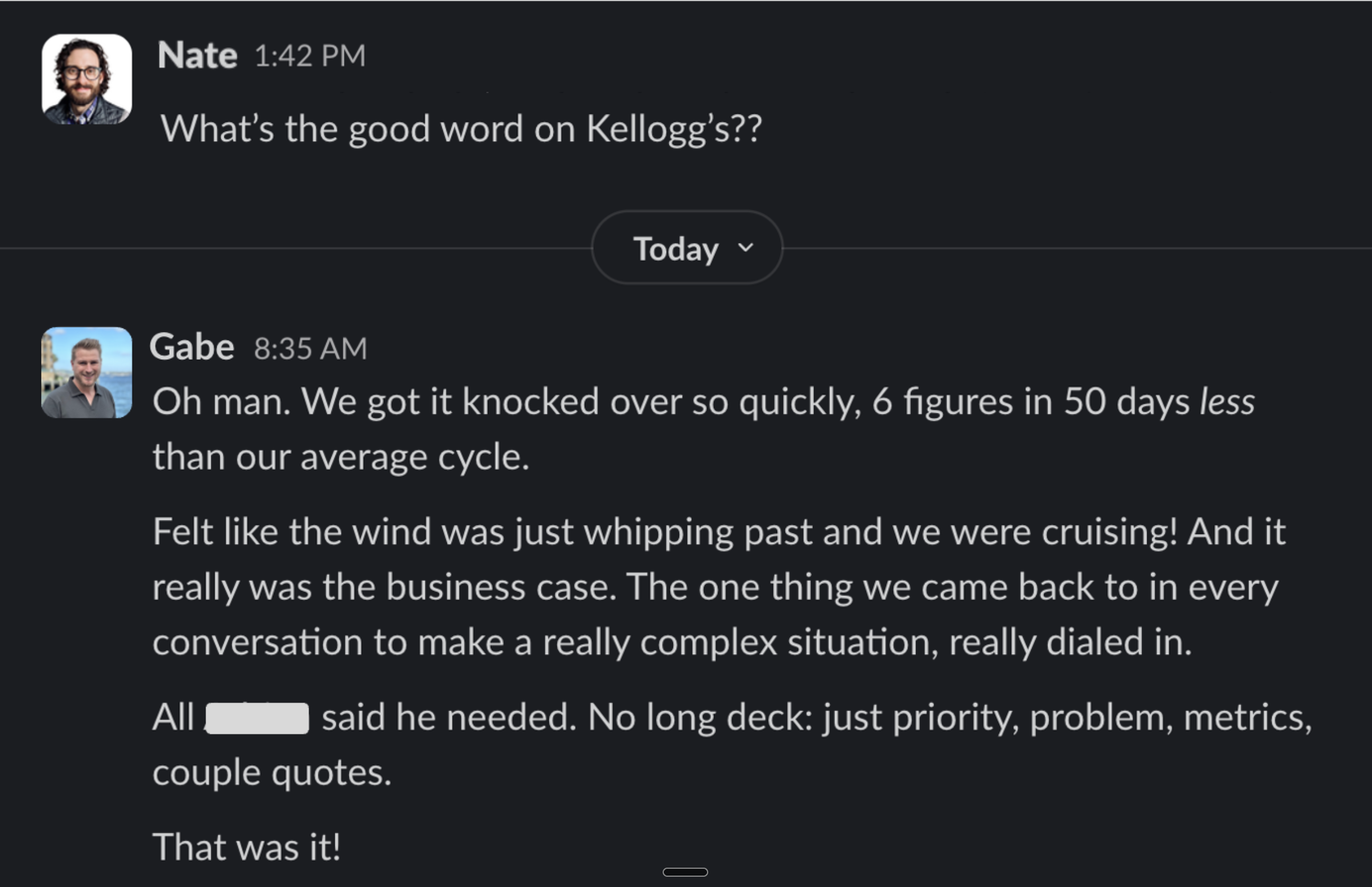
This is what multithreading actually looks like when it works. Not spray-and-pray outreach to every stakeholder you can find. One precise document, adapted for each conversation, that your champion can use to sell internally without you in the room.
Ask your AI vendor: Can the system produce stakeholder-specific variations of the same business case — without your rep having to rebuild it from scratch for each person?
Why Your AI Sales Content Sounds Like a Robot (And How to Fix It)
Your champion forwards your business case to their CFO. The CFO has seen dozens of AI-generated documents this quarter. They can spot the patterns: generic value propositions, templated ROI calculations, messaging that sounds like it came from a vendor, not a trusted advisor.
This is the snake oil problem. And it's getting worse as AI-generated content proliferates.
The tell is in the details. Does the document know that this CFO capped projections at 8% in the last three business cases they approved? Does it know that the champion's company just went through a rough board review and the exec team is hypersensitive to operational risk right now? Does it know what language this specific buyer responded to six weeks ago in a call?
Generic AI doesn't know any of that. It knows the CFO persona. It knows the industry vertical. It produces content optimized for the archetype, not the person.
The fix isn't better prompting. It's architecture. A system trained on outcomes — on what actually moved deals forward vs. what stalled them — builds a completely different kind of content than a system trained on persona templates. It writes from accumulated deal context. It sounds like your rep wrote it because, in a meaningful sense, it's drawing on everything your rep knows:
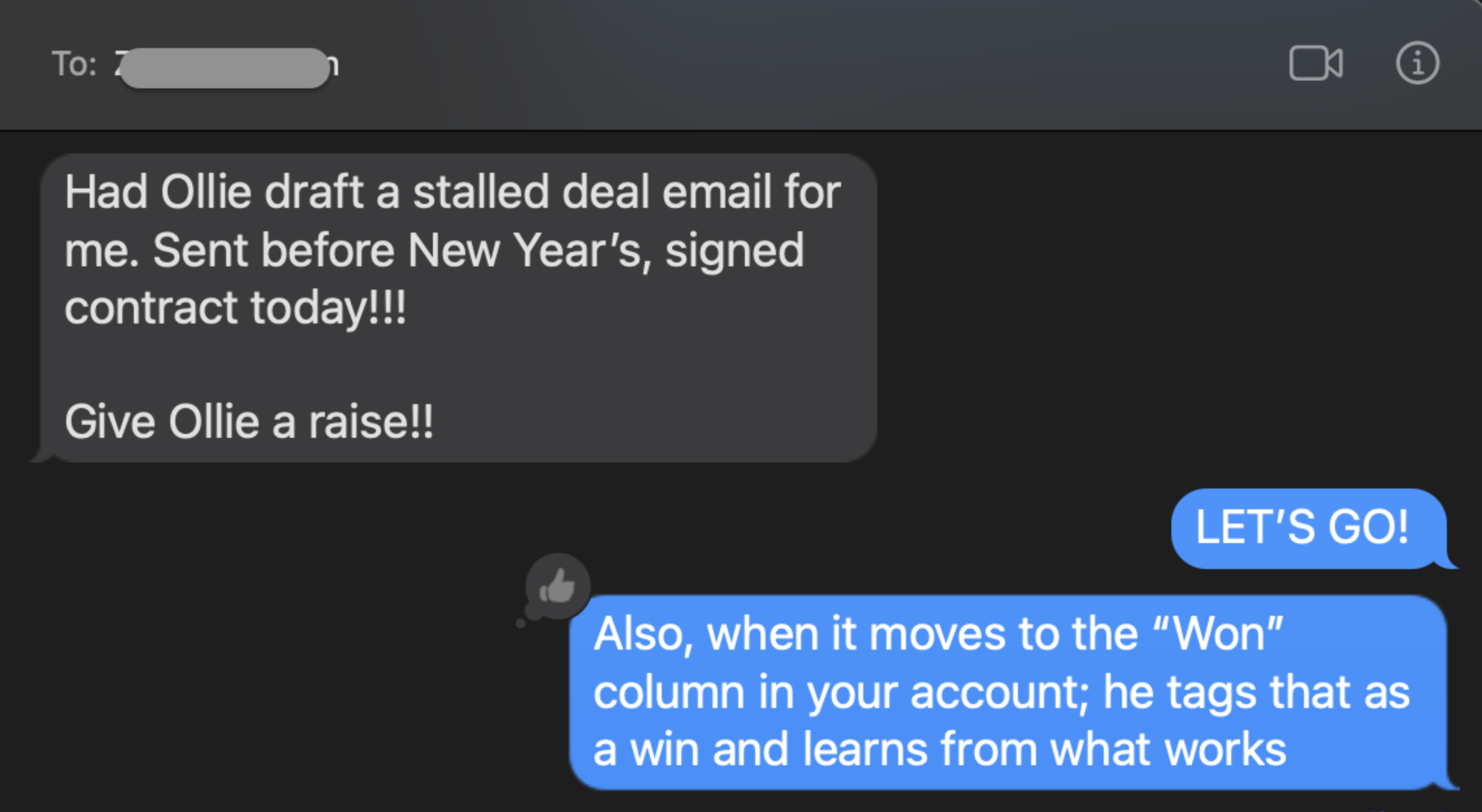
The self-training loop matters here. When a deal closes, Olli tags the plays that worked. When a deal stalls, it notes what didn't. The content it produces six months from now will be smarter than what it produces today — not because a prompt was rewritten, but because it learned from outcomes.
That's not how multi-agent systems work. Each agent needs independent retraining. New messaging framework? Update the content agent. New competitive intel? Update the research agent. New methodology? Update the sequencing agent. Three separate maintenance streams, three separate failure points.
Ask your AI vendor: When my deals close or stall, does the system learn from that? Or does improving the output require my team to rewrite prompts?
Ready to see Olli work a real deal?
The deals that move aren't the ones with the most outreach. They're the ones where your champion had exactly the right document at exactly the right moment — a reframe that got forwarded to an exec team and turned a Q2 next year into next week, a business case concise enough that it became the one thing every conversation came back to, an email drafted before New Year's that came back as a signed contract.
That's not automation. That's high-value judgment, built from every meeting, email, and document in your deal, not a persona template. Olli works the way a great rep thinks: with full context, visible reasoning, and a memory for what actually closed deals like yours.
FAQ's on:
The most effective way to unstick a stalled deal is to reframe the decision for your champion — giving them a document they can carry internally that makes the cost of waiting visible. Generic check-in emails don't move deals. A tightly reasoned argument, specific to the actual objection, written for the stakeholders your champion needs to convince, does. The key is that the document has to be specific enough to be credible. That requires an AI with full deal context, not a template.
Enterprise cycles compress when your champion can move information quickly through their organization without you in the room. That means giving them documents that are precise enough to be credible, concise enough to get read, and framed correctly for each stakeholder. Reps who close 6-figure deals 50 days faster than their average cycle aren't doing more outreach — they're producing better internal selling tools for their champions.
Generic AI content is an architecture problem, not a prompting problem. Systems that generate content from persona templates and industry verticals will always produce content that reads like a vendor wrote it. Systems trained on actual deal outcomes — what moved specific deals forward, what stalled them — produce content that draws on accumulated context and sounds like the rep wrote it. The difference becomes most visible when that content reaches a CFO or economic buyer who has seen dozens of AI-generated documents this quarter.
The orchestration tax is the reconciliation work created when multiple AI agents disagree. In a multi-agent system, a research agent, content agent, and sequencing agent each optimize for their narrow function. When they produce conflicting outputs — different stakeholder priorities, different messaging angles, different timing recommendations — someone has to resolve the conflict. That resolution layer is overhead that wasn't in the original automation pitch.
For enterprise accounts, the most important criteria are: (1) transparency — can you see why the system recommended a specific play; (2) full deal context — does the system synthesize everything across the deal, or work from snapshots; (3) self-training — does it learn from closed and stalled deals automatically, or require manual prompt maintenance; and (4) stakeholder-level specificity — can it produce variations of a business case for different internal stakeholders, not just different persona templates.
Why stop now?
You’re on a roll. Keep reading related write-up’s:

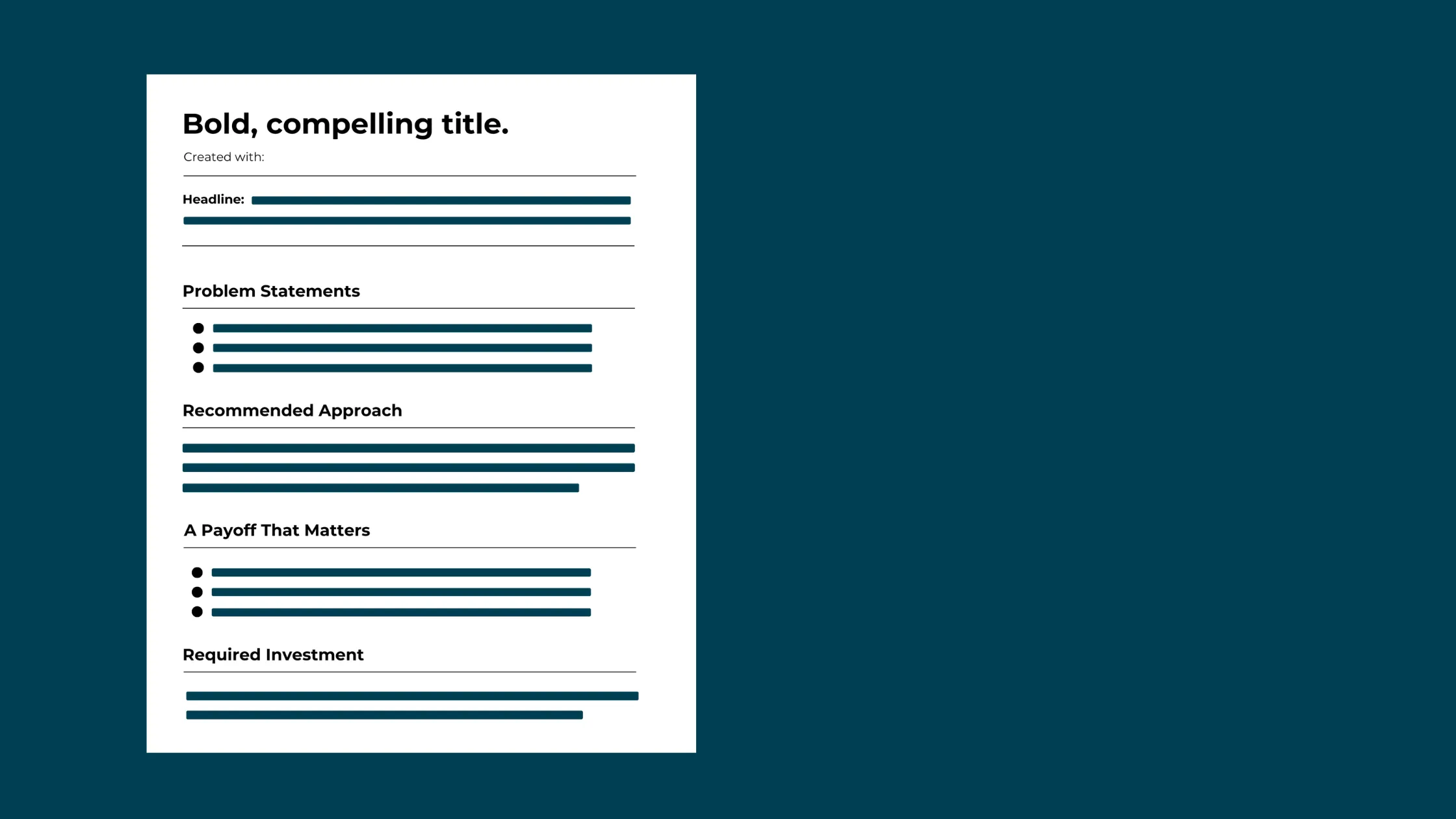



Draft with one click, go from DIY, to done-with-you AI
Get an executive-ready business case in seconds, built with your buyer's words and our AI.
Meet the sellers simplifying complex deals
Loved by top performers from 500+ companies with over $250M in closed-won revenue, across 19,900 deals managed with Fluint

Now getting more call transcripts into the tool so I can do more of that 1-click goodness.



The buying team literally skipped entire steps in the decision process after seeing our champion lay out the value for them.


Which is what Fluint lets me do: enable my champions, by making it easy for them to sell what matters to them and impacts their role.

