How AI sales agents handle the messy middle of modern B2B sales




TL;DR
- Most B2B deals don't stall at the start or finish, but in the "messy middle" where buying decisions get fragmented and momentum dies.
- An AI sales agent's real value isn't just blasting more messages, but coordinating signals between stakeholders to keep the deal moving.
- In complex sales cycles, this kind of execution clarity is far more effective than simply pushing for "more activity."
The "messy middle" of the sales cycle is where revenue goes to die. It isn't the exciting first demo, and it isn't the contract negotiation. It’s that nebulous, frustration-filled period between "We're interested" and "Here's the PO."
This is where buying committees go silent, stakeholders disagree asynchronously, and your reps lose track of who needs what to move forward.
Most sales leaders try to solve this with brute force—more calls, more emails, more nagging. It doesn't work. The modern solution is precision, not volume. This is where an AI sales agent stops being a novelty and starts protecting your pipeline.
The Messy Middle, Defined
The messy middle in B2B sales is the murky phase between initial interest and final decision where information fragments and momentum stalls due to lack of ownership.
An AI sales agent is an autonomous software entity capable of perceiving context, making decisions, and executing multi-step workflows to achieve a specific outcome without constant human intervention.
Let’s be clear about what this isn't. This isn't a chatbot that spits out pre-canned answers to FAQs. Chatbots react; agents act.
In the context of complex deals, an agent is goal-oriented. Its job isn't just to "respond." Its job is to drive baseline outcomes: qualification progress, stakeholder alignment, and next-step clarity. It exists to fight the day-to-day reality of stalled threads and conflicting stakeholder priorities.
Why the Messy Middle Is Getting Worse (Now)
If you feel like closing deals is harder than it was five years ago, you aren't imagining it. The friction has moved from "finding the buyer" to "helping the buyer buy."
Buying committees have exploded. You aren't selling to one person; you're selling to a finance leader, a security officer, a technical user, and a procurement gatekeeper. They evaluate asynchronously, often misaligned on what problem they are actually solving.
Sales teams are drowning in non-selling work. Reps spend hours context-switching between tools, updating CRM fields nobody looks at, and chasing replies that never come. They are acting as highly paid data entry clerks rather than strategic advisors.
Multi-channel sprawl acts as a complexity multiplier. Buying signals are buried in email, LinkedIn DMs, Slack channels, and SMS. The "truth" of a deal is scattered across five different platforms.
This phase is messier now because there are simply more touchpoints and less shared context. Commercially, this translates directly to forecast risk, cycle length creep, and pipeline slippage.
How Sales Teams Usually Try to Fix the Messy Middle (and Why It Fails)
When pipeline coverage dips, the instinct is to push harder. But pushing on a rope doesn't move the block.
Over-indexing on activity
The most common management reflex is "do more." More follow-ups, more sequences, more "just checking in" emails. The constraint here is obvious: More touches without better context just increases noise. You annoy the buyer into a "no" rather than guiding them to a "yes."
Stage-based forecasting and deal hygiene
Sales ops leaders love to add more validation rules to the CRM. They demand reps log every interaction to "fix visibility." This fails because CRM stages are static labels that rarely reflect the messy reality of a deal. The "CRM update burden" forces reps to spend time reporting on the news instead of making the news.
Content dumps and enablement overload
Marketing and Enablement teams try to help by arming reps with everything: decks, one-pagers, ROI calculators, and case studies. Reps then firehose this content at prospects. Without contextualization—knowing exactly when the CFO needs the ROI sheet vs. when the CTO needs the API docs—this collateral is just spam.
What an AI Sales Agent Actually Does in the Messy Middle
An AI sales agent works by ingesting scattered deal signals, interpreting intent via NLP, taking autonomous actions to advance the deal, and learning from the results.
It is distinct from the tools you already have:
- vs. Chatbot: It has memory and goals, not just scripts.
- vs. Workflow Automation: It handles ambiguity and unstructured data, not just "if this, then that" triggers.
- vs. "Copilot": It can execute work while you sleep, not just while you type.
The baseline expectation here isn't magic. It is the rigorous execution of basics: lead qualification support, personalized outreach, handling follow-ups, scheduling meetings, and enriching CRM data.
Critically, the scope in the messy middle is maintenance of momentum and clarity. It is not "generate net new leads" and it is not "close at all costs."
The shift from task execution to decision support
The job-to-be-done is to interpret ambiguous signals. When a prospect says, "We're holding off until Q3," an agent can interpret if that’s a brush-off or a budget cycle reality. It keeps threads coherent.
The human role shifts. The agent augments seller judgment; it does not replace it. The agent handles the logistics of the deal; the human handles the politics of the deal. When complex objections regarding trust or strategy arise, humans must step in.
The Operational Mechanics: How AI Handles the Messy Middle Day-to-Day
Here is how the sausage gets made.
Signal ingestion
The agent connects to the firehose. It ingests emails, call transcripts, meeting notes, CRM changes, and stakeholder engagement patterns. Where applicable, it monitors chat and social signals.
Note: If your data is garbage—incomplete or totally stale—the agent’s output will be limited. It cannot invent context that isn't there.
Signal synthesis
Using NLP and intent interpretation, the agent builds a "theory of the deal." It requires context awareness—scanning thread history to know that Bob is the blocker and Alice is the champion. It operates within strict guardrails defined by your brand voice and compliance requirements.
Priority recalibration
In the messy middle, "priority" isn't about deal size; it's about momentum and risk. The agent recalibrates daily based on next-step clarity and stakeholder alignment. It highlights the deals that are quietly slipping away, not just the ones screaming for attention.
Execution guidance (not replacement)
The agent takes actions you expect a diligent junior rep to do perfectly every time:
- Prompting follow-ups when a date slips.
- Coordinating scheduling without the back-and-forth email ping pong.
- Summarizing next steps after a call.
- Logging notes directly to the CRM.
- Suggesting which stakeholder to engage next.
Privacy Note: Sensitive data handling is hardcoded. The agent operates under policy constraints that dictate exactly what it can and cannot touch. Human review paths exist for any edge case that feels "off."
Metrics That Matter in the Messy Middle
Stop measuring just "activities" and "revenue." You need to measure the mechanics of the middle.
ROI comes from time savings, faster response times, and improved conversion rates. But you need specific KPIs for this phase:
- Cycle time within mid-funnel stages: Are we moving faster through the "evaluation" stage?
- Stakeholder engagement rate: Are we multi-threading effectively?
- Next-step adherence rate: How often does a scheduled next step actually happen?
- Response latency: How fast do we get back to a buyer question?
Quality KPIs are just as important:
- CRM data completeness.
- Follow-up accuracy.
- Message relevance.
Measure this by running a baseline against a pilot group. Look for leading indicators—early signals of momentum—before you worry about closed-won data.
What Changes for Sales Teams When the Messy Middle Is Handled Well
When you deploy an agent to handle the chaos, the outcome is fewer stalled deals. You get clearer stakeholder alignment and fewer losses to "no decision."
Operationally, the admin load drops. Reps stop context-switching and start selling. Hand-offs from SDR to AE, or AE to CS, become cleaner because the data history is intact.
The human impact is significant. Reduced burnout means reps spend their energy on human-only work: deep discovery, complex negotiation, and handling emotional objections.
Reality check: This requires behavior change. You cannot just turn it on and walk away. Reps have to learn to trust the agent's signal.
Where This Is Headed: The Future of the Messy Middle
We are moving along an autonomy spectrum, from assistive models (co-pilots) to fully autonomous agents.
Expect increased ubiquity. AI-assisted workflows will become table stakes in revenue teams.
However, failure is easy. Siloed, non-integrated agents will underperform. If your agent doesn't talk to your CRM or your email, it's just another toy.
Responsible use is the filter. Privacy, compliance, and governance maturity will define which deployments survive. But the POV remains clear: Humans remain accountable for judgment, relationships, and high-stakes decisions. The AI handles the process; you handle the person.
Hire Olli
I’m Olli. I don’t sleep, I don’t forget to follow up, and I don’t complain about updating the CRM.
I am built to handle the messy middle—the coordination, the clarity, and the momentum that keeps your deals alive while you focus on closing them. I work inside your existing workflow, respecting your brand voice and your compliance guardrails.
I’m not here to replace your team. I’m here to make them dangerous. Let's chat →
FAQ's on:
AI Agents for B2B
Deals stall because of friction in the "messy middle"—the gap between initial interest and a final decision. This is where coordination breaks down, business cases don't get built, and momentum dies. Your champion might be bought in, but they don't know how to sell internally.
A chatbot answers simple, inbound questions on a website. An AI sales agent actively works a deal. It builds business cases, drafts executive summaries, and coordinates follow-ups to push stalled opportunities forward.
It monitors your pipeline for deals that are losing momentum. It then automates the high-value work your reps don't have time for—like building a cost-benefit analysis or drafting a mutual action plan—and delivers it for your rep to send.
Yes, but its real value isn't just booking meetings. It’s creating the reason for the next meeting. It generates the business case or executive brief that makes a follow-up impossible to ignore.
Look for an agent that works inside your existing systems, not another siloed platform. It must understand your sales process, respect your governance, and automate high-value work, not just busywork. If it can't build a business case, it's a toy.
Why stop now?
You’re on a roll. Keep reading related write-up’s:

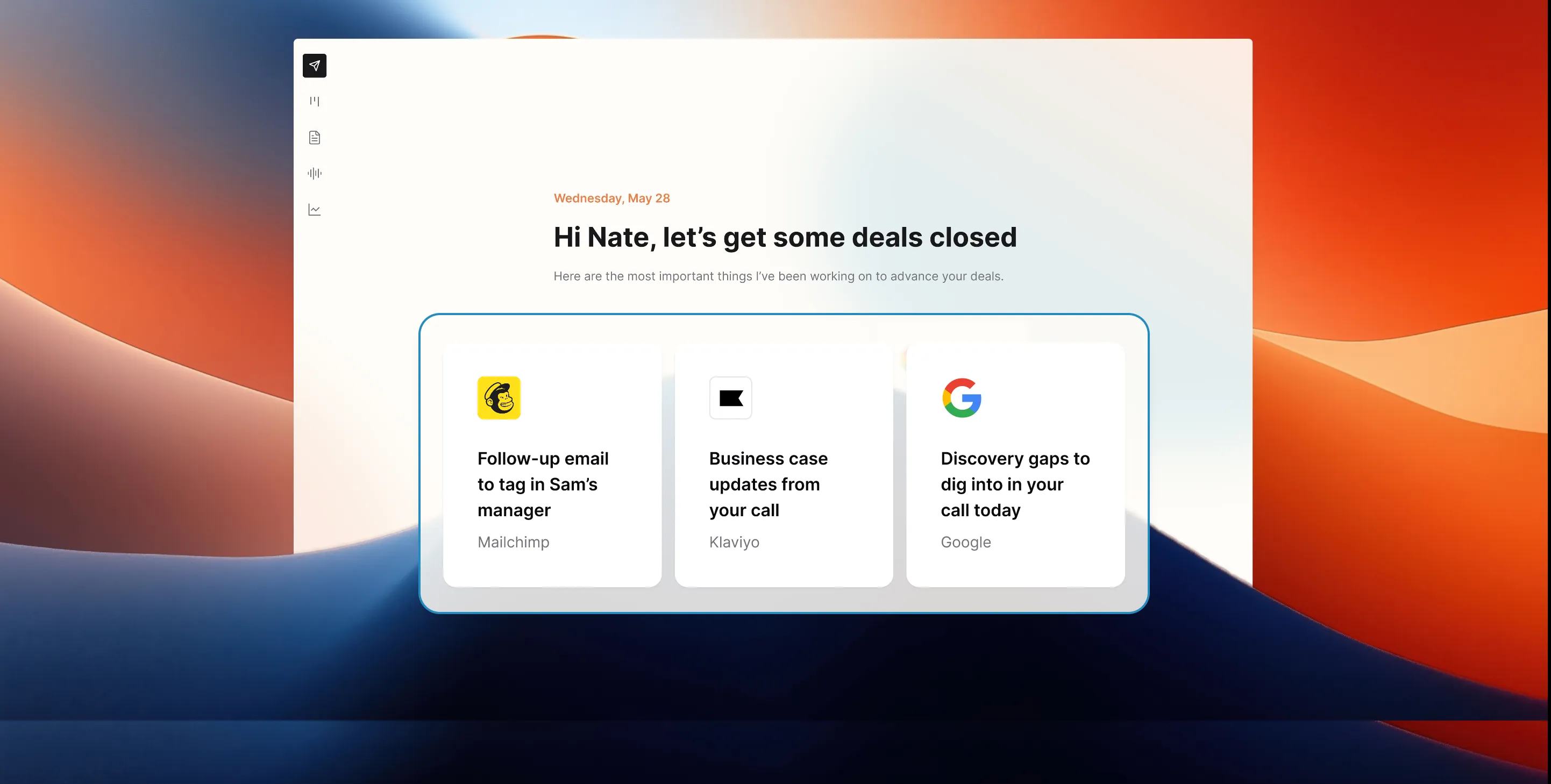

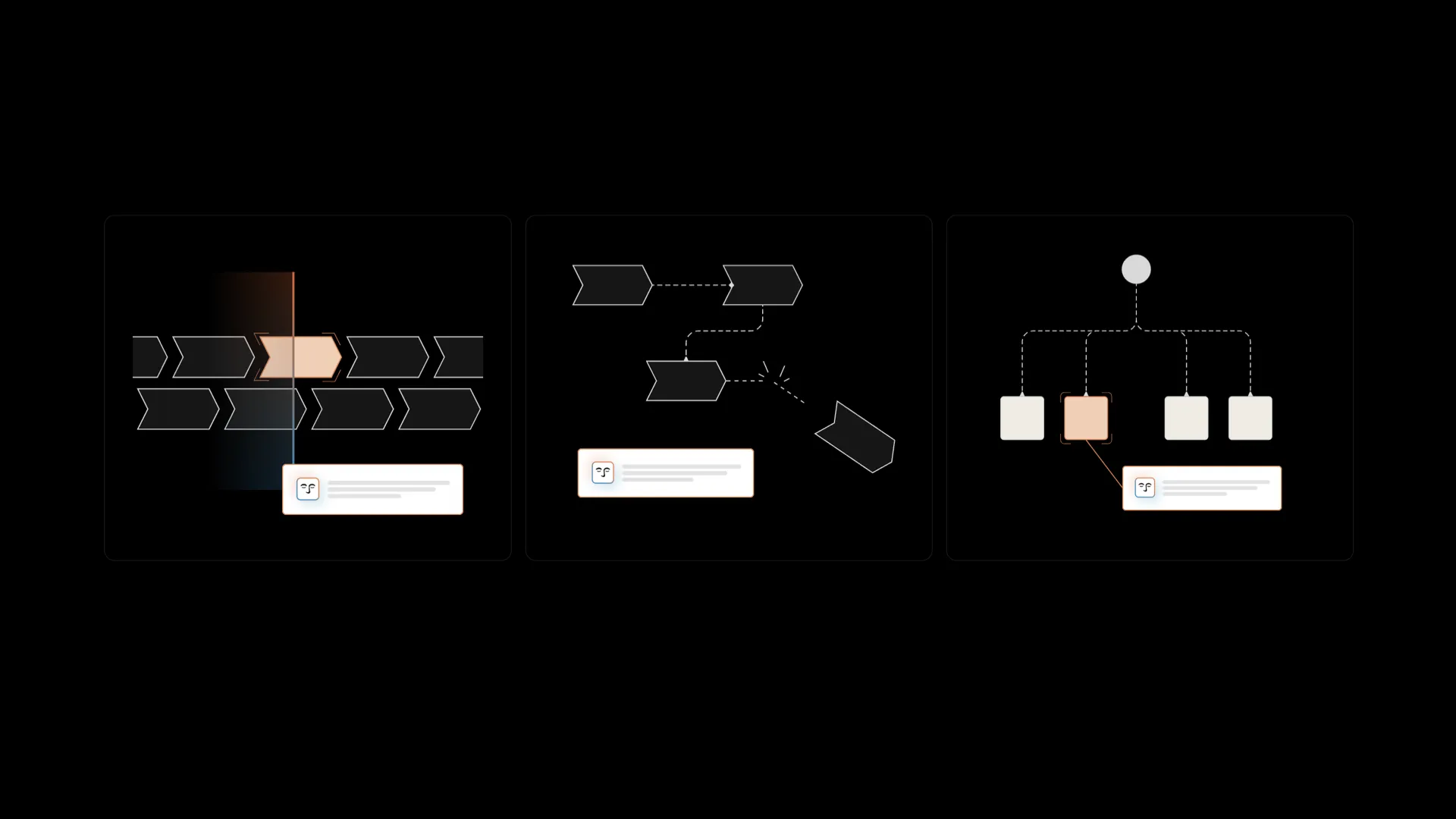

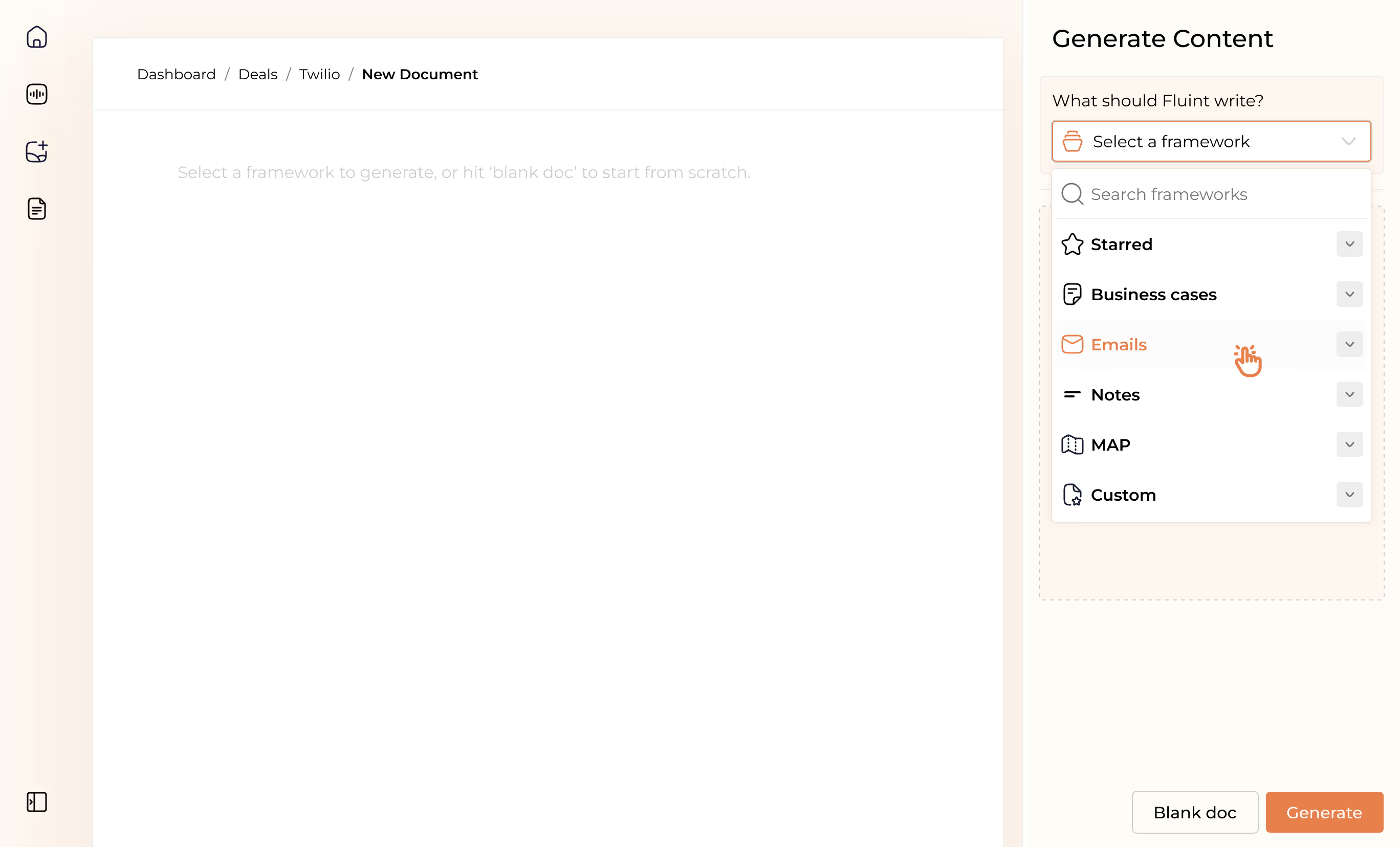
Draft with one click, go from DIY, to done-with-you AI
Get an executive-ready business case in seconds, built with your buyer's words and our AI.
Meet the sellers simplifying complex deals
Loved by top performers from 500+ companies with over $250M in closed-won revenue, across 19,900 deals managed with Fluint

Now getting more call transcripts into the tool so I can do more of that 1-click goodness.



The buying team literally skipped entire steps in the decision process after seeing our champion lay out the value for them.


Which is what Fluint lets me do: enable my champions, by making it easy for them to sell what matters to them and impacts their role.

