AI in sales enablement: A complete guide for modern revenue teams




TL;DR
- AI moves sales enablement from a content library to an active part of deal execution.
- The impact is measured in deal velocity, consistency, and win rates—not content views.
- AI operates as a continuous, in-workflow guide, not a static system you log into.
Sales enablement has a structural problem: it’s built around preparation, not execution. It gives reps access to information but doesn’t help them use it when it matters. That model is obsolete.
The shift is from enablement as a library to enablement as an active operator inside your revenue workflows. AI is what makes this happen. It’s not another tool to log into. It’s the engine that closes the gap between knowing what to do and actually doing it.
What AI in sales enablement actually means
AI in sales enablement is the application of intelligent automation and real-time guidance directly within a sales team's daily workflows to improve execution and outcomes.
Forget static portals and content libraries. Think of AI as an in-workflow system, a digital coach that guides reps through live deals. It’s not about finding a case study; it's about getting the right talking point for the specific objection you're facing on a call right now.
The scope is specific:
- Automation of routine tasks: Eliminating the manual work that clogs up a rep’s day—CRM updates, pre-call research, follow-up scheduling.
- Personalization of guidance and content: Moving beyond generic templates to deliver content and messaging tailored to the buyer's industry, role, and stage in the deal.
- Real-time insights and next-best actions: Analyzing deal data to surface risks and recommend the specific action most likely to advance the sale.
This isn’t about making information available. It's about making execution better.
Why sales enablement needed AI in the first place
The old model of enablement was already failing before AI became a viable solution. The symptoms are familiar to any sales leader. Reps spend hours searching for content. CRM data is incomplete or inaccurate. Coaching is reactive, inconsistent, and tied to a manager’s limited availability. Onboarding is a one-time event, not a continuous process.
These structural pains became acute because the business environment got harder.
- Deal cycles are longer.
- Buying committees are larger and more complex.
- Execution complexity has exploded.
Reps need more than a playbook PDF. They need active support inside the chaos of a live deal. Waiting for a manager to review a call or hoping a rep finds the right asset is a strategy for losing. AI addresses the core failure: enablement was a passive resource when teams needed an active partner.
The traditional sales enablement model is structurally flawed
Let’s name the legacy components and why they fail. The old system was built on a foundation of good intentions and flawed assumptions.
It consisted of:
- Content libraries and asset repositories: These become digital graveyards. Most content is never used or becomes outdated, yet reps are expected to find the single correct asset among thousands.
- Static playbooks: A playbook is obsolete the moment it's published. It can’t adapt to market shifts, new competitor messaging, or the specific context of a live deal.
- Periodic training and coaching: One-off training sessions have near-zero retention. Coaching happens inconsistently, based on a manager’s gut feeling rather than objective data.
The results are predictable. Unused content. Inconsistent execution. A massive "truth gap" between what’s happening in deals and what’s recorded in the CRM. This isn't a failure of people; it's a failure of system design.
The real shift: from enablement as preparation to enablement as execution
The fundamental change is this: enablement must operate during live deals, not just before them. It has to move from a preparatory function to an execution-focused one.
This is where AI changes the game. It’s not about giving a rep a library of battle cards. It’s about surfacing the single, most effective talking point for the competitor mentioned on a live call, at that exact moment.
AI delivers:
- Context-aware recommendations: The system knows the industry, the persona, the products discussed, and the deal stage. Guidance is specific, not generic.
- Real-time guidance: Support isn't a day later during a pipeline review. It's an automated suggestion in a rep’s ear during a demo or a prompt to send a specific follow-up email after a call ends.
The critical distinction is between knowledge availability and execution timing. Traditional enablement makes knowledge available. AI-driven enablement ensures the right knowledge is executed at the right time. One is passive, the other is active.
Core AI workflows inside modern sales enablement
This isn’t about a single feature. It’s about orchestrating workflows that help reps sell better.
These are the core functions:
- Content discovery and version control: Surfacing the correct, approved asset based on deal context, eliminating search time and the risk of using outdated materials.
- Training and continuous reinforcement: Shifting from one-time onboarding to "everboarding," where training is delivered in small, contextual doses throughout a rep's tenure.
- Conversation intelligence and automated coaching: Analyzing call data to identify coachable moments, track keyword mentions, and provide objective feedback at scale.
- Predictive analytics and next-best-action: Using historical data to forecast deal outcomes and recommend the next best action to increase the probability of winning.
- Automated content creation and personalization: Generating first drafts of emails, proposals, and business cases tailored to the specific buyer.
- Buyer-facing experiences: Powering digital sales rooms with personalized content and mutual action plans that guide the buyer through their process.
- Automation of repetitive tasks: Handling CRM updates, meeting notes, and pre-call research so reps can focus on selling.
These workflows don't operate in isolation. They connect to create a single, intelligent layer that supports the entire revenue process.
What AI-enabled enablement actually changes for reps and managers
The impact is practical and immediate. This isn't a theoretical improvement; it's a change in the daily work.
For reps:
- Reduced manual work: Less time on data entry and content searches, more time engaging with prospects.
- Faster ramp and continuous skill development: New hires become productive faster, and veteran reps continuously refine their skills with data-driven feedback.
- Guidance surfaced in real time: Confidence increases because support is always available, precisely when it's needed most.
For managers:
- Objective coaching signals: Move from subjective call reviews to data-backed insights on what’s working and what isn’t across the team.
- Consistent deal inspection: AI can flag risks and inconsistencies in every single deal, not just the ones a manager has time to review.
- Less subjective review cycles: Performance conversations are grounded in objective metrics and real-world execution data.
How to measure AI impact in sales enablement
Measuring AI's impact means abandoning vanity metrics. Content views and asset downloads are irrelevant. They measure activity, not outcomes.
Focus on the metrics that matter to the business:
- Win-rate changes: Are we closing more of the deals we engage?
- Deal size impact: Is the average contract value increasing?
- Sales cycle length: Are deals closing faster?
- Time saved per rep per day: How much administrative work has been eliminated, freeing up time for selling?
The ROI conversation should be structured around these KPIs. AI in enablement isn't a software expense; it's a direct investment in revenue efficiency and growth. If it isn't moving these numbers, it isn't working.
Common misconceptions about AI in sales enablement
There is a lot of noise. Let’s correct the most common errors in thinking.
- "AI replaces sales reps." False. AI augments rep execution. It automates the tasks reps hate and provides the guidance they need to be more effective. It scales their ability, it doesn't replace them.
- "AI is just for content recommendations." This is a limited, legacy view. Content is one piece. The real value is in workflow automation, real-time coaching, and predictive guidance.
- "AI only improves training and onboarding." While it dramatically improves ramp time, its primary function is to enhance execution in live deals for the entire team, from new hires to top performers.
AI is about improving the quality and consistency of human execution, not reducing headcount.
Where this is heading: the future of sales enablement
The trend is clear. Enablement systems are being redesigned around AI-native workflows. The idea of periodic, manual enablement interventions will soon seem as outdated as a rolodex.
Enablement will become a continuous, real-time function embedded in the tools reps use every day. This shift requires more than just buying new software; it requires redesigning the workflows themselves. Adoption will accelerate as the performance gap widens between teams using AI and those who are not.
As this unfolds, new considerations become critical:
- Human oversight: AI provides recommendations, but experienced reps and managers must retain final judgment.
- Data quality and governance: The output of an AI system is only as good as the data it’s trained on. Clean data is no longer optional.
- Responsible and compliant AI usage: Ensuring AI is used ethically and in compliance with privacy regulations is non-negotiable.
The future of enablement isn't another dashboard. It's an intelligent, automated partner that helps your team win.
Hire Olli
Hi, I’m Olli, Fluint’s AI sales assistant. My function is to execute. While your team is busy with discovery calls and demos, I am busy building the business case, drafting the executive summary, and ensuring the deal maintains momentum.
I don’t need training or motivation. I operate inside your live deals, reinforcing your methodology, following up on commitments, and doing the high-value work that too often falls through the cracks.
Sound like you can use someone like me on your team? Let’s chat.
FAQ's on:
AI in sales enablement
that automates tasks, provides real-time guidance during calls and emails, and delivers personalized insights directly within a rep's workflow. It’s about execution, not just access.
AI directly addresses workflow inefficiencies and coaching gaps. It automates manual CRM updates, eliminates time spent searching for content, and provides objective, data-driven coaching signals. This frees up reps to sell and helps managers coach more effectively and consistently.
It means getting specific, contextual help during a live interaction. For example, when a prospect mentions a competitor on a call, the AI can instantly surface the right talking points on the rep’s screen. After the call, it can suggest the most effective follow-up email based on the conversation.
ROI is measured by core business metrics, not vanity metrics like content views. Teams should track changes in win rates, average deal size, and sales cycle length. You also measure productivity gains, like hours saved per rep per week from automating administrative tasks.
No. AI is an augmentation tool, not a replacement. It handles repetitive, low-value tasks, allowing reps to focus on strategic selling and relationship building. It provides managers with objective data, enabling them to be better, more consistent coaches.
Effective AI integrates seamlessly. It should operate within the CRM and other tools your team already uses, like email and calendars. The goal is to enhance existing workflows, not force reps to adopt another separate platform. It reads data from your systems and pushes updates and insights back into them.
Why stop now?
You’re on a roll. Keep reading related write-up’s:


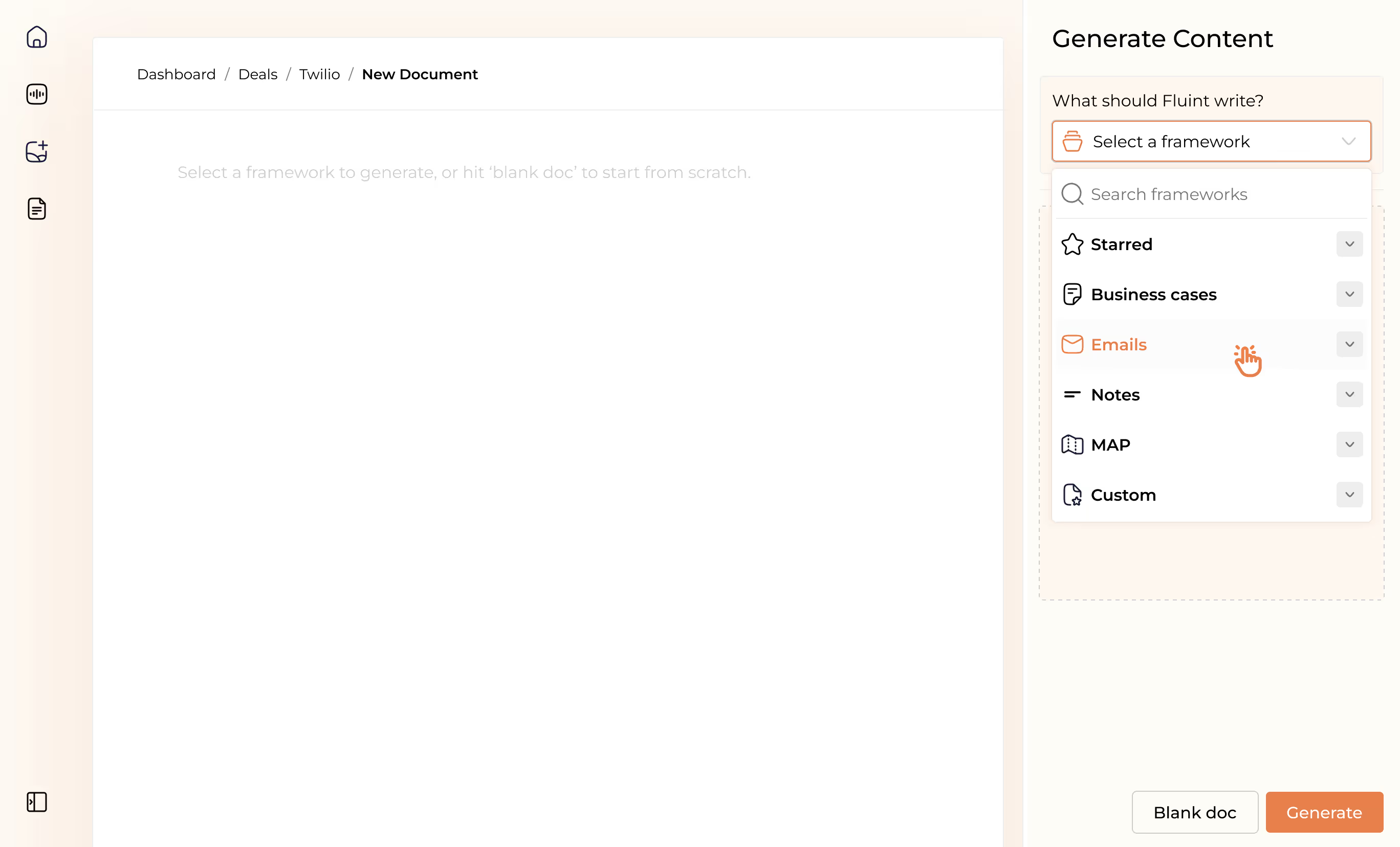
Draft with one click, go from DIY, to done-with-you AI
Get an executive-ready business case in seconds, built with your buyer's words and our AI.
Meet the sellers simplifying complex deals
Loved by top performers from 500+ companies with over $250M in closed-won revenue, across 19,900 deals managed with Fluint

Now getting more call transcripts into the tool so I can do more of that 1-click goodness.



The buying team literally skipped entire steps in the decision process after seeing our champion lay out the value for them.


Which is what Fluint lets me do: enable my champions, by making it easy for them to sell what matters to them and impacts their role.

