Build vs. buy

Connecting Claude to your CRM takes an afternoon. The context layer takes 35 to 40 engineer-weeks.
We know because we built one, and we published the spec. If you're weighing a build, here's where the time goes, what your CRM quietly drops, and when building it yourself is the right call.
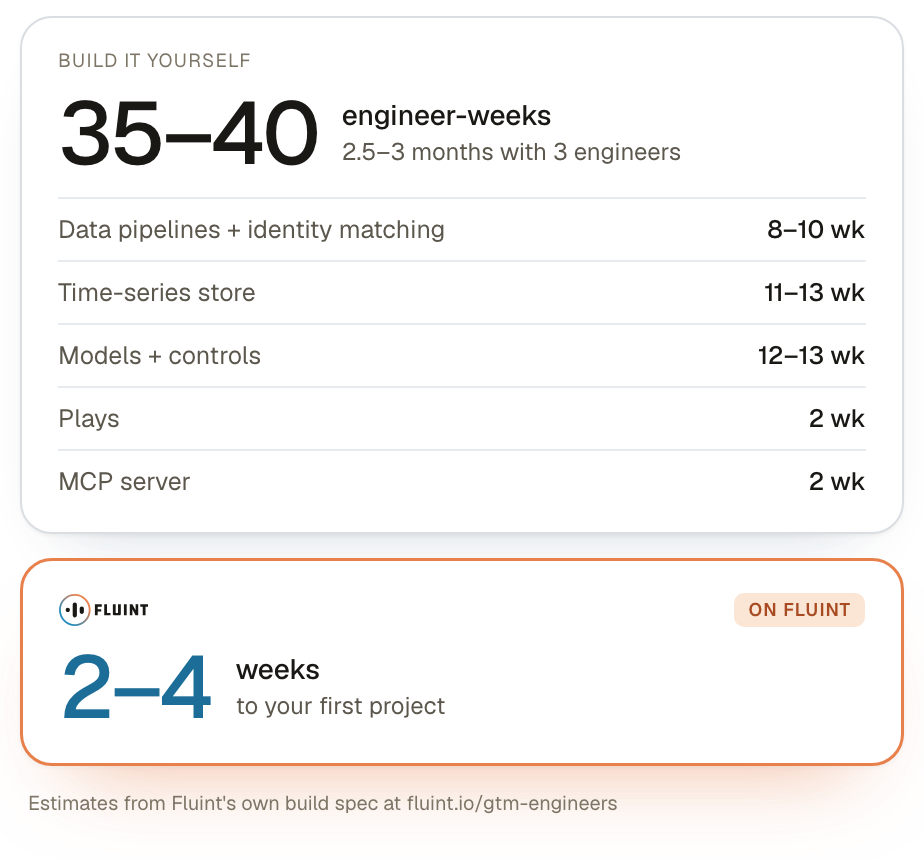
Building a GTM context layer yourself takes 35 to 40 engineer-weeks (2.5 to 3 months with 3 engineers), broken down by component; a first project on Fluint takes 2 to 4 weeks.

“Fluint gave us months of AI engineering work with a single integration. Now everything we build is grounded in how we win, with the right context for every agent and seller.”

Quincy Landingham
Quincy Landingham
GTM AI Lead

What does it take to build a GTM context layer?

Connecting your CRM and serving it over MCP is the easy part. Most of the 35 to 40 engineer-weeks go to the three things below: keeping the history your CRM drops, scoring deals on what was true at the time, and separating what drives wins from what just shows up in won deals.

How much deal history do Salesforce and HubSpot keep?
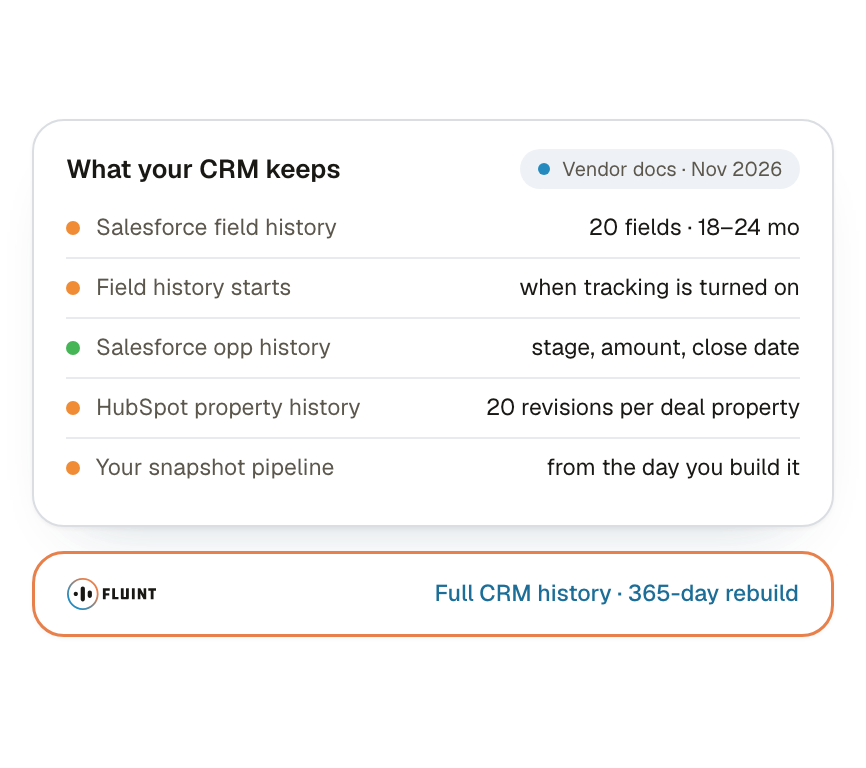
Salesforce tracks history on up to 20 fields per object, keeps it 18 to 24 months, and only from the day you turn tracking on. HubSpot keeps up to 20 revisions per deal property. (Salesforce does keep stage, amount, and close date changes on its own, which helps.) A snapshot pipeline starts the day you build it. Fluint imports your full CRM history, rebuilds the last 365 days as a time series, and keeps every change from then on.
What CRMs keep: Salesforce field history on 20 fields for 18 to 24 months from when tracking starts; HubSpot 20 revisions per deal property; Fluint imports full history with a 365-day rebuild.
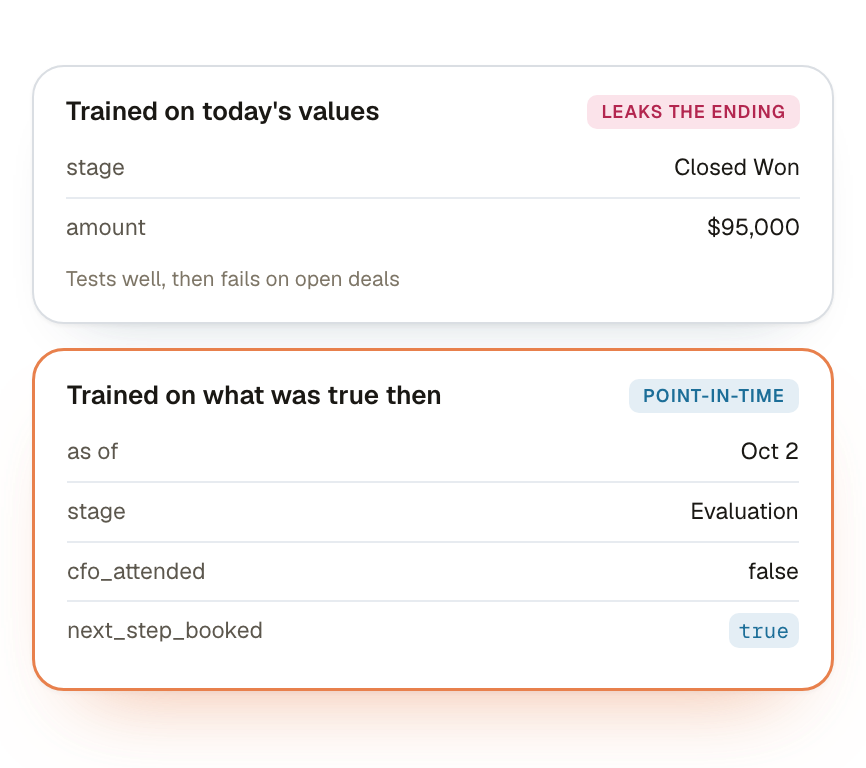
Training on today's CRM values leaks the outcome; training on point-in-time snapshots uses what was true on each date.

Why do homegrown deal-scoring models fail on open deals?

Usually because they train on today's CRM values. Stage and amount get overwritten as deals move, so the model learns from the ending: it tests well and fails on open deals. We made exactly that mistake the first time we built this. The fix was to snapshot every change and score each deal on what was true at the time, which means rebuilding the past every time a stage or field definition changes. That's 11 to 13 engineer-weeks on its own, and we rebuilt it twice.

How do you know which sales behaviors actually drive wins?
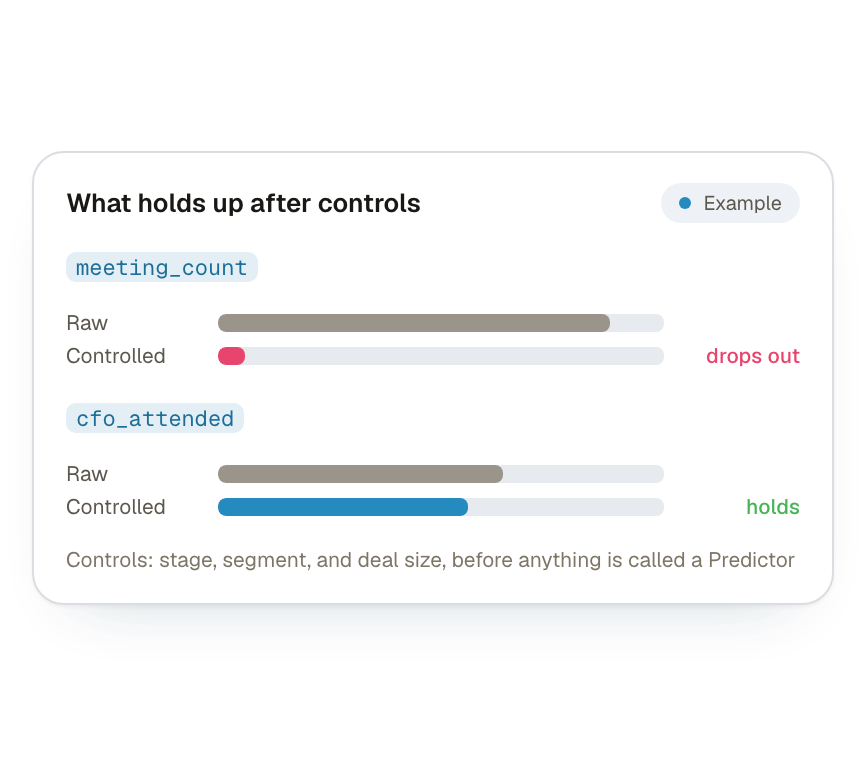
You control for stage, segment, and deal size before calling anything a predictor, because plenty of what shows up in won deals didn't cause the win. Won deals have more meetings, for example, mostly because they were already going well. We treated meeting count as a predictor once, and it sent reps chasing the wrong thing. So Fluint runs those controls first, then measures each play's share of impact at every stage and serves the next one over MCP.
Meeting count looks predictive until controlled for stage, segment, and deal size; CFO attendance holds up.

How much does it cost to build a GTM context layer?

About $150K–$170K to build and roughly $250K a year to run, based on our own build.

  • Time to a first working model: 2.5–3 months with 3 engineers (35–40 engineer-weeks). On Fluint, 2–4 weeks to your first project.

  • Build cost: $150K–$170K. On Fluint, free up to 50 reps, or Growth at $1,200/mo for 10 sellers.

  • Upkeep: about 1.15 engineers, roughly $250K a year, for retraining, drift checks, schema changes, and new sources. On Fluint, it's included.

Assumes $220K a year per engineer, fully loaded. US median GTM engineer base pay runs $150K–$159K before benefits.

See the full build spec →

When should you build your own GTM context layer?

Building is a good call when:

  1. Your question is reporting ("what happened last quarter?"). A warehouse and a semantic layer handle that well.

  2. You need one narrow agent (lead triage, account research, call summaries), not a layer that learns. Teams are shipping these in a couple of weeks.

  3. You already have the people: a data engineer and a data scientist with a couple of quarters, plus 1–2 engineers to keep it running.

  4. You've snapshotted deal history for years in your warehouse, so half of step one is done.

  5. Your data can't leave your cloud.

And most teams land in the middle: they build the agents their reps and leaders see, and buy the layer underneath. That's what building on Fluint context is for.

Comparison Table

Build it yourself vs. Fluint

Features
Build it yourself
Connect and serve
Connect CRM, calls, and email
X Icon
Off-the-shelf connectors and official MCP servers
Checkmark
Serve context to Claude or ChatGPT over MCP
X Icon
Minutes with native connectors; ~2 engineer-weeks for precomputed context
Checkmark
One connection, precomputed with citations
Match the same account and person across tools
X Icon
Build it (3–4 engineer-weeks)
Checkmark
History
Every change kept
X Icon
What your CRM keeps (20 tracked fields in Salesforce, 20 revisions per HubSpot deal property), plus snapshots from the day you build them
Checkmark
Full CRM history imported, 365-day rebuild, every change after
Any deal as it stood on any date
X Icon
Stage, amount, and close date in Salesforce; everything else needs snapshots (4 engineer-weeks)
Checkmark
Learning from outcomes
Predictors scored on every deal at every date
X Icon
Build it (5–6 engineer-weeks, plus 3 for retraining and drift)
Checkmark
Separate what drives wins from what shows up in won deals
X Icon
Build it (4 engineer-weeks, "very hard")
Checkmark
Each play's share of impact, every stage
X Icon
Build it (2 engineer-weeks to turn findings into plays)
Checkmark
Time and cost
Time to first working model
X Icon
2.5–3 months with 3 engineers
2–4 weeks
Build cost
X Icon
$150K–$170K
Free up to 50 reps · Growth $1,200/mo for 10 sellers
Upkeep
X Icon
1–2 engineers ongoing
Included

Engineer-week estimates come from Fluint's own build, published in the build spec. CRM limits come from Salesforce and HubSpot documentation as of November 2026.

FAQ

Common questions about building a GTM context layer

Can't we just connect Claude to Salesforce?

Yes, and for live lookups you should. Salesforce's hosted MCP server sets up in under 30 minutes. What it can't give you is history your CRM never kept, or a measured answer to which plays win at each stage.

We already have Snowflake and dbt. Why buy?

You might have half of step one. If you've been snapshotting opps, contact roles, and activity for years, you're ahead of most teams. What's left is the stage models, the controls for deal mix, retraining, and turning findings into plays, which is about 14 to 15 engineer-weeks in our spec, plus upkeep.

How long would it take us to build?

In our experience, 35 to 40 engineer-weeks to a first working model, so roughly 2.5 to 3 months with 3 engineers who've done this before. Then 1 to 2 engineers to keep it accurate as your process changes.

Can we build part and buy part?

Yes, and it's what most teams we talk to do. Build the agents, scoring, and routing your team actually uses, and call Fluint context over MCP for the predictors, plays, and history underneath.

How much data does Fluint need to start?

There's no minimum time on Fluint. It imports your full CRM history and rebuilds the last 365 days when you connect.

A close-up headshot of the Nate Nasralla, with dark curly hair, a full beard, and patterned glasses.

Let’s see if there’s a good fit

We’ll look at how other GTM teams are already:

Engaging exec-level buyers
Engaging exec-level buyers with a strong point of view.
Driving 10.4X sales velocity
Driving 10.4X sales velocity with more calm, less chaos.
Confidently forecasting
Confidently forecasting, with deal reviews based on written evidence.
Enabling champions
Enabling champions to multithreaded and sell internally.
Are you a Sales Rep or AE?
Watch a video demo and jump right in to an account: